Debussy: Orchestral Works, Vol. 4 / Markl, Orchestra National De Lyon
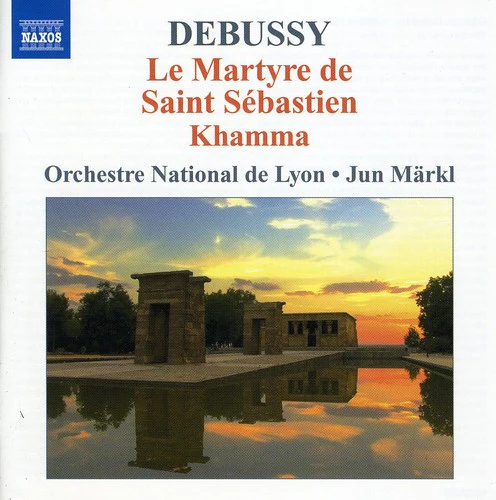
The fourth volume in Naxos’s highly praised series of Debussy’s Orchestral Works presents music drawn from three of his theatrical ventures and from one of his Prix de Rome entries. The prelude, fanfares and four symphonic fragments from Le Martyre de Saint Sébastien were taken for concert performance from Debussy’s incidental music for Gabriele D’Annunzio’s scandalous mystery play. While rarely heard today, the ‘danced legend’ Khamma, set in ancient Egypt, and incidental music for Shakespeare’s King Lear, provide suitably atmospheric music, as do the Cortège et air de danse from The Prodigal Son, the cantata which gained Debussy the Prix de Rome in 1884.
The fourth volume in Naxos’s highly praised series of Debussy’s Orchestral Works presents music drawn from three of his theatrical ventures and from one of his Prix de Rome entries. The prelude, fanfares and four symphonic fragments from Le Martyre de Saint Sébastien were taken for concert performance from Debussy’s incidental music for Gabriele D’Annunzio’s scandalous mystery play. While rarely heard today, the ‘danced legend’ Khamma, set in ancient Egypt, and incidental music for Shakespeare’s King Lear, provide suitably atmospheric music, as do the Cortège et air de danse from The Prodigal Son, the cantata which gained Debussy the Prix de Rome in 1884.
Description
The fourth volume in Naxos’s highly praised series of Debussy’s Orchestral Works presents music drawn from three of his theatrical ventures and from one of his Prix de Rome entries. The prelude, fanfares and four symphonic fragments from Le Martyre de Saint Sébastien were taken for concert performance from Debussy’s incidental music for Gabriele D’Annunzio’s scandalous mystery play. While rarely heard today, the ‘danced legend’ Khamma, set in ancient Egypt, and incidental music for Shakespeare’s King Lear, provide suitably atmospheric music, as do the Cortège et air de danse from The Prodigal Son, the cantata which gained Debussy the Prix de Rome in 1884.