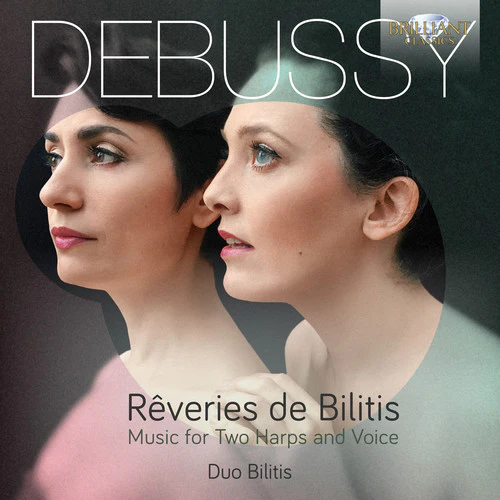
Debussy: Reveries de Bilitis - Music for Two Harps & Voice / Duo Bilitis
Harpists Eva Tebbe and Ekaterina Levental remark that Debussy makes the invisible visible and turns the unspeakable into a musical world full of mysticism, layers of ambiguity and evocative meanings. A century after his death, he is being celebrated across the world in 2018, and this album promises to make a special contribution on record with arrangements of works, most of them relatively unfamiliar, which particularly lend themselves to the ethereal and exquisite combination of voice and harps. Much of the music here was written while Debussy was composing his only opera Pelléas et Mélisande, a Symbolist drama based on the play by Maurice Maeterlinck, who recognized that in many ways Debussy had not only set his play to music but even outstripped and further enriched his original. There is the early and peaceful Ballade from 1890, then the Proses lyriques from 1892-3 and the seductive Trois Chansons de Bilitis (1897), from which this musical partnership takes its name. Bilitis is the fictional poet of Classical antiquity invented by Pierre Louÿs, writing in an erotic, symbolist vein after the fashion of Sappho: and when in 1900 Debussy came to use the texts of Louÿs again for the Musique de Scène pour les chansons de Bilitis, the music accompanied a tableau vivant in pre-Raphaelite style of winsome and scantily clothed young women. The recital is completed by the Danse sacrée et danse profane – originally composed for harp and orchestra in 1904, here with the orchestral parts arranged for a second harp – and the six Epigraphes Antiques from 1914, which return to the musical material of the Bilitis works but in the composer’s more allusive late style which would lead to his final masterpiece written for Serge Diaghilev, Jeux.
Harpists Eva Tebbe and Ekaterina Levental remark that Debussy makes the invisible visible and turns the unspeakable into a musical world full of mysticism, layers of ambiguity and evocative meanings. A century after his death, he is being celebrated across the world in 2018, and this album promises to make a special contribution on record with arrangements of works, most of them relatively unfamiliar, which particularly lend themselves to the ethereal and exquisite combination of voice and harps. Much of the music here was written while Debussy was composing his only opera Pelléas et Mélisande, a Symbolist drama based on the play by Maurice Maeterlinck, who recognized that in many ways Debussy had not only set his play to music but even outstripped and further enriched his original. There is the early and peaceful Ballade from 1890, then the Proses lyriques from 1892-3 and the seductive Trois Chansons de Bilitis (1897), from which this musical partnership takes its name. Bilitis is the fictional poet of Classical antiquity invented by Pierre Louÿs, writing in an erotic, symbolist vein after the fashion of Sappho: and when in 1900 Debussy came to use the texts of Louÿs again for the Musique de Scène pour les chansons de Bilitis, the music accompanied a tableau vivant in pre-Raphaelite style of winsome and scantily clothed young women. The recital is completed by the Danse sacrée et danse profane – originally composed for harp and orchestra in 1904, here with the orchestral parts arranged for a second harp – and the six Epigraphes Antiques from 1914, which return to the musical material of the Bilitis works but in the composer’s more allusive late style which would lead to his final masterpiece written for Serge Diaghilev, Jeux.
Original: $7.00
-65%$7.00
$2.45Description
Harpists Eva Tebbe and Ekaterina Levental remark that Debussy makes the invisible visible and turns the unspeakable into a musical world full of mysticism, layers of ambiguity and evocative meanings. A century after his death, he is being celebrated across the world in 2018, and this album promises to make a special contribution on record with arrangements of works, most of them relatively unfamiliar, which particularly lend themselves to the ethereal and exquisite combination of voice and harps. Much of the music here was written while Debussy was composing his only opera Pelléas et Mélisande, a Symbolist drama based on the play by Maurice Maeterlinck, who recognized that in many ways Debussy had not only set his play to music but even outstripped and further enriched his original. There is the early and peaceful Ballade from 1890, then the Proses lyriques from 1892-3 and the seductive Trois Chansons de Bilitis (1897), from which this musical partnership takes its name. Bilitis is the fictional poet of Classical antiquity invented by Pierre Louÿs, writing in an erotic, symbolist vein after the fashion of Sappho: and when in 1900 Debussy came to use the texts of Louÿs again for the Musique de Scène pour les chansons de Bilitis, the music accompanied a tableau vivant in pre-Raphaelite style of winsome and scantily clothed young women. The recital is completed by the Danse sacrée et danse profane – originally composed for harp and orchestra in 1904, here with the orchestral parts arranged for a second harp – and the six Epigraphes Antiques from 1914, which return to the musical material of the Bilitis works but in the composer’s more allusive late style which would lead to his final masterpiece written for Serge Diaghilev, Jeux.