🎉 Up to 70% Off Selected ItemsShop Sale

1 / 2
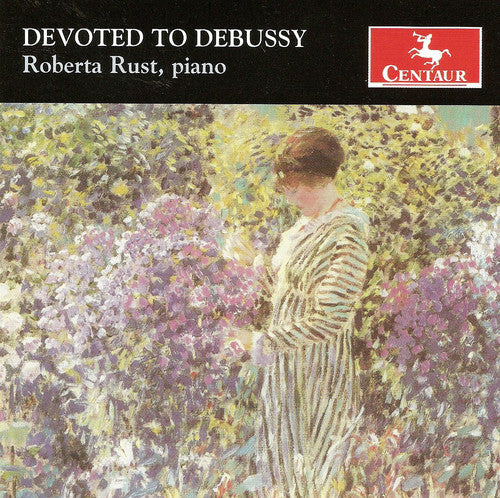
Devoted To Debussy - Estampes, Preludes, Etc / Roberta Rust
DEBUSSY Estampes. Pour le piano. Suite bergamasques: Clair de lune. Préludes: Feux d’artifice. Des pas sur la neige; La puerta del vino; Ce qu’a vu le vent d’ouest. Etudes: pour les sonorities opposes. Berceuse héroique. Morceau de concours. Ballade. Pièce sans titre. Elégie • Roberta Rust (pn) • CENTAUR 2867 (71:18)
This is my first encounter with the playing of Roberta Rust, a pianist who has studied with John Perry and Ivan Davis, among others. She now has an active international career and her previous recordings include piano works by Haydn, Villa-Lobos, and Prokofiev. On this disc she proves herself a first-rate Debussy player, someone who listens acutely to each sound she makes, who characterizes the music in a personal way while at the same time honoring Debussy’s very detailed notation, and who has an arsenal of touches—and a beautifully recorded piano—at her disposal. The disc provides a fine cross section of Debussy piano output, from the early, ubiquitous “Clair de lune” (1890) to his great triptych Estampes (1903) and his final piano pieces, including the sad little Elegie (1915). For me, Estampes is the highlight, with the numerous fade-ins and fade-outs of ideas under superb control in all three movements: “Pagodes” and “Soirée dans Grenade” come across as wonderfully evocative improvisations—and not even a Richter has always been so successful at this; and “Jardins sous la pluie” is truly a tempest in a théière. In Pour le piano, the Prelude and Toccata are never dry—and the latter concludes with tremendous reserves of speed and color. Imagination and virtuosity are equally in the service of “Feux d’artifice” and “Ce qu’a vu le vent d’ouest” (technically the two hardest of Debussy’s 24 Préludes ), and the hypnotic mood of “Des pas sur la neige” (the slowest and easiest of them) is captured perfectly. This is quite simply one of the finest Debussy discs I have heard in recent memory, and I hope that it won’t be long before Rust gives a complete set of the Préludes or the two sets of Images. Very highly recommended.
FANFARE: Charles Timbrell
DEBUSSY Estampes. Pour le piano. Suite bergamasques: Clair de lune. Préludes: Feux d’artifice. Des pas sur la neige; La puerta del vino; Ce qu’a vu le vent d’ouest. Etudes: pour les sonorities opposes. Berceuse héroique. Morceau de concours. Ballade. Pièce sans titre. Elégie • Roberta Rust (pn) • CENTAUR 2867 (71:18)
This is my first encounter with the playing of Roberta Rust, a pianist who has studied with John Perry and Ivan Davis, among others. She now has an active international career and her previous recordings include piano works by Haydn, Villa-Lobos, and Prokofiev. On this disc she proves herself a first-rate Debussy player, someone who listens acutely to each sound she makes, who characterizes the music in a personal way while at the same time honoring Debussy’s very detailed notation, and who has an arsenal of touches—and a beautifully recorded piano—at her disposal. The disc provides a fine cross section of Debussy piano output, from the early, ubiquitous “Clair de lune” (1890) to his great triptych Estampes (1903) and his final piano pieces, including the sad little Elegie (1915). For me, Estampes is the highlight, with the numerous fade-ins and fade-outs of ideas under superb control in all three movements: “Pagodes” and “Soirée dans Grenade” come across as wonderfully evocative improvisations—and not even a Richter has always been so successful at this; and “Jardins sous la pluie” is truly a tempest in a théière. In Pour le piano, the Prelude and Toccata are never dry—and the latter concludes with tremendous reserves of speed and color. Imagination and virtuosity are equally in the service of “Feux d’artifice” and “Ce qu’a vu le vent d’ouest” (technically the two hardest of Debussy’s 24 Préludes ), and the hypnotic mood of “Des pas sur la neige” (the slowest and easiest of them) is captured perfectly. This is quite simply one of the finest Debussy discs I have heard in recent memory, and I hope that it won’t be long before Rust gives a complete set of the Préludes or the two sets of Images. Very highly recommended.
FANFARE: Charles Timbrell
$6.65
Original: $18.99
-65%Devoted To Debussy - Estampes, Preludes, Etc / Roberta Rust—
$18.99
$6.65Description
DEBUSSY Estampes. Pour le piano. Suite bergamasques: Clair de lune. Préludes: Feux d’artifice. Des pas sur la neige; La puerta del vino; Ce qu’a vu le vent d’ouest. Etudes: pour les sonorities opposes. Berceuse héroique. Morceau de concours. Ballade. Pièce sans titre. Elégie • Roberta Rust (pn) • CENTAUR 2867 (71:18)
This is my first encounter with the playing of Roberta Rust, a pianist who has studied with John Perry and Ivan Davis, among others. She now has an active international career and her previous recordings include piano works by Haydn, Villa-Lobos, and Prokofiev. On this disc she proves herself a first-rate Debussy player, someone who listens acutely to each sound she makes, who characterizes the music in a personal way while at the same time honoring Debussy’s very detailed notation, and who has an arsenal of touches—and a beautifully recorded piano—at her disposal. The disc provides a fine cross section of Debussy piano output, from the early, ubiquitous “Clair de lune” (1890) to his great triptych Estampes (1903) and his final piano pieces, including the sad little Elegie (1915). For me, Estampes is the highlight, with the numerous fade-ins and fade-outs of ideas under superb control in all three movements: “Pagodes” and “Soirée dans Grenade” come across as wonderfully evocative improvisations—and not even a Richter has always been so successful at this; and “Jardins sous la pluie” is truly a tempest in a théière. In Pour le piano, the Prelude and Toccata are never dry—and the latter concludes with tremendous reserves of speed and color. Imagination and virtuosity are equally in the service of “Feux d’artifice” and “Ce qu’a vu le vent d’ouest” (technically the two hardest of Debussy’s 24 Préludes ), and the hypnotic mood of “Des pas sur la neige” (the slowest and easiest of them) is captured perfectly. This is quite simply one of the finest Debussy discs I have heard in recent memory, and I hope that it won’t be long before Rust gives a complete set of the Préludes or the two sets of Images. Very highly recommended.
FANFARE: Charles Timbrell