🎉 Up to 70% Off Selected ItemsShop Sale

1 / 2
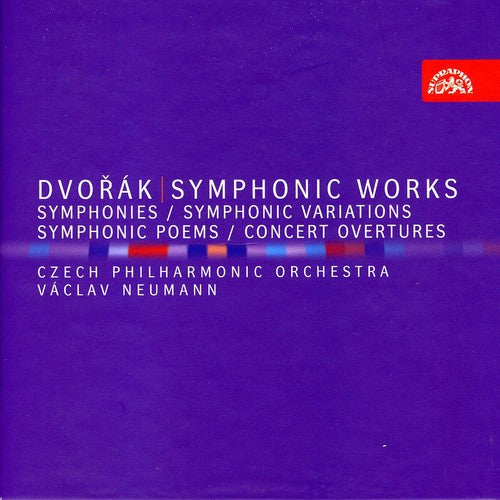
Dvorak: Symphonic Works / Neumann, Czech
This is a set that no one who cares about Dvorák’s symphonies can afford to ignore. These performances really do belong in every serious collection.
Supraphon has finally released Václav Neumann’s 1970s Dvorák symphony cycle, and what a wonderful event it is. These performances are, on the whole, fresher and freer than his digital remakes, fine though those are, and more warmly recorded. The only exception is the somewhat shrill engineering in the First Symphony, but in general the sonics are comparable to other cycles of the period—Kertész, Kubelik, and Rowicki—and this is unquestionably the best played of them all. It’s difficult to overestimate the value of having the Czech Philharmonic in top form in this music, but the sound of the ensemble really does speak for itself. Kubelik’s Berlin Philharmonic might have the best strings, and the London Symphony for Kertész and Rowicki the boldest horns, but the Czech Philharmonic has the best ensemble, top to bottom, at least in Dvorák.
Consider one example: the climax of the first movement of the Seventh Symphony, a work that shows both the orchestra and Neumann at their very best. If you imprinted on this performance, nothing else can match it in power and intensity. The passionate lyricism of the strings, the thrilling low timpani roll that propels the trombones’ upward arpeggio, and those bright, sforzando trumpets combine to make an unforgettable impression (sound clip below), and it’s all exactly as Dvorák wrote it. Interestingly, where Neumann deviates from the printed page, as in the main theme’s fortissimo counterstatement in the first movement, or in the work’s concluding chorale, he gives the doubling parts to the trumpets rather than the horns, as in most other performances, and this too proves the better decision.
This brings us to Neumann’s own contribution. Traditionally he has gotten short shrift compared to the competition. Some of this was politics. In the 1960s and ’70s the British naturally preferred anything featuring the LSO, and Kubelik was a symbol of democratic resistance to Communist rule. He also had the superb Berlin Philharmonic at his disposal, rather than his usual Bavarian Radio forces, and Deutsche Grammophon behind him. Neumann, on LP at least, was spottily available on generally horrible pressings, and he had the disadvantage to be taking over from Ancerl, an indisputably great conductor who wound up on the right side of Cold War politics. Then Neumann remade all the symphonies in digital sound, a set that Supraphon promoted intensely, and this earlier effort simply disappeared from sight.
In general, Neumann’s approach might sound a touch “old fashioned”—quick movements move at moderate speeds, slow movements flow without ever dragging. Although not quite so slow in the allegros, conductors like Otto Klemperer come to mind. And yet, Neumann is by no means lacking in energy. His Eighth Symphony is as fresh (and swift) as any in the catalog. He whips up quite a frenzy in the finale of the Fifth, and this Third Symphony might just be the best on disc. Its first movement is as energetic as can be, the central funeral march is gorgeous and never stiff, while the finale actually sounds less mechanical at this moderate speed than it does when taken more quickly. The Sixth seldom has been paced more naturally, and as Dvorák fans all know, Ancerl’s benchmark performance is a tough act to follow. Neumann has nothing to fear from the comparison, especially in the coda of the finale, which is stunning.
Neumann always did well by the “New World” Symphony, and in only a few spots in the first two symphonies does Neumann sound less than fully engaged (though in the former, he’s still more effective than in his digital remake). The third movement of the Second, particularly, needs to be crisper. Suitner on Berlin Classics is unmatched here. For the most part, though, Neumann’s performances have held up extremely well. In particular, he offers an object lesson in phrasing and, especially, the correct use of legato in lyrical passages. So many performances today, perhaps encouraged by the perpetual staccato of the early music movement, break up Dvorák’s melodies into fragments, whereas Neumann conducts in whole paragraphs.
The couplings add greatly to this set’s attractions. They are uniformly excellent. The Symphonic Variations overflows with character; the three concert overtures belong together (they share a theme, heard at the outset of In Nature’s Realm), and these versions of the four late symphonic poems rank with the best available. They are also very well recorded. So to summarize, this is a set that no one who cares about Dvorák’s symphonies can afford to ignore. Even if you have the versions just mentioned, these performances really do belong in every serious collection.
-- David Hurwitz, ClassicsToday.com
Supraphon has finally released Václav Neumann’s 1970s Dvorák symphony cycle, and what a wonderful event it is. These performances are, on the whole, fresher and freer than his digital remakes, fine though those are, and more warmly recorded. The only exception is the somewhat shrill engineering in the First Symphony, but in general the sonics are comparable to other cycles of the period—Kertész, Kubelik, and Rowicki—and this is unquestionably the best played of them all. It’s difficult to overestimate the value of having the Czech Philharmonic in top form in this music, but the sound of the ensemble really does speak for itself. Kubelik’s Berlin Philharmonic might have the best strings, and the London Symphony for Kertész and Rowicki the boldest horns, but the Czech Philharmonic has the best ensemble, top to bottom, at least in Dvorák.
Consider one example: the climax of the first movement of the Seventh Symphony, a work that shows both the orchestra and Neumann at their very best. If you imprinted on this performance, nothing else can match it in power and intensity. The passionate lyricism of the strings, the thrilling low timpani roll that propels the trombones’ upward arpeggio, and those bright, sforzando trumpets combine to make an unforgettable impression (sound clip below), and it’s all exactly as Dvorák wrote it. Interestingly, where Neumann deviates from the printed page, as in the main theme’s fortissimo counterstatement in the first movement, or in the work’s concluding chorale, he gives the doubling parts to the trumpets rather than the horns, as in most other performances, and this too proves the better decision.
This brings us to Neumann’s own contribution. Traditionally he has gotten short shrift compared to the competition. Some of this was politics. In the 1960s and ’70s the British naturally preferred anything featuring the LSO, and Kubelik was a symbol of democratic resistance to Communist rule. He also had the superb Berlin Philharmonic at his disposal, rather than his usual Bavarian Radio forces, and Deutsche Grammophon behind him. Neumann, on LP at least, was spottily available on generally horrible pressings, and he had the disadvantage to be taking over from Ancerl, an indisputably great conductor who wound up on the right side of Cold War politics. Then Neumann remade all the symphonies in digital sound, a set that Supraphon promoted intensely, and this earlier effort simply disappeared from sight.
In general, Neumann’s approach might sound a touch “old fashioned”—quick movements move at moderate speeds, slow movements flow without ever dragging. Although not quite so slow in the allegros, conductors like Otto Klemperer come to mind. And yet, Neumann is by no means lacking in energy. His Eighth Symphony is as fresh (and swift) as any in the catalog. He whips up quite a frenzy in the finale of the Fifth, and this Third Symphony might just be the best on disc. Its first movement is as energetic as can be, the central funeral march is gorgeous and never stiff, while the finale actually sounds less mechanical at this moderate speed than it does when taken more quickly. The Sixth seldom has been paced more naturally, and as Dvorák fans all know, Ancerl’s benchmark performance is a tough act to follow. Neumann has nothing to fear from the comparison, especially in the coda of the finale, which is stunning.
Neumann always did well by the “New World” Symphony, and in only a few spots in the first two symphonies does Neumann sound less than fully engaged (though in the former, he’s still more effective than in his digital remake). The third movement of the Second, particularly, needs to be crisper. Suitner on Berlin Classics is unmatched here. For the most part, though, Neumann’s performances have held up extremely well. In particular, he offers an object lesson in phrasing and, especially, the correct use of legato in lyrical passages. So many performances today, perhaps encouraged by the perpetual staccato of the early music movement, break up Dvorák’s melodies into fragments, whereas Neumann conducts in whole paragraphs.
The couplings add greatly to this set’s attractions. They are uniformly excellent. The Symphonic Variations overflows with character; the three concert overtures belong together (they share a theme, heard at the outset of In Nature’s Realm), and these versions of the four late symphonic poems rank with the best available. They are also very well recorded. So to summarize, this is a set that no one who cares about Dvorák’s symphonies can afford to ignore. Even if you have the versions just mentioned, these performances really do belong in every serious collection.
-- David Hurwitz, ClassicsToday.com
This is a set that no one who cares about Dvorák’s symphonies can afford to ignore. These performances really do belong in every serious collection.
Supraphon has finally released Václav Neumann’s 1970s Dvorák symphony cycle, and what a wonderful event it is. These performances are, on the whole, fresher and freer than his digital remakes, fine though those are, and more warmly recorded. The only exception is the somewhat shrill engineering in the First Symphony, but in general the sonics are comparable to other cycles of the period—Kertész, Kubelik, and Rowicki—and this is unquestionably the best played of them all. It’s difficult to overestimate the value of having the Czech Philharmonic in top form in this music, but the sound of the ensemble really does speak for itself. Kubelik’s Berlin Philharmonic might have the best strings, and the London Symphony for Kertész and Rowicki the boldest horns, but the Czech Philharmonic has the best ensemble, top to bottom, at least in Dvorák.
Consider one example: the climax of the first movement of the Seventh Symphony, a work that shows both the orchestra and Neumann at their very best. If you imprinted on this performance, nothing else can match it in power and intensity. The passionate lyricism of the strings, the thrilling low timpani roll that propels the trombones’ upward arpeggio, and those bright, sforzando trumpets combine to make an unforgettable impression (sound clip below), and it’s all exactly as Dvorák wrote it. Interestingly, where Neumann deviates from the printed page, as in the main theme’s fortissimo counterstatement in the first movement, or in the work’s concluding chorale, he gives the doubling parts to the trumpets rather than the horns, as in most other performances, and this too proves the better decision.
This brings us to Neumann’s own contribution. Traditionally he has gotten short shrift compared to the competition. Some of this was politics. In the 1960s and ’70s the British naturally preferred anything featuring the LSO, and Kubelik was a symbol of democratic resistance to Communist rule. He also had the superb Berlin Philharmonic at his disposal, rather than his usual Bavarian Radio forces, and Deutsche Grammophon behind him. Neumann, on LP at least, was spottily available on generally horrible pressings, and he had the disadvantage to be taking over from Ancerl, an indisputably great conductor who wound up on the right side of Cold War politics. Then Neumann remade all the symphonies in digital sound, a set that Supraphon promoted intensely, and this earlier effort simply disappeared from sight.
In general, Neumann’s approach might sound a touch “old fashioned”—quick movements move at moderate speeds, slow movements flow without ever dragging. Although not quite so slow in the allegros, conductors like Otto Klemperer come to mind. And yet, Neumann is by no means lacking in energy. His Eighth Symphony is as fresh (and swift) as any in the catalog. He whips up quite a frenzy in the finale of the Fifth, and this Third Symphony might just be the best on disc. Its first movement is as energetic as can be, the central funeral march is gorgeous and never stiff, while the finale actually sounds less mechanical at this moderate speed than it does when taken more quickly. The Sixth seldom has been paced more naturally, and as Dvorák fans all know, Ancerl’s benchmark performance is a tough act to follow. Neumann has nothing to fear from the comparison, especially in the coda of the finale, which is stunning.
Neumann always did well by the “New World” Symphony, and in only a few spots in the first two symphonies does Neumann sound less than fully engaged (though in the former, he’s still more effective than in his digital remake). The third movement of the Second, particularly, needs to be crisper. Suitner on Berlin Classics is unmatched here. For the most part, though, Neumann’s performances have held up extremely well. In particular, he offers an object lesson in phrasing and, especially, the correct use of legato in lyrical passages. So many performances today, perhaps encouraged by the perpetual staccato of the early music movement, break up Dvorák’s melodies into fragments, whereas Neumann conducts in whole paragraphs.
The couplings add greatly to this set’s attractions. They are uniformly excellent. The Symphonic Variations overflows with character; the three concert overtures belong together (they share a theme, heard at the outset of In Nature’s Realm), and these versions of the four late symphonic poems rank with the best available. They are also very well recorded. So to summarize, this is a set that no one who cares about Dvorák’s symphonies can afford to ignore. Even if you have the versions just mentioned, these performances really do belong in every serious collection.
-- David Hurwitz, ClassicsToday.com
Supraphon has finally released Václav Neumann’s 1970s Dvorák symphony cycle, and what a wonderful event it is. These performances are, on the whole, fresher and freer than his digital remakes, fine though those are, and more warmly recorded. The only exception is the somewhat shrill engineering in the First Symphony, but in general the sonics are comparable to other cycles of the period—Kertész, Kubelik, and Rowicki—and this is unquestionably the best played of them all. It’s difficult to overestimate the value of having the Czech Philharmonic in top form in this music, but the sound of the ensemble really does speak for itself. Kubelik’s Berlin Philharmonic might have the best strings, and the London Symphony for Kertész and Rowicki the boldest horns, but the Czech Philharmonic has the best ensemble, top to bottom, at least in Dvorák.
Consider one example: the climax of the first movement of the Seventh Symphony, a work that shows both the orchestra and Neumann at their very best. If you imprinted on this performance, nothing else can match it in power and intensity. The passionate lyricism of the strings, the thrilling low timpani roll that propels the trombones’ upward arpeggio, and those bright, sforzando trumpets combine to make an unforgettable impression (sound clip below), and it’s all exactly as Dvorák wrote it. Interestingly, where Neumann deviates from the printed page, as in the main theme’s fortissimo counterstatement in the first movement, or in the work’s concluding chorale, he gives the doubling parts to the trumpets rather than the horns, as in most other performances, and this too proves the better decision.
This brings us to Neumann’s own contribution. Traditionally he has gotten short shrift compared to the competition. Some of this was politics. In the 1960s and ’70s the British naturally preferred anything featuring the LSO, and Kubelik was a symbol of democratic resistance to Communist rule. He also had the superb Berlin Philharmonic at his disposal, rather than his usual Bavarian Radio forces, and Deutsche Grammophon behind him. Neumann, on LP at least, was spottily available on generally horrible pressings, and he had the disadvantage to be taking over from Ancerl, an indisputably great conductor who wound up on the right side of Cold War politics. Then Neumann remade all the symphonies in digital sound, a set that Supraphon promoted intensely, and this earlier effort simply disappeared from sight.
In general, Neumann’s approach might sound a touch “old fashioned”—quick movements move at moderate speeds, slow movements flow without ever dragging. Although not quite so slow in the allegros, conductors like Otto Klemperer come to mind. And yet, Neumann is by no means lacking in energy. His Eighth Symphony is as fresh (and swift) as any in the catalog. He whips up quite a frenzy in the finale of the Fifth, and this Third Symphony might just be the best on disc. Its first movement is as energetic as can be, the central funeral march is gorgeous and never stiff, while the finale actually sounds less mechanical at this moderate speed than it does when taken more quickly. The Sixth seldom has been paced more naturally, and as Dvorák fans all know, Ancerl’s benchmark performance is a tough act to follow. Neumann has nothing to fear from the comparison, especially in the coda of the finale, which is stunning.
Neumann always did well by the “New World” Symphony, and in only a few spots in the first two symphonies does Neumann sound less than fully engaged (though in the former, he’s still more effective than in his digital remake). The third movement of the Second, particularly, needs to be crisper. Suitner on Berlin Classics is unmatched here. For the most part, though, Neumann’s performances have held up extremely well. In particular, he offers an object lesson in phrasing and, especially, the correct use of legato in lyrical passages. So many performances today, perhaps encouraged by the perpetual staccato of the early music movement, break up Dvorák’s melodies into fragments, whereas Neumann conducts in whole paragraphs.
The couplings add greatly to this set’s attractions. They are uniformly excellent. The Symphonic Variations overflows with character; the three concert overtures belong together (they share a theme, heard at the outset of In Nature’s Realm), and these versions of the four late symphonic poems rank with the best available. They are also very well recorded. So to summarize, this is a set that no one who cares about Dvorák’s symphonies can afford to ignore. Even if you have the versions just mentioned, these performances really do belong in every serious collection.
-- David Hurwitz, ClassicsToday.com
$56.99
Dvorak: Symphonic Works / Neumann, Czech—
$56.99
Description
This is a set that no one who cares about Dvorák’s symphonies can afford to ignore. These performances really do belong in every serious collection.
Supraphon has finally released Václav Neumann’s 1970s Dvorák symphony cycle, and what a wonderful event it is. These performances are, on the whole, fresher and freer than his digital remakes, fine though those are, and more warmly recorded. The only exception is the somewhat shrill engineering in the First Symphony, but in general the sonics are comparable to other cycles of the period—Kertész, Kubelik, and Rowicki—and this is unquestionably the best played of them all. It’s difficult to overestimate the value of having the Czech Philharmonic in top form in this music, but the sound of the ensemble really does speak for itself. Kubelik’s Berlin Philharmonic might have the best strings, and the London Symphony for Kertész and Rowicki the boldest horns, but the Czech Philharmonic has the best ensemble, top to bottom, at least in Dvorák.
Consider one example: the climax of the first movement of the Seventh Symphony, a work that shows both the orchestra and Neumann at their very best. If you imprinted on this performance, nothing else can match it in power and intensity. The passionate lyricism of the strings, the thrilling low timpani roll that propels the trombones’ upward arpeggio, and those bright, sforzando trumpets combine to make an unforgettable impression (sound clip below), and it’s all exactly as Dvorák wrote it. Interestingly, where Neumann deviates from the printed page, as in the main theme’s fortissimo counterstatement in the first movement, or in the work’s concluding chorale, he gives the doubling parts to the trumpets rather than the horns, as in most other performances, and this too proves the better decision.
This brings us to Neumann’s own contribution. Traditionally he has gotten short shrift compared to the competition. Some of this was politics. In the 1960s and ’70s the British naturally preferred anything featuring the LSO, and Kubelik was a symbol of democratic resistance to Communist rule. He also had the superb Berlin Philharmonic at his disposal, rather than his usual Bavarian Radio forces, and Deutsche Grammophon behind him. Neumann, on LP at least, was spottily available on generally horrible pressings, and he had the disadvantage to be taking over from Ancerl, an indisputably great conductor who wound up on the right side of Cold War politics. Then Neumann remade all the symphonies in digital sound, a set that Supraphon promoted intensely, and this earlier effort simply disappeared from sight.
In general, Neumann’s approach might sound a touch “old fashioned”—quick movements move at moderate speeds, slow movements flow without ever dragging. Although not quite so slow in the allegros, conductors like Otto Klemperer come to mind. And yet, Neumann is by no means lacking in energy. His Eighth Symphony is as fresh (and swift) as any in the catalog. He whips up quite a frenzy in the finale of the Fifth, and this Third Symphony might just be the best on disc. Its first movement is as energetic as can be, the central funeral march is gorgeous and never stiff, while the finale actually sounds less mechanical at this moderate speed than it does when taken more quickly. The Sixth seldom has been paced more naturally, and as Dvorák fans all know, Ancerl’s benchmark performance is a tough act to follow. Neumann has nothing to fear from the comparison, especially in the coda of the finale, which is stunning.
Neumann always did well by the “New World” Symphony, and in only a few spots in the first two symphonies does Neumann sound less than fully engaged (though in the former, he’s still more effective than in his digital remake). The third movement of the Second, particularly, needs to be crisper. Suitner on Berlin Classics is unmatched here. For the most part, though, Neumann’s performances have held up extremely well. In particular, he offers an object lesson in phrasing and, especially, the correct use of legato in lyrical passages. So many performances today, perhaps encouraged by the perpetual staccato of the early music movement, break up Dvorák’s melodies into fragments, whereas Neumann conducts in whole paragraphs.
The couplings add greatly to this set’s attractions. They are uniformly excellent. The Symphonic Variations overflows with character; the three concert overtures belong together (they share a theme, heard at the outset of In Nature’s Realm), and these versions of the four late symphonic poems rank with the best available. They are also very well recorded. So to summarize, this is a set that no one who cares about Dvorák’s symphonies can afford to ignore. Even if you have the versions just mentioned, these performances really do belong in every serious collection.
-- David Hurwitz, ClassicsToday.com
Supraphon has finally released Václav Neumann’s 1970s Dvorák symphony cycle, and what a wonderful event it is. These performances are, on the whole, fresher and freer than his digital remakes, fine though those are, and more warmly recorded. The only exception is the somewhat shrill engineering in the First Symphony, but in general the sonics are comparable to other cycles of the period—Kertész, Kubelik, and Rowicki—and this is unquestionably the best played of them all. It’s difficult to overestimate the value of having the Czech Philharmonic in top form in this music, but the sound of the ensemble really does speak for itself. Kubelik’s Berlin Philharmonic might have the best strings, and the London Symphony for Kertész and Rowicki the boldest horns, but the Czech Philharmonic has the best ensemble, top to bottom, at least in Dvorák.
Consider one example: the climax of the first movement of the Seventh Symphony, a work that shows both the orchestra and Neumann at their very best. If you imprinted on this performance, nothing else can match it in power and intensity. The passionate lyricism of the strings, the thrilling low timpani roll that propels the trombones’ upward arpeggio, and those bright, sforzando trumpets combine to make an unforgettable impression (sound clip below), and it’s all exactly as Dvorák wrote it. Interestingly, where Neumann deviates from the printed page, as in the main theme’s fortissimo counterstatement in the first movement, or in the work’s concluding chorale, he gives the doubling parts to the trumpets rather than the horns, as in most other performances, and this too proves the better decision.
This brings us to Neumann’s own contribution. Traditionally he has gotten short shrift compared to the competition. Some of this was politics. In the 1960s and ’70s the British naturally preferred anything featuring the LSO, and Kubelik was a symbol of democratic resistance to Communist rule. He also had the superb Berlin Philharmonic at his disposal, rather than his usual Bavarian Radio forces, and Deutsche Grammophon behind him. Neumann, on LP at least, was spottily available on generally horrible pressings, and he had the disadvantage to be taking over from Ancerl, an indisputably great conductor who wound up on the right side of Cold War politics. Then Neumann remade all the symphonies in digital sound, a set that Supraphon promoted intensely, and this earlier effort simply disappeared from sight.
In general, Neumann’s approach might sound a touch “old fashioned”—quick movements move at moderate speeds, slow movements flow without ever dragging. Although not quite so slow in the allegros, conductors like Otto Klemperer come to mind. And yet, Neumann is by no means lacking in energy. His Eighth Symphony is as fresh (and swift) as any in the catalog. He whips up quite a frenzy in the finale of the Fifth, and this Third Symphony might just be the best on disc. Its first movement is as energetic as can be, the central funeral march is gorgeous and never stiff, while the finale actually sounds less mechanical at this moderate speed than it does when taken more quickly. The Sixth seldom has been paced more naturally, and as Dvorák fans all know, Ancerl’s benchmark performance is a tough act to follow. Neumann has nothing to fear from the comparison, especially in the coda of the finale, which is stunning.
Neumann always did well by the “New World” Symphony, and in only a few spots in the first two symphonies does Neumann sound less than fully engaged (though in the former, he’s still more effective than in his digital remake). The third movement of the Second, particularly, needs to be crisper. Suitner on Berlin Classics is unmatched here. For the most part, though, Neumann’s performances have held up extremely well. In particular, he offers an object lesson in phrasing and, especially, the correct use of legato in lyrical passages. So many performances today, perhaps encouraged by the perpetual staccato of the early music movement, break up Dvorák’s melodies into fragments, whereas Neumann conducts in whole paragraphs.
The couplings add greatly to this set’s attractions. They are uniformly excellent. The Symphonic Variations overflows with character; the three concert overtures belong together (they share a theme, heard at the outset of In Nature’s Realm), and these versions of the four late symphonic poems rank with the best available. They are also very well recorded. So to summarize, this is a set that no one who cares about Dvorák’s symphonies can afford to ignore. Even if you have the versions just mentioned, these performances really do belong in every serious collection.
-- David Hurwitz, ClassicsToday.com