🎉 Up to 70% Off Selected ItemsShop Sale

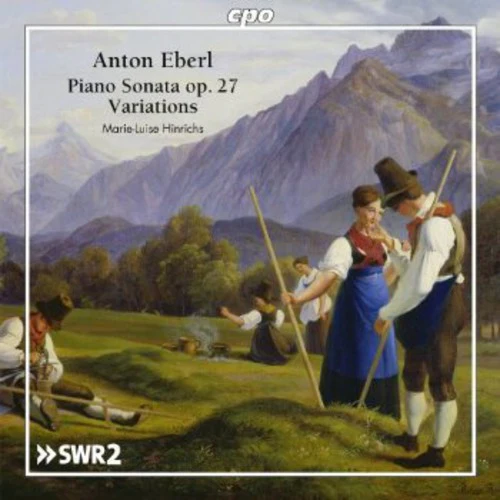
Eberl: Piano Sonata Op. 27; Variations / Marie-luise Hinrichs
EBERL Piano Sonata in g, op. 27 . 12 Variations in D. 10 Variations in E? • Marie-Luise Hinrichs (pn) • CPO 7776052 (53:27)
Present-day appreciation of the music of the prolific Viennese composer Anton Eberl (1765–1807) probably lags behind our awareness of his friendship and musical association with Mozart, and, for a time, his public rivalry with Beethoven. Eberl’s Symphony in E? was favorably compared by at least one Vienna critic to the “Eroica,” which was composed around the same time, and premiered on the same concert.
Eberl’s Grand Sonata in G Minor, op. 27, was published in 1805, a few months prior to Beethoven’s “Waldstein,” and dedicated to Cherubini. It’s an ambitious work whose first movement sounds almost nothing like Mozart‘s keyboard music—though its key and dramatic mood show the influence of the 40th Symphony—and not essentially like Beethoven’s, though each movement’s large dimensions may reflect his influence. Rather, the sonata’s textures, which are thicker than Mozart’s, along with its frequent, quick changes between major and minor, and its overall lyrical impulse, remind me a great deal of Schubert’s early piano sonatas, which it predates, as well as the more harmonically experimental passages in some of Dussek’s. In fact, it’s a better piece than the sonatas that Schubert composed before 1817, operating on a grander scale, and holding consistent interest throughout its three movements. The second movement operates like an early Beethoven slow movement, with florid lines that look toward Weber. The work’s high quality is maintained in its third movement, a large form, one of whose motives echoes the Haydn B-Minor Sonata, but whose sweep looks forward to Mendelssohn, with a dose of Beethovenian humor at the close. This is not to say that the music feels derivative. Repeated hearing of the piece has increased my respect for it, and especially in the first movement, Eberl is a composer with something of emotional import to impart, in a voice that’s his own.
The Variations recorded here are a set of 12 in D, based on an appealing theme by Carl Ditters von Dittersdorf, the Arietta Freudin sanfter Herzenstriebe , and a set of 10 in E? based on a similarly good-natured theme by the Singspiel composer Ignaz Umlauf, Zu Steffen sprach im Traume , the latter set supposedly held in great esteem by Mozart, and attributed to him many early editions. Here Eberl’s assured keyboard writing might be mistaken for Beethoven’s in many of his early variation sets. Eberl’s variations stick close to the original themes. The music is cheerful, workmanlike, but not terribly interesting. (Come to think of it, that description fits most of Haydn’s keyboard variations, excepting the F-Minor set, the majority of Mozart’s, and Beethoven’s, before he began to experiment with thematic transformation.)
The advocacy of a pianist who plays as well as Marie-Luise Hinrichs is just what is needed to elevate a second-rank composer like Eberl into the category of one whose music should be heard. Her playing is flexible, sensitive, tasteful, and persuasive in every way. She has the ability to communicate warmth of feeling, and if there are other Eberl works that are on the same high level as the G-Minor Sonata, I would enjoy hearing her play them. There’s a 3-CD set of Eberl’s keyboard music that includes the G-Minor Sonata, played by John Khouri on Music and Arts, the recorded sound of whose fortepiano does the music no favors. CPO provides Hinrichs’s modern instrument with flattering sound.
FANFARE: Paul Orgel
EBERL Piano Sonata in g, op. 27 . 12 Variations in D. 10 Variations in E? • Marie-Luise Hinrichs (pn) • CPO 7776052 (53:27)
Present-day appreciation of the music of the prolific Viennese composer Anton Eberl (1765–1807) probably lags behind our awareness of his friendship and musical association with Mozart, and, for a time, his public rivalry with Beethoven. Eberl’s Symphony in E? was favorably compared by at least one Vienna critic to the “Eroica,” which was composed around the same time, and premiered on the same concert.
Eberl’s Grand Sonata in G Minor, op. 27, was published in 1805, a few months prior to Beethoven’s “Waldstein,” and dedicated to Cherubini. It’s an ambitious work whose first movement sounds almost nothing like Mozart‘s keyboard music—though its key and dramatic mood show the influence of the 40th Symphony—and not essentially like Beethoven’s, though each movement’s large dimensions may reflect his influence. Rather, the sonata’s textures, which are thicker than Mozart’s, along with its frequent, quick changes between major and minor, and its overall lyrical impulse, remind me a great deal of Schubert’s early piano sonatas, which it predates, as well as the more harmonically experimental passages in some of Dussek’s. In fact, it’s a better piece than the sonatas that Schubert composed before 1817, operating on a grander scale, and holding consistent interest throughout its three movements. The second movement operates like an early Beethoven slow movement, with florid lines that look toward Weber. The work’s high quality is maintained in its third movement, a large form, one of whose motives echoes the Haydn B-Minor Sonata, but whose sweep looks forward to Mendelssohn, with a dose of Beethovenian humor at the close. This is not to say that the music feels derivative. Repeated hearing of the piece has increased my respect for it, and especially in the first movement, Eberl is a composer with something of emotional import to impart, in a voice that’s his own.
The Variations recorded here are a set of 12 in D, based on an appealing theme by Carl Ditters von Dittersdorf, the Arietta Freudin sanfter Herzenstriebe , and a set of 10 in E? based on a similarly good-natured theme by the Singspiel composer Ignaz Umlauf, Zu Steffen sprach im Traume , the latter set supposedly held in great esteem by Mozart, and attributed to him many early editions. Here Eberl’s assured keyboard writing might be mistaken for Beethoven’s in many of his early variation sets. Eberl’s variations stick close to the original themes. The music is cheerful, workmanlike, but not terribly interesting. (Come to think of it, that description fits most of Haydn’s keyboard variations, excepting the F-Minor set, the majority of Mozart’s, and Beethoven’s, before he began to experiment with thematic transformation.)
The advocacy of a pianist who plays as well as Marie-Luise Hinrichs is just what is needed to elevate a second-rank composer like Eberl into the category of one whose music should be heard. Her playing is flexible, sensitive, tasteful, and persuasive in every way. She has the ability to communicate warmth of feeling, and if there are other Eberl works that are on the same high level as the G-Minor Sonata, I would enjoy hearing her play them. There’s a 3-CD set of Eberl’s keyboard music that includes the G-Minor Sonata, played by John Khouri on Music and Arts, the recorded sound of whose fortepiano does the music no favors. CPO provides Hinrichs’s modern instrument with flattering sound.
FANFARE: Paul Orgel
$13.99
Eberl: Piano Sonata Op. 27; Variations / Marie-luise Hinrichs—
$13.99
Description
EBERL Piano Sonata in g, op. 27 . 12 Variations in D. 10 Variations in E? • Marie-Luise Hinrichs (pn) • CPO 7776052 (53:27)
Present-day appreciation of the music of the prolific Viennese composer Anton Eberl (1765–1807) probably lags behind our awareness of his friendship and musical association with Mozart, and, for a time, his public rivalry with Beethoven. Eberl’s Symphony in E? was favorably compared by at least one Vienna critic to the “Eroica,” which was composed around the same time, and premiered on the same concert.
Eberl’s Grand Sonata in G Minor, op. 27, was published in 1805, a few months prior to Beethoven’s “Waldstein,” and dedicated to Cherubini. It’s an ambitious work whose first movement sounds almost nothing like Mozart‘s keyboard music—though its key and dramatic mood show the influence of the 40th Symphony—and not essentially like Beethoven’s, though each movement’s large dimensions may reflect his influence. Rather, the sonata’s textures, which are thicker than Mozart’s, along with its frequent, quick changes between major and minor, and its overall lyrical impulse, remind me a great deal of Schubert’s early piano sonatas, which it predates, as well as the more harmonically experimental passages in some of Dussek’s. In fact, it’s a better piece than the sonatas that Schubert composed before 1817, operating on a grander scale, and holding consistent interest throughout its three movements. The second movement operates like an early Beethoven slow movement, with florid lines that look toward Weber. The work’s high quality is maintained in its third movement, a large form, one of whose motives echoes the Haydn B-Minor Sonata, but whose sweep looks forward to Mendelssohn, with a dose of Beethovenian humor at the close. This is not to say that the music feels derivative. Repeated hearing of the piece has increased my respect for it, and especially in the first movement, Eberl is a composer with something of emotional import to impart, in a voice that’s his own.
The Variations recorded here are a set of 12 in D, based on an appealing theme by Carl Ditters von Dittersdorf, the Arietta Freudin sanfter Herzenstriebe , and a set of 10 in E? based on a similarly good-natured theme by the Singspiel composer Ignaz Umlauf, Zu Steffen sprach im Traume , the latter set supposedly held in great esteem by Mozart, and attributed to him many early editions. Here Eberl’s assured keyboard writing might be mistaken for Beethoven’s in many of his early variation sets. Eberl’s variations stick close to the original themes. The music is cheerful, workmanlike, but not terribly interesting. (Come to think of it, that description fits most of Haydn’s keyboard variations, excepting the F-Minor set, the majority of Mozart’s, and Beethoven’s, before he began to experiment with thematic transformation.)
The advocacy of a pianist who plays as well as Marie-Luise Hinrichs is just what is needed to elevate a second-rank composer like Eberl into the category of one whose music should be heard. Her playing is flexible, sensitive, tasteful, and persuasive in every way. She has the ability to communicate warmth of feeling, and if there are other Eberl works that are on the same high level as the G-Minor Sonata, I would enjoy hearing her play them. There’s a 3-CD set of Eberl’s keyboard music that includes the G-Minor Sonata, played by John Khouri on Music and Arts, the recorded sound of whose fortepiano does the music no favors. CPO provides Hinrichs’s modern instrument with flattering sound.
FANFARE: Paul Orgel






















