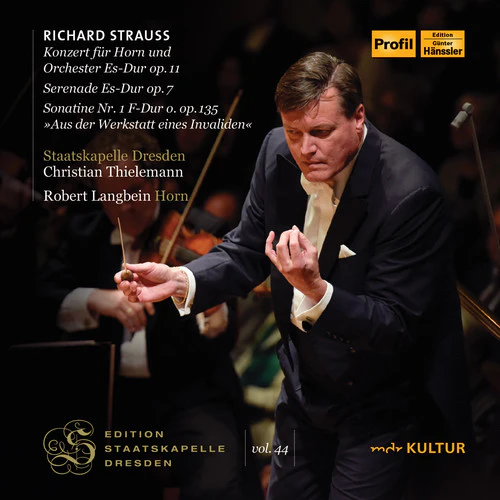
Edition Staatskapelle Dresden, Vol. 44: Richard Strauss / Thielemann, Langhein
The way Richard Strauss spoke of his “beloved Dresdeners” rang of Bavarian humor blended with a subtle touch of mischievous irony and, first and foremost, a good dose of respect and appreciation. Home to the Königliche musikalische Kapelle (“Royal Musical Ensemble”) and the Court Opera, Dresden soon became a center of Strauss’s music; many of his works were given their premiere there. Ernst von Schuch, Strauss’s “most loyal conductor of choice”, was a key figure: at the symphony concerts given by the Kapelle, the Dresden General Music Director soon acquainted audiences with all of Strauss’s tone poems, from Till Eulenspiegels lustige Streiche through Also sprach Zarathustra to Sinfonia domestica. Strauss enthused that, years later, it was “the brilliant Schuch’s untiring magic wand” that eventually opened the series of “exemplary premieres” of his operas in Dresden. Works including Salome, Elektra and Der Rosenkavalier made Strauss the leading musical dramatist of his time. He had no fewer than nine operas premiered in Dresden, his “Eldorado for premieres”, and dedicated the Alpine Symphony to the Dresden Kapelle as a token of his gratitude. The present release is the 44th volume in the Staatskapelle Dresden’s exploration of Strauss’s work, and includes, most notably, his Konzert fur Horn und Orchester op. 11.
The way Richard Strauss spoke of his “beloved Dresdeners” rang of Bavarian humor blended with a subtle touch of mischievous irony and, first and foremost, a good dose of respect and appreciation. Home to the Königliche musikalische Kapelle (“Royal Musical Ensemble”) and the Court Opera, Dresden soon became a center of Strauss’s music; many of his works were given their premiere there. Ernst von Schuch, Strauss’s “most loyal conductor of choice”, was a key figure: at the symphony concerts given by the Kapelle, the Dresden General Music Director soon acquainted audiences with all of Strauss’s tone poems, from Till Eulenspiegels lustige Streiche through Also sprach Zarathustra to Sinfonia domestica. Strauss enthused that, years later, it was “the brilliant Schuch’s untiring magic wand” that eventually opened the series of “exemplary premieres” of his operas in Dresden. Works including Salome, Elektra and Der Rosenkavalier made Strauss the leading musical dramatist of his time. He had no fewer than nine operas premiered in Dresden, his “Eldorado for premieres”, and dedicated the Alpine Symphony to the Dresden Kapelle as a token of his gratitude. The present release is the 44th volume in the Staatskapelle Dresden’s exploration of Strauss’s work, and includes, most notably, his Konzert fur Horn und Orchester op. 11.
Original: $18.99
-65%$18.99
$6.65Description
The way Richard Strauss spoke of his “beloved Dresdeners” rang of Bavarian humor blended with a subtle touch of mischievous irony and, first and foremost, a good dose of respect and appreciation. Home to the Königliche musikalische Kapelle (“Royal Musical Ensemble”) and the Court Opera, Dresden soon became a center of Strauss’s music; many of his works were given their premiere there. Ernst von Schuch, Strauss’s “most loyal conductor of choice”, was a key figure: at the symphony concerts given by the Kapelle, the Dresden General Music Director soon acquainted audiences with all of Strauss’s tone poems, from Till Eulenspiegels lustige Streiche through Also sprach Zarathustra to Sinfonia domestica. Strauss enthused that, years later, it was “the brilliant Schuch’s untiring magic wand” that eventually opened the series of “exemplary premieres” of his operas in Dresden. Works including Salome, Elektra and Der Rosenkavalier made Strauss the leading musical dramatist of his time. He had no fewer than nine operas premiered in Dresden, his “Eldorado for premieres”, and dedicated the Alpine Symphony to the Dresden Kapelle as a token of his gratitude. The present release is the 44th volume in the Staatskapelle Dresden’s exploration of Strauss’s work, and includes, most notably, his Konzert fur Horn und Orchester op. 11.