🎉 Up to 70% Off Selected ItemsShop Sale

1 / 2
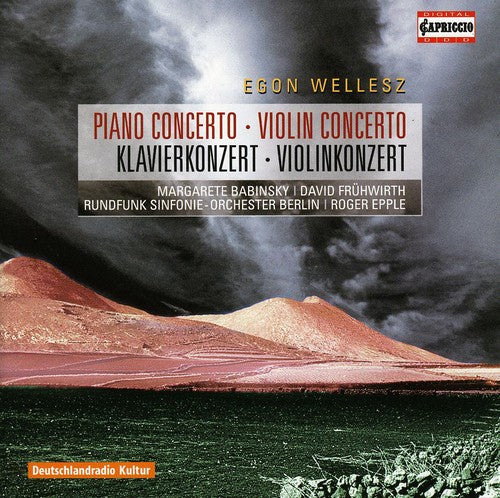
Egon Wellesz: Piano Concerto; Violin Concerto
WELLESZ Piano Concerto , op. 49 1; Violin Concerto , op. 84 2 • 1 Margarete Babinsky (piano); 2 David Frühwirt (vn); Roger Epple, cond; RSO Berlin • CAPRICCIO 5027 (53:15)
Egon Wellesz, born in Vienna in 1885, is among the group of composers of “degenerate art” who survived the Nazi era physically, but not artistically. Like Braunfels, Zeisl, Mittler, or to a lesser degree Hartmann, his music died twice: once when the Nazis declared it “degenerate” and forced him into emigration, then again when the heavily subsidized postwar arts scene thought him not “degenerate” enough—too tonal, too beholden to music rather than organized sound. Even the many, many honors he received in the 50s, 60s, and 70s—in that sense he was luckier than many a colleague with a similar fate—smacked of guilt and placation, not genuine interest in his œuvre.
Wellesz was taught by Guido Adler (also Webern’s professor), became one of the first private students of Schoenberg, and later Schoenberg’s first biographer. In 1974 he died a CBO scholar in Oxford but was buried in his unappreciative home town, Vienna.
On this disc, further exploring “lost” 20th-century repertoire, Capriccio presents a piano concerto that decidedly, finally, doesn’t remind me of Ravel’s! Not that I don’t adore Ravel’s piano concertos to pieces; I do. It’s just that it started to seem like a strange running joke how anything from Zeisl to von Einem ( Fanfare 33:6) to Krenz ( Fanfare 33:2) seemed to remind of Ravel’s G-Major work. Wellesz doesn’t, partly because of his bold writing for piano and a more reticent orchestral part. From the first movement’s unhurried orchestral introduction over an impatient, then calming piano part, to the sudden spunk that picks up at around the two-minute mark, there is little that would immediately, much less invariably, remind one of any other composer. The virtuosic spikes that the pianist traverses, meanwhile, don’t just strike me as jazzy because I am listening to it (and writing this) as I am at a jazz festival in Bolzano, between gigs in this medieval town in South Tyrol. Pianistic ruminations and short orchestra exclamation marks take turns, with much of the material given to the solo piano. The five-minute, unintrusive slow second movement has the ability to just flit by if you don’t pay attention. The orchestra attempts to wax lyrically; the piano interrupts with coy runs. The third movement takes over stealthily with another slow introduction before virtuosity breaks through once again, pulling through to the end with some rambunctiousness and grand gestures. All together the work is not, to my ears, as wholly marvelous a discovery as Eric Zeisl’s (cpo 777226), to mention just an even more obscure work from a composer with a similar-enough biography. But it’s well worth listening to if concertos in general, and that lost period of music in particular, are of interest to you.
The same verdict stands for the Violin Concerto from 1961—even though it is considerably different in style. If you know Wellesz’s symphonies (also on cpo), you will have noticed a distinct break between the essentially late-Romantic symphonies Nos. 1 through 4 and the more explicitly modern Nos. 5 through 8. Wellesz called his Violin Concerto the brother of his Fifth Symphony and that is reflected by a greater—belated, if you will—incorporation of some elements of the serialist school. All movements are based on the same material, albeit a situation that Wellesz claimed to have discovered only after the fact.
The work manages to suggest density while retaining clear lines, and it is—at four movements—considerably more expansive than the Piano Concerto. After its premiere it was favorably compared to Berg (which it obliquely refers to) and Schoenberg. I don’t hear the beauty in it that I hear in the Berg (which, it should be pointed out, benefits from the advantage of far greater exposure, familiarity, and tons of wonderful recordings). It also seems less austere than Schoenberg’s concerto. Listeners who can just be brought to enjoy or accept the harmonic language of the Piano Concerto will find the Violin Concerto less attractive; tougher listening. But with some good will they should be able to access that work, too … especially via the Andante sostenuto, the fourth and last movement which, a terse and frenzied cadenza apart, has repose and considerable lyricism to offer. The violin part in the first movement has a good deal of electric, buzzing moments that are highly enjoyable. For getting to know the composer Wellesz, I’d start with the symphonies, but if they have turned you on already, then his two full-size concertos will be a mandatory expansion pack.
I know it must be frustrating for soloists or ensemble musicians when their work is done away with in one sentence, only because they are not famous enough to have pre-impressed the critic. This kindly dismissal usually takes place with adjectives like “adequate” or “perfectly acceptable.” Unfortunately for lack of comparison, knowledge of the score, and any immediately sensed enthusiasm about the playing (as in the Wetzler recording— Fanfare 33:4—for example), that’s exactly what I’ll have to do. Certainly the soloists Margarete Babinsky, David Frühwirt, or the Berlin RSO under Roger Epple don’t stand in the way of enjoyment.
FANFARE: Jens F. Laurson
WELLESZ Piano Concerto , op. 49 1; Violin Concerto , op. 84 2 • 1 Margarete Babinsky (piano); 2 David Frühwirt (vn); Roger Epple, cond; RSO Berlin • CAPRICCIO 5027 (53:15)
Egon Wellesz, born in Vienna in 1885, is among the group of composers of “degenerate art” who survived the Nazi era physically, but not artistically. Like Braunfels, Zeisl, Mittler, or to a lesser degree Hartmann, his music died twice: once when the Nazis declared it “degenerate” and forced him into emigration, then again when the heavily subsidized postwar arts scene thought him not “degenerate” enough—too tonal, too beholden to music rather than organized sound. Even the many, many honors he received in the 50s, 60s, and 70s—in that sense he was luckier than many a colleague with a similar fate—smacked of guilt and placation, not genuine interest in his œuvre.
Wellesz was taught by Guido Adler (also Webern’s professor), became one of the first private students of Schoenberg, and later Schoenberg’s first biographer. In 1974 he died a CBO scholar in Oxford but was buried in his unappreciative home town, Vienna.
On this disc, further exploring “lost” 20th-century repertoire, Capriccio presents a piano concerto that decidedly, finally, doesn’t remind me of Ravel’s! Not that I don’t adore Ravel’s piano concertos to pieces; I do. It’s just that it started to seem like a strange running joke how anything from Zeisl to von Einem ( Fanfare 33:6) to Krenz ( Fanfare 33:2) seemed to remind of Ravel’s G-Major work. Wellesz doesn’t, partly because of his bold writing for piano and a more reticent orchestral part. From the first movement’s unhurried orchestral introduction over an impatient, then calming piano part, to the sudden spunk that picks up at around the two-minute mark, there is little that would immediately, much less invariably, remind one of any other composer. The virtuosic spikes that the pianist traverses, meanwhile, don’t just strike me as jazzy because I am listening to it (and writing this) as I am at a jazz festival in Bolzano, between gigs in this medieval town in South Tyrol. Pianistic ruminations and short orchestra exclamation marks take turns, with much of the material given to the solo piano. The five-minute, unintrusive slow second movement has the ability to just flit by if you don’t pay attention. The orchestra attempts to wax lyrically; the piano interrupts with coy runs. The third movement takes over stealthily with another slow introduction before virtuosity breaks through once again, pulling through to the end with some rambunctiousness and grand gestures. All together the work is not, to my ears, as wholly marvelous a discovery as Eric Zeisl’s (cpo 777226), to mention just an even more obscure work from a composer with a similar-enough biography. But it’s well worth listening to if concertos in general, and that lost period of music in particular, are of interest to you.
The same verdict stands for the Violin Concerto from 1961—even though it is considerably different in style. If you know Wellesz’s symphonies (also on cpo), you will have noticed a distinct break between the essentially late-Romantic symphonies Nos. 1 through 4 and the more explicitly modern Nos. 5 through 8. Wellesz called his Violin Concerto the brother of his Fifth Symphony and that is reflected by a greater—belated, if you will—incorporation of some elements of the serialist school. All movements are based on the same material, albeit a situation that Wellesz claimed to have discovered only after the fact.
The work manages to suggest density while retaining clear lines, and it is—at four movements—considerably more expansive than the Piano Concerto. After its premiere it was favorably compared to Berg (which it obliquely refers to) and Schoenberg. I don’t hear the beauty in it that I hear in the Berg (which, it should be pointed out, benefits from the advantage of far greater exposure, familiarity, and tons of wonderful recordings). It also seems less austere than Schoenberg’s concerto. Listeners who can just be brought to enjoy or accept the harmonic language of the Piano Concerto will find the Violin Concerto less attractive; tougher listening. But with some good will they should be able to access that work, too … especially via the Andante sostenuto, the fourth and last movement which, a terse and frenzied cadenza apart, has repose and considerable lyricism to offer. The violin part in the first movement has a good deal of electric, buzzing moments that are highly enjoyable. For getting to know the composer Wellesz, I’d start with the symphonies, but if they have turned you on already, then his two full-size concertos will be a mandatory expansion pack.
I know it must be frustrating for soloists or ensemble musicians when their work is done away with in one sentence, only because they are not famous enough to have pre-impressed the critic. This kindly dismissal usually takes place with adjectives like “adequate” or “perfectly acceptable.” Unfortunately for lack of comparison, knowledge of the score, and any immediately sensed enthusiasm about the playing (as in the Wetzler recording— Fanfare 33:4—for example), that’s exactly what I’ll have to do. Certainly the soloists Margarete Babinsky, David Frühwirt, or the Berlin RSO under Roger Epple don’t stand in the way of enjoyment.
FANFARE: Jens F. Laurson
$7.70
Original: $21.99
-65%Egon Wellesz: Piano Concerto; Violin Concerto—
$21.99
$7.70Description
WELLESZ Piano Concerto , op. 49 1; Violin Concerto , op. 84 2 • 1 Margarete Babinsky (piano); 2 David Frühwirt (vn); Roger Epple, cond; RSO Berlin • CAPRICCIO 5027 (53:15)
Egon Wellesz, born in Vienna in 1885, is among the group of composers of “degenerate art” who survived the Nazi era physically, but not artistically. Like Braunfels, Zeisl, Mittler, or to a lesser degree Hartmann, his music died twice: once when the Nazis declared it “degenerate” and forced him into emigration, then again when the heavily subsidized postwar arts scene thought him not “degenerate” enough—too tonal, too beholden to music rather than organized sound. Even the many, many honors he received in the 50s, 60s, and 70s—in that sense he was luckier than many a colleague with a similar fate—smacked of guilt and placation, not genuine interest in his œuvre.
Wellesz was taught by Guido Adler (also Webern’s professor), became one of the first private students of Schoenberg, and later Schoenberg’s first biographer. In 1974 he died a CBO scholar in Oxford but was buried in his unappreciative home town, Vienna.
On this disc, further exploring “lost” 20th-century repertoire, Capriccio presents a piano concerto that decidedly, finally, doesn’t remind me of Ravel’s! Not that I don’t adore Ravel’s piano concertos to pieces; I do. It’s just that it started to seem like a strange running joke how anything from Zeisl to von Einem ( Fanfare 33:6) to Krenz ( Fanfare 33:2) seemed to remind of Ravel’s G-Major work. Wellesz doesn’t, partly because of his bold writing for piano and a more reticent orchestral part. From the first movement’s unhurried orchestral introduction over an impatient, then calming piano part, to the sudden spunk that picks up at around the two-minute mark, there is little that would immediately, much less invariably, remind one of any other composer. The virtuosic spikes that the pianist traverses, meanwhile, don’t just strike me as jazzy because I am listening to it (and writing this) as I am at a jazz festival in Bolzano, between gigs in this medieval town in South Tyrol. Pianistic ruminations and short orchestra exclamation marks take turns, with much of the material given to the solo piano. The five-minute, unintrusive slow second movement has the ability to just flit by if you don’t pay attention. The orchestra attempts to wax lyrically; the piano interrupts with coy runs. The third movement takes over stealthily with another slow introduction before virtuosity breaks through once again, pulling through to the end with some rambunctiousness and grand gestures. All together the work is not, to my ears, as wholly marvelous a discovery as Eric Zeisl’s (cpo 777226), to mention just an even more obscure work from a composer with a similar-enough biography. But it’s well worth listening to if concertos in general, and that lost period of music in particular, are of interest to you.
The same verdict stands for the Violin Concerto from 1961—even though it is considerably different in style. If you know Wellesz’s symphonies (also on cpo), you will have noticed a distinct break between the essentially late-Romantic symphonies Nos. 1 through 4 and the more explicitly modern Nos. 5 through 8. Wellesz called his Violin Concerto the brother of his Fifth Symphony and that is reflected by a greater—belated, if you will—incorporation of some elements of the serialist school. All movements are based on the same material, albeit a situation that Wellesz claimed to have discovered only after the fact.
The work manages to suggest density while retaining clear lines, and it is—at four movements—considerably more expansive than the Piano Concerto. After its premiere it was favorably compared to Berg (which it obliquely refers to) and Schoenberg. I don’t hear the beauty in it that I hear in the Berg (which, it should be pointed out, benefits from the advantage of far greater exposure, familiarity, and tons of wonderful recordings). It also seems less austere than Schoenberg’s concerto. Listeners who can just be brought to enjoy or accept the harmonic language of the Piano Concerto will find the Violin Concerto less attractive; tougher listening. But with some good will they should be able to access that work, too … especially via the Andante sostenuto, the fourth and last movement which, a terse and frenzied cadenza apart, has repose and considerable lyricism to offer. The violin part in the first movement has a good deal of electric, buzzing moments that are highly enjoyable. For getting to know the composer Wellesz, I’d start with the symphonies, but if they have turned you on already, then his two full-size concertos will be a mandatory expansion pack.
I know it must be frustrating for soloists or ensemble musicians when their work is done away with in one sentence, only because they are not famous enough to have pre-impressed the critic. This kindly dismissal usually takes place with adjectives like “adequate” or “perfectly acceptable.” Unfortunately for lack of comparison, knowledge of the score, and any immediately sensed enthusiasm about the playing (as in the Wetzler recording— Fanfare 33:4—for example), that’s exactly what I’ll have to do. Certainly the soloists Margarete Babinsky, David Frühwirt, or the Berlin RSO under Roger Epple don’t stand in the way of enjoyment.
FANFARE: Jens F. Laurson