🎉 Up to 70% Off Selected ItemsShop Sale

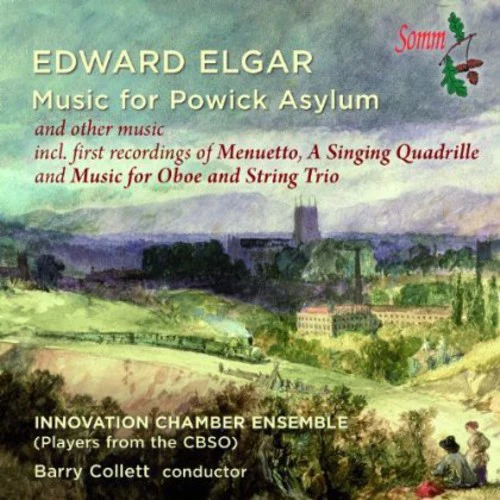
Elgar: Music For Powick Asylum
ELGAR Quadrilles: Die junge Kokette; L’Assomoir; La brunette; Paris; A Singing Quadrille. The Valentine: Five Lancers. Polkas: Maud; Nelly; La Blonde; Helcia; Blumine. Menuetto. Andante and Allegro for Oboe and String Trio. Duett for Trombone and Double Bass. Fugue for Oboe and Violin • Barry Collett, cond; Innovation C Ens; Zoë Beyers (vn); Louise Williams (va); Richard Jenkinson (vc); John Tattersdill (db); Victoria Brawn (ob); Duncan Wilson (trb) • SOMM 252 (76:59)
Back in the 19th century, music therapy was important in a number of what were then called “lunatic asylums.” Gottschalk used to play, with great enthusiasm, at an institution in Utica, New York. And in 1879, the young Elgar was given a position as “Bandmaster” at the Powick Asylum, a couple of miles outside Worcester. His job was to compose dance music for the inmates—and this recording apparently gathers up all the quadrilles, lancers, and polkas that still survive, in editions by Andrew Lyle (who, along with Barry Collett, is also responsible for filling out the sketch score of A Singing Quadrille ).
Given Elgar’s relative inexperience (he was no prodigy), given the utilitarian function of the music, given the seedy, hodge-podge orchestration (limited to friends and colleagues, his ensemble—according to Lyle’s scrupulous notes—consisted of a few violins sometimes supplemented by a viola, a cello, a bass, a piccolo, a flute, a clarinet, two cornets, a euphonium, a bombardon, and a piano) … given the circumstances, you wouldn’t expect to this to be first-rate music. And it isn’t. Nor, despite a measure or two here and there that look ahead, does it give us much sense of the composer to come. If, hearing it without identification, you were asked to guess the origins of the first dance in Die junge Kokette , you’d be apt to guess it a minor chip off Sullivan’s workbench before you’d assign it to Elgar; much of the rest is more anonymous still. Even so, the music—more vital, rhythmically, than much of Elgar’s early output—is dotted with attractive tunes and artful harmonic turns. There are also a fair share of whimsical musical references: The last dance in the set of lancers seems to hint at Gaudeamus Igitur , just as L’Assomoir (Elgar’s misspelling) sounds momentarily as if it were a cousin to Gounod’s Funeral March for a Marionette —and A Singing Quadrille is overtly, and very shrewdly, based on pre-existing material, including nursery rhymes. The disc is filled out with a few chamber works that were not written for Powick—the most interesting is the wacky 1887 “duett” (Elgar’s spelling again) for trombone and double bass, a cheeky minute or so during which the composer delights (as Stravinsky was to do much later in Pulcinella ) in the sheer absurdity of the combination.
Nothing here is especially deep: If the title of L’Assomoir refers to Zola, the music assuredly doesn’t. As a result, you might not want to listen carefully to this whole disc straight through. Still, in small doses, or as background music, it’s got plenty of charm—and this is obviously the place to turn if you’re interested in getting to know it. Yes, Collett recorded most of this music with the Rutland Sinfonia a quarter-century ago. But that disc, which I’ve not heard, is long out of print; and the remakes, based on the new Elgar edition and featuring a snappy group drawn from the City of Birmingham Symphony Orchestra, are as idiomatic as you could want. Add to this the fine engineering and the presence of three first recordings (the Menuetto , the Andante and Allegro , and A Singing Quadrille ), and you have a disc that should attract the more avid of Fanfare ’s Elgarians.
FANFARE: Peter J. Rabinowitz
ELGAR Quadrilles: Die junge Kokette; L’Assomoir; La brunette; Paris; A Singing Quadrille. The Valentine: Five Lancers. Polkas: Maud; Nelly; La Blonde; Helcia; Blumine. Menuetto. Andante and Allegro for Oboe and String Trio. Duett for Trombone and Double Bass. Fugue for Oboe and Violin • Barry Collett, cond; Innovation C Ens; Zoë Beyers (vn); Louise Williams (va); Richard Jenkinson (vc); John Tattersdill (db); Victoria Brawn (ob); Duncan Wilson (trb) • SOMM 252 (76:59)
Back in the 19th century, music therapy was important in a number of what were then called “lunatic asylums.” Gottschalk used to play, with great enthusiasm, at an institution in Utica, New York. And in 1879, the young Elgar was given a position as “Bandmaster” at the Powick Asylum, a couple of miles outside Worcester. His job was to compose dance music for the inmates—and this recording apparently gathers up all the quadrilles, lancers, and polkas that still survive, in editions by Andrew Lyle (who, along with Barry Collett, is also responsible for filling out the sketch score of A Singing Quadrille ).
Given Elgar’s relative inexperience (he was no prodigy), given the utilitarian function of the music, given the seedy, hodge-podge orchestration (limited to friends and colleagues, his ensemble—according to Lyle’s scrupulous notes—consisted of a few violins sometimes supplemented by a viola, a cello, a bass, a piccolo, a flute, a clarinet, two cornets, a euphonium, a bombardon, and a piano) … given the circumstances, you wouldn’t expect to this to be first-rate music. And it isn’t. Nor, despite a measure or two here and there that look ahead, does it give us much sense of the composer to come. If, hearing it without identification, you were asked to guess the origins of the first dance in Die junge Kokette , you’d be apt to guess it a minor chip off Sullivan’s workbench before you’d assign it to Elgar; much of the rest is more anonymous still. Even so, the music—more vital, rhythmically, than much of Elgar’s early output—is dotted with attractive tunes and artful harmonic turns. There are also a fair share of whimsical musical references: The last dance in the set of lancers seems to hint at Gaudeamus Igitur , just as L’Assomoir (Elgar’s misspelling) sounds momentarily as if it were a cousin to Gounod’s Funeral March for a Marionette —and A Singing Quadrille is overtly, and very shrewdly, based on pre-existing material, including nursery rhymes. The disc is filled out with a few chamber works that were not written for Powick—the most interesting is the wacky 1887 “duett” (Elgar’s spelling again) for trombone and double bass, a cheeky minute or so during which the composer delights (as Stravinsky was to do much later in Pulcinella ) in the sheer absurdity of the combination.
Nothing here is especially deep: If the title of L’Assomoir refers to Zola, the music assuredly doesn’t. As a result, you might not want to listen carefully to this whole disc straight through. Still, in small doses, or as background music, it’s got plenty of charm—and this is obviously the place to turn if you’re interested in getting to know it. Yes, Collett recorded most of this music with the Rutland Sinfonia a quarter-century ago. But that disc, which I’ve not heard, is long out of print; and the remakes, based on the new Elgar edition and featuring a snappy group drawn from the City of Birmingham Symphony Orchestra, are as idiomatic as you could want. Add to this the fine engineering and the presence of three first recordings (the Menuetto , the Andante and Allegro , and A Singing Quadrille ), and you have a disc that should attract the more avid of Fanfare ’s Elgarians.
FANFARE: Peter J. Rabinowitz
$7.35
Original: $20.99
-65%Elgar: Music For Powick Asylum—
$20.99
$7.35Description
ELGAR Quadrilles: Die junge Kokette; L’Assomoir; La brunette; Paris; A Singing Quadrille. The Valentine: Five Lancers. Polkas: Maud; Nelly; La Blonde; Helcia; Blumine. Menuetto. Andante and Allegro for Oboe and String Trio. Duett for Trombone and Double Bass. Fugue for Oboe and Violin • Barry Collett, cond; Innovation C Ens; Zoë Beyers (vn); Louise Williams (va); Richard Jenkinson (vc); John Tattersdill (db); Victoria Brawn (ob); Duncan Wilson (trb) • SOMM 252 (76:59)
Back in the 19th century, music therapy was important in a number of what were then called “lunatic asylums.” Gottschalk used to play, with great enthusiasm, at an institution in Utica, New York. And in 1879, the young Elgar was given a position as “Bandmaster” at the Powick Asylum, a couple of miles outside Worcester. His job was to compose dance music for the inmates—and this recording apparently gathers up all the quadrilles, lancers, and polkas that still survive, in editions by Andrew Lyle (who, along with Barry Collett, is also responsible for filling out the sketch score of A Singing Quadrille ).
Given Elgar’s relative inexperience (he was no prodigy), given the utilitarian function of the music, given the seedy, hodge-podge orchestration (limited to friends and colleagues, his ensemble—according to Lyle’s scrupulous notes—consisted of a few violins sometimes supplemented by a viola, a cello, a bass, a piccolo, a flute, a clarinet, two cornets, a euphonium, a bombardon, and a piano) … given the circumstances, you wouldn’t expect to this to be first-rate music. And it isn’t. Nor, despite a measure or two here and there that look ahead, does it give us much sense of the composer to come. If, hearing it without identification, you were asked to guess the origins of the first dance in Die junge Kokette , you’d be apt to guess it a minor chip off Sullivan’s workbench before you’d assign it to Elgar; much of the rest is more anonymous still. Even so, the music—more vital, rhythmically, than much of Elgar’s early output—is dotted with attractive tunes and artful harmonic turns. There are also a fair share of whimsical musical references: The last dance in the set of lancers seems to hint at Gaudeamus Igitur , just as L’Assomoir (Elgar’s misspelling) sounds momentarily as if it were a cousin to Gounod’s Funeral March for a Marionette —and A Singing Quadrille is overtly, and very shrewdly, based on pre-existing material, including nursery rhymes. The disc is filled out with a few chamber works that were not written for Powick—the most interesting is the wacky 1887 “duett” (Elgar’s spelling again) for trombone and double bass, a cheeky minute or so during which the composer delights (as Stravinsky was to do much later in Pulcinella ) in the sheer absurdity of the combination.
Nothing here is especially deep: If the title of L’Assomoir refers to Zola, the music assuredly doesn’t. As a result, you might not want to listen carefully to this whole disc straight through. Still, in small doses, or as background music, it’s got plenty of charm—and this is obviously the place to turn if you’re interested in getting to know it. Yes, Collett recorded most of this music with the Rutland Sinfonia a quarter-century ago. But that disc, which I’ve not heard, is long out of print; and the remakes, based on the new Elgar edition and featuring a snappy group drawn from the City of Birmingham Symphony Orchestra, are as idiomatic as you could want. Add to this the fine engineering and the presence of three first recordings (the Menuetto , the Andante and Allegro , and A Singing Quadrille ), and you have a disc that should attract the more avid of Fanfare ’s Elgarians.
FANFARE: Peter J. Rabinowitz






















