🎉 Up to 70% Off Selected ItemsShop Sale

1 / 2
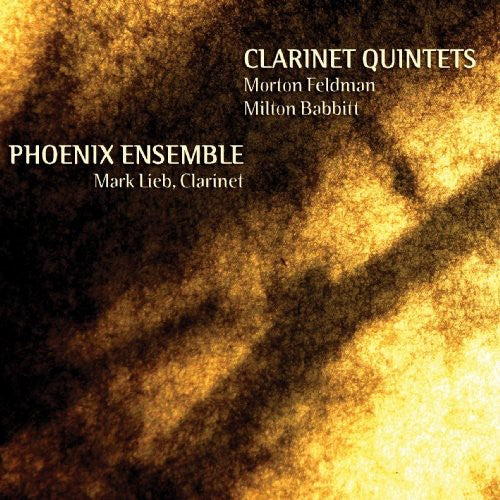
Feldman, Babbitt: Clarinet Quintets / Mark Lieb, Et Al
FELDMAN Clarinet and String Quartet. BABBITT Clarinet Quintet • Mark Lieb (cl); Phoenix Ensemble • INNOVA 746 (62:35)
By reputation, such ideologically distinct composers would seem to be an awkward pairing as discmates—Morton Feldman’s abstract expressionist-influenced, intuitive, repetitively detailed formal design versus Milton Babbitt’s mathematically abstracted, reason-induced, labyrinthine methodology—and yet the individual virtues of each seem to emphasize and illuminate the dramatic character of the other. The contrast between these two works is both revealing and satisfying.
Feldman’s Clarinet and String Quartet (1983) is constructed around repeated, subtly altered, and juxtaposed melodic and textural patterns; the music’s progress is like a stationary view of a single shape (the combined colors and often divided attacks of the clarinet and strings) until it is replaced by a new shape, so there is continual forward motion, but not conventional rhythmic momentum. The effect is not passive, but intently active—the melodic outline expands and contracts, as natural as breathing—circumscribing an emotional voice that is muted, but nevertheless capable of suggesting moments of sadness, inquisitiveness, mystery, and fascination.
Though linked together seamlessly, the patterns of Feldman’s compositional design are on display continuously, so the structure is transparently audible. On the other hand, Babbitt’s Quintet for Clarinet and String Quartet (1996) is swept along on an animated elaboration of melody, and the internal complexity of its form is of no concern. Details drive the music forward—twisting clarinet contours, contrapuntal string maneuvers, an unexpected sequence of pizzicato, sudden dynamic displacements, impulsive bursts of energy. The quintet’s extended linear development is in some ways reminiscent of Babbitt’s teacher, Roger Sessions, and what Sessions derived from Schoenberg, but given added oomph by the verve and scintillation of Babbitt’s wit.
Clarinetist Mark Lieb and his cohorts do a brilliant job in capturing the specific character of such radically different pieces of music. The Babbitt, by the way, receives its premiere recording—one wonders why such an exhilarating piece was neglected for so long. Highly recommended.
FANFARE: Art Lange
Those familiar with Morton Feldman’s music will know what to expect from his Clarinet Quintet: austere minimalist textures, rigorous logical structuring, detached but sonorous consonant chords, repeating but continually set off-kilter by asymmetric time signatures. They might be more surprised by the fact that there is room on the CD for another work, and that the work in question is by Milton Babbitt, a composer at the maximalist end of the American new music spectrum.
In fact, the pairing works very well. The Feldman work is far from ambient and requires the same kind of focused attention that listeners would expect to pay to Babbitt. The Feldman is process music to a degree, yet the processes are regularly subjected to human intervention. Motifs are introduced by, for example, scoring a bar of 5/4 as an accumulating chord, one instrument starting the bar, the next entering on the second beat, and so on until the final note is a chord made up of the motif. It’s a neat way of marrying harmony and melody, and it is far from the only textural device in the work, but all the others are of a similar level of simplicity. The clarinet stands out from the strings although less than you might expect: more of a guiding voice through the textures than a true soloist. Mark Lieb stresses the simplicity of the line in his clarinet playing. His stamina and evenness of tone are remarkable assets here. The work is currently available on two other commercial recordings, one in the Feldman Edition on the Mode label (Mode 119) with clarinettist Carol Robinson, the other on Metier with Roger Heaton (MSV 92082). This recording has the edge over both, thanks to the performance and the sound. Much of the music is at a very low dynamic, and the precision of the recording allows each of the detached, attenuated sounds to appear with the utmost clarity, and from a crystalline silence. Similarly, the disciplined precision of the string quartet is fully attuned to Feldman’s stern aesthetic. The few articulations that he indicates are never exaggerated to the point of disturbing his uneasy, but ultimately unbroken, continuum.
Milton Babbitt’s Quintet for Clarinet and String Quartet is another extended single span of music: a paradoxical combination of expansive form and minutely detailed construction. But much about Milton Babbitt is paradoxical, not least the fact that his career at the cutting edge of serialist Modernism grew out of jazzy and folky roots. According to the liner-notes - and this was news to me - jazz and popular song have always been a part of the composer’s musical psyche. In his early days, he even wrote a Broadway musical entitled Fabulous Voyage. Less surprisingly, Broadway wasn’t interested. The Quintet dates from 1995-6, the far end of the composer’s career, but the jazzy rhythms on the clarinet are an important part of its musical identity. Alex Ross wrote of the work when he heard its premiere that it was ‘a delight to the senses, a fast flow of lovely chords and spry rhythms, a thing of sweetness and light.’ I’m not prepared to go quite that far, but the combination of lively rhythms and widely-spaced chordal textures gives the work a feeling of openness that is often absent from the composer’s more mathematical constructions. The counterpoint is very much in the serialist mould, with spaces in the texture appearing through the seemingly arbitrary and coincidental absences of notes in the individual parts.
If I were to describe the work as an indicator of the composer mellowing with age, it would be with the proviso that even Babbitt’s take on mellowness will seem violently aggressive to most listeners. But it is a rewarding listen, the composer’s ear for timbral and harmonic - or at least vertical - detail shines through in every bar. And there are surprises along the way, continually nudging the listener out of any sense of complacency at having fully digested a texture or contrapuntal construction. As with the Feldman, the formidable difficulties are expertly handled by the ensemble, which is fully attuned to Babbitt’s musical methods, and whose performance here is apparently endorsed by the composer. This is the first commercial recording of the work, and should serve as an excellent benchmark for future performers.
-- Gavin Dixon, MusicWeb International
FELDMAN Clarinet and String Quartet. BABBITT Clarinet Quintet • Mark Lieb (cl); Phoenix Ensemble • INNOVA 746 (62:35)
By reputation, such ideologically distinct composers would seem to be an awkward pairing as discmates—Morton Feldman’s abstract expressionist-influenced, intuitive, repetitively detailed formal design versus Milton Babbitt’s mathematically abstracted, reason-induced, labyrinthine methodology—and yet the individual virtues of each seem to emphasize and illuminate the dramatic character of the other. The contrast between these two works is both revealing and satisfying.
Feldman’s Clarinet and String Quartet (1983) is constructed around repeated, subtly altered, and juxtaposed melodic and textural patterns; the music’s progress is like a stationary view of a single shape (the combined colors and often divided attacks of the clarinet and strings) until it is replaced by a new shape, so there is continual forward motion, but not conventional rhythmic momentum. The effect is not passive, but intently active—the melodic outline expands and contracts, as natural as breathing—circumscribing an emotional voice that is muted, but nevertheless capable of suggesting moments of sadness, inquisitiveness, mystery, and fascination.
Though linked together seamlessly, the patterns of Feldman’s compositional design are on display continuously, so the structure is transparently audible. On the other hand, Babbitt’s Quintet for Clarinet and String Quartet (1996) is swept along on an animated elaboration of melody, and the internal complexity of its form is of no concern. Details drive the music forward—twisting clarinet contours, contrapuntal string maneuvers, an unexpected sequence of pizzicato, sudden dynamic displacements, impulsive bursts of energy. The quintet’s extended linear development is in some ways reminiscent of Babbitt’s teacher, Roger Sessions, and what Sessions derived from Schoenberg, but given added oomph by the verve and scintillation of Babbitt’s wit.
Clarinetist Mark Lieb and his cohorts do a brilliant job in capturing the specific character of such radically different pieces of music. The Babbitt, by the way, receives its premiere recording—one wonders why such an exhilarating piece was neglected for so long. Highly recommended.
FANFARE: Art Lange
Those familiar with Morton Feldman’s music will know what to expect from his Clarinet Quintet: austere minimalist textures, rigorous logical structuring, detached but sonorous consonant chords, repeating but continually set off-kilter by asymmetric time signatures. They might be more surprised by the fact that there is room on the CD for another work, and that the work in question is by Milton Babbitt, a composer at the maximalist end of the American new music spectrum.
In fact, the pairing works very well. The Feldman work is far from ambient and requires the same kind of focused attention that listeners would expect to pay to Babbitt. The Feldman is process music to a degree, yet the processes are regularly subjected to human intervention. Motifs are introduced by, for example, scoring a bar of 5/4 as an accumulating chord, one instrument starting the bar, the next entering on the second beat, and so on until the final note is a chord made up of the motif. It’s a neat way of marrying harmony and melody, and it is far from the only textural device in the work, but all the others are of a similar level of simplicity. The clarinet stands out from the strings although less than you might expect: more of a guiding voice through the textures than a true soloist. Mark Lieb stresses the simplicity of the line in his clarinet playing. His stamina and evenness of tone are remarkable assets here. The work is currently available on two other commercial recordings, one in the Feldman Edition on the Mode label (Mode 119) with clarinettist Carol Robinson, the other on Metier with Roger Heaton (MSV 92082). This recording has the edge over both, thanks to the performance and the sound. Much of the music is at a very low dynamic, and the precision of the recording allows each of the detached, attenuated sounds to appear with the utmost clarity, and from a crystalline silence. Similarly, the disciplined precision of the string quartet is fully attuned to Feldman’s stern aesthetic. The few articulations that he indicates are never exaggerated to the point of disturbing his uneasy, but ultimately unbroken, continuum.
Milton Babbitt’s Quintet for Clarinet and String Quartet is another extended single span of music: a paradoxical combination of expansive form and minutely detailed construction. But much about Milton Babbitt is paradoxical, not least the fact that his career at the cutting edge of serialist Modernism grew out of jazzy and folky roots. According to the liner-notes - and this was news to me - jazz and popular song have always been a part of the composer’s musical psyche. In his early days, he even wrote a Broadway musical entitled Fabulous Voyage. Less surprisingly, Broadway wasn’t interested. The Quintet dates from 1995-6, the far end of the composer’s career, but the jazzy rhythms on the clarinet are an important part of its musical identity. Alex Ross wrote of the work when he heard its premiere that it was ‘a delight to the senses, a fast flow of lovely chords and spry rhythms, a thing of sweetness and light.’ I’m not prepared to go quite that far, but the combination of lively rhythms and widely-spaced chordal textures gives the work a feeling of openness that is often absent from the composer’s more mathematical constructions. The counterpoint is very much in the serialist mould, with spaces in the texture appearing through the seemingly arbitrary and coincidental absences of notes in the individual parts.
If I were to describe the work as an indicator of the composer mellowing with age, it would be with the proviso that even Babbitt’s take on mellowness will seem violently aggressive to most listeners. But it is a rewarding listen, the composer’s ear for timbral and harmonic - or at least vertical - detail shines through in every bar. And there are surprises along the way, continually nudging the listener out of any sense of complacency at having fully digested a texture or contrapuntal construction. As with the Feldman, the formidable difficulties are expertly handled by the ensemble, which is fully attuned to Babbitt’s musical methods, and whose performance here is apparently endorsed by the composer. This is the first commercial recording of the work, and should serve as an excellent benchmark for future performers.
-- Gavin Dixon, MusicWeb International
$5.95
Original: $16.99
-65%Feldman, Babbitt: Clarinet Quintets / Mark Lieb, Et Al—
$16.99
$5.95Description
FELDMAN Clarinet and String Quartet. BABBITT Clarinet Quintet • Mark Lieb (cl); Phoenix Ensemble • INNOVA 746 (62:35)
By reputation, such ideologically distinct composers would seem to be an awkward pairing as discmates—Morton Feldman’s abstract expressionist-influenced, intuitive, repetitively detailed formal design versus Milton Babbitt’s mathematically abstracted, reason-induced, labyrinthine methodology—and yet the individual virtues of each seem to emphasize and illuminate the dramatic character of the other. The contrast between these two works is both revealing and satisfying.
Feldman’s Clarinet and String Quartet (1983) is constructed around repeated, subtly altered, and juxtaposed melodic and textural patterns; the music’s progress is like a stationary view of a single shape (the combined colors and often divided attacks of the clarinet and strings) until it is replaced by a new shape, so there is continual forward motion, but not conventional rhythmic momentum. The effect is not passive, but intently active—the melodic outline expands and contracts, as natural as breathing—circumscribing an emotional voice that is muted, but nevertheless capable of suggesting moments of sadness, inquisitiveness, mystery, and fascination.
Though linked together seamlessly, the patterns of Feldman’s compositional design are on display continuously, so the structure is transparently audible. On the other hand, Babbitt’s Quintet for Clarinet and String Quartet (1996) is swept along on an animated elaboration of melody, and the internal complexity of its form is of no concern. Details drive the music forward—twisting clarinet contours, contrapuntal string maneuvers, an unexpected sequence of pizzicato, sudden dynamic displacements, impulsive bursts of energy. The quintet’s extended linear development is in some ways reminiscent of Babbitt’s teacher, Roger Sessions, and what Sessions derived from Schoenberg, but given added oomph by the verve and scintillation of Babbitt’s wit.
Clarinetist Mark Lieb and his cohorts do a brilliant job in capturing the specific character of such radically different pieces of music. The Babbitt, by the way, receives its premiere recording—one wonders why such an exhilarating piece was neglected for so long. Highly recommended.
FANFARE: Art Lange
Those familiar with Morton Feldman’s music will know what to expect from his Clarinet Quintet: austere minimalist textures, rigorous logical structuring, detached but sonorous consonant chords, repeating but continually set off-kilter by asymmetric time signatures. They might be more surprised by the fact that there is room on the CD for another work, and that the work in question is by Milton Babbitt, a composer at the maximalist end of the American new music spectrum.
In fact, the pairing works very well. The Feldman work is far from ambient and requires the same kind of focused attention that listeners would expect to pay to Babbitt. The Feldman is process music to a degree, yet the processes are regularly subjected to human intervention. Motifs are introduced by, for example, scoring a bar of 5/4 as an accumulating chord, one instrument starting the bar, the next entering on the second beat, and so on until the final note is a chord made up of the motif. It’s a neat way of marrying harmony and melody, and it is far from the only textural device in the work, but all the others are of a similar level of simplicity. The clarinet stands out from the strings although less than you might expect: more of a guiding voice through the textures than a true soloist. Mark Lieb stresses the simplicity of the line in his clarinet playing. His stamina and evenness of tone are remarkable assets here. The work is currently available on two other commercial recordings, one in the Feldman Edition on the Mode label (Mode 119) with clarinettist Carol Robinson, the other on Metier with Roger Heaton (MSV 92082). This recording has the edge over both, thanks to the performance and the sound. Much of the music is at a very low dynamic, and the precision of the recording allows each of the detached, attenuated sounds to appear with the utmost clarity, and from a crystalline silence. Similarly, the disciplined precision of the string quartet is fully attuned to Feldman’s stern aesthetic. The few articulations that he indicates are never exaggerated to the point of disturbing his uneasy, but ultimately unbroken, continuum.
Milton Babbitt’s Quintet for Clarinet and String Quartet is another extended single span of music: a paradoxical combination of expansive form and minutely detailed construction. But much about Milton Babbitt is paradoxical, not least the fact that his career at the cutting edge of serialist Modernism grew out of jazzy and folky roots. According to the liner-notes - and this was news to me - jazz and popular song have always been a part of the composer’s musical psyche. In his early days, he even wrote a Broadway musical entitled Fabulous Voyage. Less surprisingly, Broadway wasn’t interested. The Quintet dates from 1995-6, the far end of the composer’s career, but the jazzy rhythms on the clarinet are an important part of its musical identity. Alex Ross wrote of the work when he heard its premiere that it was ‘a delight to the senses, a fast flow of lovely chords and spry rhythms, a thing of sweetness and light.’ I’m not prepared to go quite that far, but the combination of lively rhythms and widely-spaced chordal textures gives the work a feeling of openness that is often absent from the composer’s more mathematical constructions. The counterpoint is very much in the serialist mould, with spaces in the texture appearing through the seemingly arbitrary and coincidental absences of notes in the individual parts.
If I were to describe the work as an indicator of the composer mellowing with age, it would be with the proviso that even Babbitt’s take on mellowness will seem violently aggressive to most listeners. But it is a rewarding listen, the composer’s ear for timbral and harmonic - or at least vertical - detail shines through in every bar. And there are surprises along the way, continually nudging the listener out of any sense of complacency at having fully digested a texture or contrapuntal construction. As with the Feldman, the formidable difficulties are expertly handled by the ensemble, which is fully attuned to Babbitt’s musical methods, and whose performance here is apparently endorsed by the composer. This is the first commercial recording of the work, and should serve as an excellent benchmark for future performers.
-- Gavin Dixon, MusicWeb International