🎉 Up to 70% Off Selected ItemsShop Sale

1 / 2
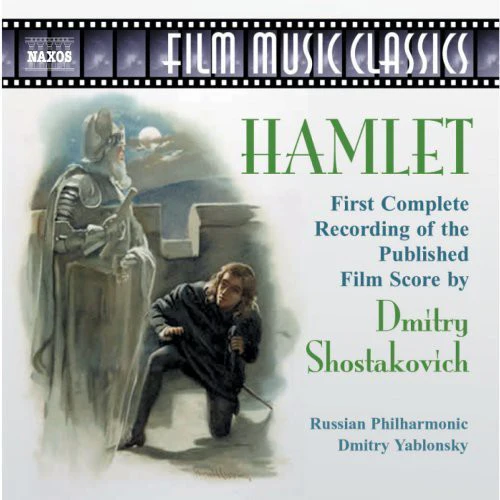
Film Music Classics - Shostakovich: Hamlet / Yablonsky
Shostakovich's film score to Hamlet is one of his finest, possibly because it's a serious film rather than a socialist-realist potboiler, and the composer's moody, mostly spare music supports the action with unfailing accuracy and makes compelling listening on its own. The well-known suite leaves out a lot of music, and while there's inevitably a degree of repetition involved, this complete recording is very welcome for its inclusion of such segments as "Hamlet's Parting from Ophelia", "Hamlet's Monologue", "Ophelia's Descent into Madness", "Hamlet at Ophelia's Grave", and "The Cemetery".
As you may have guessed from the titles, the added music creates a considerably darker overall impression than does the suite, and this in a work that begins with the "whip-crack" motive from the third movement of Shostakovich's not-exactly-jocose Thirteenth Symphony "Babi Yar". So it may not be the most emotionally varied score, but it does sound very Russian and very much like late Shostakovich, and conductor Dmitry Yablonsky treats it accordingly. He and his orchestra bring just as much conviction and intensity (try "The Ghost") as they would to one of the symphonies, and Naxos' sonics are vivid. Be sure, however, to get the regular stereo CD: the SACD is a failure, with way too much stuff coming from the rear channels. Definitely worth owning.
--David Hurwitz, ClassicsToday.com
Full review from FANFARE Magazine:
Shakespeare’s indecisive hero played a persistent role in Shostakovich’s life. In 1932, the composer completed incidental music for a controversial stage production directed by Nikolai Akimov. Five years later, when the Fifth Symphony was completed, some commentators referred to it as the “Hamlet” Symphony because of its brooding and equivocal moods, and the composer himself did not escape comparisons with the great Dane. Given Shostakovich’s sizable experience with film scores, it was only natural for him to write the score to Grigori Kozintsev’s Hamlet in 1964. Over the years, there have been several recordings of the eight-item suite (op. 116a) that Lev Atovmian assembled from the score. This CD, however, appears to be the premiere recording of the complete score, including music that didn’t even make it into the film.
At this juncture, one usually makes the comment that Shostakovich’s film scores do not represent his best work, and that they shouldn’t be considered “typical” of his output. Even though I’ve made them myself, I’ve often found those comments a little condescending, however, and with Hamlet, we have music that is both top-of-the-line and typical of Shostakovich. To put this score in a chronological perspective, it is flanked by the 13th and 14th Symphonies, and it was completed in the same year as the Ninth and 10th String Quartets—hardly bad company! There’s much in Hamlet that is reminiscent of the composer’s very best work from this period. Shostakovich probably could write film music in his sleep, but it is clear that Hamlet engaged his attention and creativity in a very profound way.
Granted, not all the music is brilliant and essential—even 14-second fanfares have been included among these 23 tracks—but there’s much that is worth hearing outside of Atovmian’s suite. For example, the wonderfully eerie “Story of Horatio and the Ghost” might have been an outtake from the first movement of the 11th Symphony, and the five-minute “Hamlet’s Parting from Ophelia” proves once again that a note of music is worth a thousand words. A gently tinkling harpsichord aptly evokes both a courtly atmosphere and Ophelia’s emotional fragility. Hamlet’s music reveals his destructiveness and his nobility. And so it goes. Yes, there is some bombast here, yet it is bombast with a purpose—to evoke the empty pageantry of Claudius’s Elsinore, for example.
Yablonsky not only conducts this music passionately, he also plays it in its proper cinematic order. This is not true of Atovmian’s suite, in which the Players arrive after (!) they perform The Murder of Gonzago. As I suggested above, a few of the shorter cues are intrusive, but all in all, this CD is a satisfying listening experience, no matter what standard of judgment one uses.
Yablonsky is the son of pianist Oxana Yablonskaya, and he is accumulating quite a series of fine recordings for Naxos. Fine-sounding ones too, as the engineering is superb. Thirty years ago, who would have guessed that Russians would be making audiophile recordings in 2003? (I understand that there is an SACD version of this disc, too.)
If I had reviewed this disc a little earlier, I might have put it on my Want List for the year. The music, performances, and engineering are of the highest quality, and I can think of no better way to spend a leaden August (or November!) evening than to play this CD over and over again—which is exactly what I have done.
Raymond Tuttle, FANFARE
Click Here for the complete Naxos Film Music Classic Series
As you may have guessed from the titles, the added music creates a considerably darker overall impression than does the suite, and this in a work that begins with the "whip-crack" motive from the third movement of Shostakovich's not-exactly-jocose Thirteenth Symphony "Babi Yar". So it may not be the most emotionally varied score, but it does sound very Russian and very much like late Shostakovich, and conductor Dmitry Yablonsky treats it accordingly. He and his orchestra bring just as much conviction and intensity (try "The Ghost") as they would to one of the symphonies, and Naxos' sonics are vivid. Be sure, however, to get the regular stereo CD: the SACD is a failure, with way too much stuff coming from the rear channels. Definitely worth owning.
--David Hurwitz, ClassicsToday.com
Full review from FANFARE Magazine:
Shakespeare’s indecisive hero played a persistent role in Shostakovich’s life. In 1932, the composer completed incidental music for a controversial stage production directed by Nikolai Akimov. Five years later, when the Fifth Symphony was completed, some commentators referred to it as the “Hamlet” Symphony because of its brooding and equivocal moods, and the composer himself did not escape comparisons with the great Dane. Given Shostakovich’s sizable experience with film scores, it was only natural for him to write the score to Grigori Kozintsev’s Hamlet in 1964. Over the years, there have been several recordings of the eight-item suite (op. 116a) that Lev Atovmian assembled from the score. This CD, however, appears to be the premiere recording of the complete score, including music that didn’t even make it into the film.
At this juncture, one usually makes the comment that Shostakovich’s film scores do not represent his best work, and that they shouldn’t be considered “typical” of his output. Even though I’ve made them myself, I’ve often found those comments a little condescending, however, and with Hamlet, we have music that is both top-of-the-line and typical of Shostakovich. To put this score in a chronological perspective, it is flanked by the 13th and 14th Symphonies, and it was completed in the same year as the Ninth and 10th String Quartets—hardly bad company! There’s much in Hamlet that is reminiscent of the composer’s very best work from this period. Shostakovich probably could write film music in his sleep, but it is clear that Hamlet engaged his attention and creativity in a very profound way.
Granted, not all the music is brilliant and essential—even 14-second fanfares have been included among these 23 tracks—but there’s much that is worth hearing outside of Atovmian’s suite. For example, the wonderfully eerie “Story of Horatio and the Ghost” might have been an outtake from the first movement of the 11th Symphony, and the five-minute “Hamlet’s Parting from Ophelia” proves once again that a note of music is worth a thousand words. A gently tinkling harpsichord aptly evokes both a courtly atmosphere and Ophelia’s emotional fragility. Hamlet’s music reveals his destructiveness and his nobility. And so it goes. Yes, there is some bombast here, yet it is bombast with a purpose—to evoke the empty pageantry of Claudius’s Elsinore, for example.
Yablonsky not only conducts this music passionately, he also plays it in its proper cinematic order. This is not true of Atovmian’s suite, in which the Players arrive after (!) they perform The Murder of Gonzago. As I suggested above, a few of the shorter cues are intrusive, but all in all, this CD is a satisfying listening experience, no matter what standard of judgment one uses.
Yablonsky is the son of pianist Oxana Yablonskaya, and he is accumulating quite a series of fine recordings for Naxos. Fine-sounding ones too, as the engineering is superb. Thirty years ago, who would have guessed that Russians would be making audiophile recordings in 2003? (I understand that there is an SACD version of this disc, too.)
If I had reviewed this disc a little earlier, I might have put it on my Want List for the year. The music, performances, and engineering are of the highest quality, and I can think of no better way to spend a leaden August (or November!) evening than to play this CD over and over again—which is exactly what I have done.
Raymond Tuttle, FANFARE
Click Here for the complete Naxos Film Music Classic Series
Shostakovich's film score to Hamlet is one of his finest, possibly because it's a serious film rather than a socialist-realist potboiler, and the composer's moody, mostly spare music supports the action with unfailing accuracy and makes compelling listening on its own. The well-known suite leaves out a lot of music, and while there's inevitably a degree of repetition involved, this complete recording is very welcome for its inclusion of such segments as "Hamlet's Parting from Ophelia", "Hamlet's Monologue", "Ophelia's Descent into Madness", "Hamlet at Ophelia's Grave", and "The Cemetery".
As you may have guessed from the titles, the added music creates a considerably darker overall impression than does the suite, and this in a work that begins with the "whip-crack" motive from the third movement of Shostakovich's not-exactly-jocose Thirteenth Symphony "Babi Yar". So it may not be the most emotionally varied score, but it does sound very Russian and very much like late Shostakovich, and conductor Dmitry Yablonsky treats it accordingly. He and his orchestra bring just as much conviction and intensity (try "The Ghost") as they would to one of the symphonies, and Naxos' sonics are vivid. Be sure, however, to get the regular stereo CD: the SACD is a failure, with way too much stuff coming from the rear channels. Definitely worth owning.
--David Hurwitz, ClassicsToday.com
Full review from FANFARE Magazine:
Shakespeare’s indecisive hero played a persistent role in Shostakovich’s life. In 1932, the composer completed incidental music for a controversial stage production directed by Nikolai Akimov. Five years later, when the Fifth Symphony was completed, some commentators referred to it as the “Hamlet” Symphony because of its brooding and equivocal moods, and the composer himself did not escape comparisons with the great Dane. Given Shostakovich’s sizable experience with film scores, it was only natural for him to write the score to Grigori Kozintsev’s Hamlet in 1964. Over the years, there have been several recordings of the eight-item suite (op. 116a) that Lev Atovmian assembled from the score. This CD, however, appears to be the premiere recording of the complete score, including music that didn’t even make it into the film.
At this juncture, one usually makes the comment that Shostakovich’s film scores do not represent his best work, and that they shouldn’t be considered “typical” of his output. Even though I’ve made them myself, I’ve often found those comments a little condescending, however, and with Hamlet, we have music that is both top-of-the-line and typical of Shostakovich. To put this score in a chronological perspective, it is flanked by the 13th and 14th Symphonies, and it was completed in the same year as the Ninth and 10th String Quartets—hardly bad company! There’s much in Hamlet that is reminiscent of the composer’s very best work from this period. Shostakovich probably could write film music in his sleep, but it is clear that Hamlet engaged his attention and creativity in a very profound way.
Granted, not all the music is brilliant and essential—even 14-second fanfares have been included among these 23 tracks—but there’s much that is worth hearing outside of Atovmian’s suite. For example, the wonderfully eerie “Story of Horatio and the Ghost” might have been an outtake from the first movement of the 11th Symphony, and the five-minute “Hamlet’s Parting from Ophelia” proves once again that a note of music is worth a thousand words. A gently tinkling harpsichord aptly evokes both a courtly atmosphere and Ophelia’s emotional fragility. Hamlet’s music reveals his destructiveness and his nobility. And so it goes. Yes, there is some bombast here, yet it is bombast with a purpose—to evoke the empty pageantry of Claudius’s Elsinore, for example.
Yablonsky not only conducts this music passionately, he also plays it in its proper cinematic order. This is not true of Atovmian’s suite, in which the Players arrive after (!) they perform The Murder of Gonzago. As I suggested above, a few of the shorter cues are intrusive, but all in all, this CD is a satisfying listening experience, no matter what standard of judgment one uses.
Yablonsky is the son of pianist Oxana Yablonskaya, and he is accumulating quite a series of fine recordings for Naxos. Fine-sounding ones too, as the engineering is superb. Thirty years ago, who would have guessed that Russians would be making audiophile recordings in 2003? (I understand that there is an SACD version of this disc, too.)
If I had reviewed this disc a little earlier, I might have put it on my Want List for the year. The music, performances, and engineering are of the highest quality, and I can think of no better way to spend a leaden August (or November!) evening than to play this CD over and over again—which is exactly what I have done.
Raymond Tuttle, FANFARE
Click Here for the complete Naxos Film Music Classic Series
As you may have guessed from the titles, the added music creates a considerably darker overall impression than does the suite, and this in a work that begins with the "whip-crack" motive from the third movement of Shostakovich's not-exactly-jocose Thirteenth Symphony "Babi Yar". So it may not be the most emotionally varied score, but it does sound very Russian and very much like late Shostakovich, and conductor Dmitry Yablonsky treats it accordingly. He and his orchestra bring just as much conviction and intensity (try "The Ghost") as they would to one of the symphonies, and Naxos' sonics are vivid. Be sure, however, to get the regular stereo CD: the SACD is a failure, with way too much stuff coming from the rear channels. Definitely worth owning.
--David Hurwitz, ClassicsToday.com
Full review from FANFARE Magazine:
Shakespeare’s indecisive hero played a persistent role in Shostakovich’s life. In 1932, the composer completed incidental music for a controversial stage production directed by Nikolai Akimov. Five years later, when the Fifth Symphony was completed, some commentators referred to it as the “Hamlet” Symphony because of its brooding and equivocal moods, and the composer himself did not escape comparisons with the great Dane. Given Shostakovich’s sizable experience with film scores, it was only natural for him to write the score to Grigori Kozintsev’s Hamlet in 1964. Over the years, there have been several recordings of the eight-item suite (op. 116a) that Lev Atovmian assembled from the score. This CD, however, appears to be the premiere recording of the complete score, including music that didn’t even make it into the film.
At this juncture, one usually makes the comment that Shostakovich’s film scores do not represent his best work, and that they shouldn’t be considered “typical” of his output. Even though I’ve made them myself, I’ve often found those comments a little condescending, however, and with Hamlet, we have music that is both top-of-the-line and typical of Shostakovich. To put this score in a chronological perspective, it is flanked by the 13th and 14th Symphonies, and it was completed in the same year as the Ninth and 10th String Quartets—hardly bad company! There’s much in Hamlet that is reminiscent of the composer’s very best work from this period. Shostakovich probably could write film music in his sleep, but it is clear that Hamlet engaged his attention and creativity in a very profound way.
Granted, not all the music is brilliant and essential—even 14-second fanfares have been included among these 23 tracks—but there’s much that is worth hearing outside of Atovmian’s suite. For example, the wonderfully eerie “Story of Horatio and the Ghost” might have been an outtake from the first movement of the 11th Symphony, and the five-minute “Hamlet’s Parting from Ophelia” proves once again that a note of music is worth a thousand words. A gently tinkling harpsichord aptly evokes both a courtly atmosphere and Ophelia’s emotional fragility. Hamlet’s music reveals his destructiveness and his nobility. And so it goes. Yes, there is some bombast here, yet it is bombast with a purpose—to evoke the empty pageantry of Claudius’s Elsinore, for example.
Yablonsky not only conducts this music passionately, he also plays it in its proper cinematic order. This is not true of Atovmian’s suite, in which the Players arrive after (!) they perform The Murder of Gonzago. As I suggested above, a few of the shorter cues are intrusive, but all in all, this CD is a satisfying listening experience, no matter what standard of judgment one uses.
Yablonsky is the son of pianist Oxana Yablonskaya, and he is accumulating quite a series of fine recordings for Naxos. Fine-sounding ones too, as the engineering is superb. Thirty years ago, who would have guessed that Russians would be making audiophile recordings in 2003? (I understand that there is an SACD version of this disc, too.)
If I had reviewed this disc a little earlier, I might have put it on my Want List for the year. The music, performances, and engineering are of the highest quality, and I can think of no better way to spend a leaden August (or November!) evening than to play this CD over and over again—which is exactly what I have done.
Raymond Tuttle, FANFARE
Click Here for the complete Naxos Film Music Classic Series
$7.00
Original: $19.99
-65%Film Music Classics - Shostakovich: Hamlet / Yablonsky—
$19.99
$7.00Description
Shostakovich's film score to Hamlet is one of his finest, possibly because it's a serious film rather than a socialist-realist potboiler, and the composer's moody, mostly spare music supports the action with unfailing accuracy and makes compelling listening on its own. The well-known suite leaves out a lot of music, and while there's inevitably a degree of repetition involved, this complete recording is very welcome for its inclusion of such segments as "Hamlet's Parting from Ophelia", "Hamlet's Monologue", "Ophelia's Descent into Madness", "Hamlet at Ophelia's Grave", and "The Cemetery".
As you may have guessed from the titles, the added music creates a considerably darker overall impression than does the suite, and this in a work that begins with the "whip-crack" motive from the third movement of Shostakovich's not-exactly-jocose Thirteenth Symphony "Babi Yar". So it may not be the most emotionally varied score, but it does sound very Russian and very much like late Shostakovich, and conductor Dmitry Yablonsky treats it accordingly. He and his orchestra bring just as much conviction and intensity (try "The Ghost") as they would to one of the symphonies, and Naxos' sonics are vivid. Be sure, however, to get the regular stereo CD: the SACD is a failure, with way too much stuff coming from the rear channels. Definitely worth owning.
--David Hurwitz, ClassicsToday.com
Full review from FANFARE Magazine:
Shakespeare’s indecisive hero played a persistent role in Shostakovich’s life. In 1932, the composer completed incidental music for a controversial stage production directed by Nikolai Akimov. Five years later, when the Fifth Symphony was completed, some commentators referred to it as the “Hamlet” Symphony because of its brooding and equivocal moods, and the composer himself did not escape comparisons with the great Dane. Given Shostakovich’s sizable experience with film scores, it was only natural for him to write the score to Grigori Kozintsev’s Hamlet in 1964. Over the years, there have been several recordings of the eight-item suite (op. 116a) that Lev Atovmian assembled from the score. This CD, however, appears to be the premiere recording of the complete score, including music that didn’t even make it into the film.
At this juncture, one usually makes the comment that Shostakovich’s film scores do not represent his best work, and that they shouldn’t be considered “typical” of his output. Even though I’ve made them myself, I’ve often found those comments a little condescending, however, and with Hamlet, we have music that is both top-of-the-line and typical of Shostakovich. To put this score in a chronological perspective, it is flanked by the 13th and 14th Symphonies, and it was completed in the same year as the Ninth and 10th String Quartets—hardly bad company! There’s much in Hamlet that is reminiscent of the composer’s very best work from this period. Shostakovich probably could write film music in his sleep, but it is clear that Hamlet engaged his attention and creativity in a very profound way.
Granted, not all the music is brilliant and essential—even 14-second fanfares have been included among these 23 tracks—but there’s much that is worth hearing outside of Atovmian’s suite. For example, the wonderfully eerie “Story of Horatio and the Ghost” might have been an outtake from the first movement of the 11th Symphony, and the five-minute “Hamlet’s Parting from Ophelia” proves once again that a note of music is worth a thousand words. A gently tinkling harpsichord aptly evokes both a courtly atmosphere and Ophelia’s emotional fragility. Hamlet’s music reveals his destructiveness and his nobility. And so it goes. Yes, there is some bombast here, yet it is bombast with a purpose—to evoke the empty pageantry of Claudius’s Elsinore, for example.
Yablonsky not only conducts this music passionately, he also plays it in its proper cinematic order. This is not true of Atovmian’s suite, in which the Players arrive after (!) they perform The Murder of Gonzago. As I suggested above, a few of the shorter cues are intrusive, but all in all, this CD is a satisfying listening experience, no matter what standard of judgment one uses.
Yablonsky is the son of pianist Oxana Yablonskaya, and he is accumulating quite a series of fine recordings for Naxos. Fine-sounding ones too, as the engineering is superb. Thirty years ago, who would have guessed that Russians would be making audiophile recordings in 2003? (I understand that there is an SACD version of this disc, too.)
If I had reviewed this disc a little earlier, I might have put it on my Want List for the year. The music, performances, and engineering are of the highest quality, and I can think of no better way to spend a leaden August (or November!) evening than to play this CD over and over again—which is exactly what I have done.
Raymond Tuttle, FANFARE
Click Here for the complete Naxos Film Music Classic Series
As you may have guessed from the titles, the added music creates a considerably darker overall impression than does the suite, and this in a work that begins with the "whip-crack" motive from the third movement of Shostakovich's not-exactly-jocose Thirteenth Symphony "Babi Yar". So it may not be the most emotionally varied score, but it does sound very Russian and very much like late Shostakovich, and conductor Dmitry Yablonsky treats it accordingly. He and his orchestra bring just as much conviction and intensity (try "The Ghost") as they would to one of the symphonies, and Naxos' sonics are vivid. Be sure, however, to get the regular stereo CD: the SACD is a failure, with way too much stuff coming from the rear channels. Definitely worth owning.
--David Hurwitz, ClassicsToday.com
Full review from FANFARE Magazine:
Shakespeare’s indecisive hero played a persistent role in Shostakovich’s life. In 1932, the composer completed incidental music for a controversial stage production directed by Nikolai Akimov. Five years later, when the Fifth Symphony was completed, some commentators referred to it as the “Hamlet” Symphony because of its brooding and equivocal moods, and the composer himself did not escape comparisons with the great Dane. Given Shostakovich’s sizable experience with film scores, it was only natural for him to write the score to Grigori Kozintsev’s Hamlet in 1964. Over the years, there have been several recordings of the eight-item suite (op. 116a) that Lev Atovmian assembled from the score. This CD, however, appears to be the premiere recording of the complete score, including music that didn’t even make it into the film.
At this juncture, one usually makes the comment that Shostakovich’s film scores do not represent his best work, and that they shouldn’t be considered “typical” of his output. Even though I’ve made them myself, I’ve often found those comments a little condescending, however, and with Hamlet, we have music that is both top-of-the-line and typical of Shostakovich. To put this score in a chronological perspective, it is flanked by the 13th and 14th Symphonies, and it was completed in the same year as the Ninth and 10th String Quartets—hardly bad company! There’s much in Hamlet that is reminiscent of the composer’s very best work from this period. Shostakovich probably could write film music in his sleep, but it is clear that Hamlet engaged his attention and creativity in a very profound way.
Granted, not all the music is brilliant and essential—even 14-second fanfares have been included among these 23 tracks—but there’s much that is worth hearing outside of Atovmian’s suite. For example, the wonderfully eerie “Story of Horatio and the Ghost” might have been an outtake from the first movement of the 11th Symphony, and the five-minute “Hamlet’s Parting from Ophelia” proves once again that a note of music is worth a thousand words. A gently tinkling harpsichord aptly evokes both a courtly atmosphere and Ophelia’s emotional fragility. Hamlet’s music reveals his destructiveness and his nobility. And so it goes. Yes, there is some bombast here, yet it is bombast with a purpose—to evoke the empty pageantry of Claudius’s Elsinore, for example.
Yablonsky not only conducts this music passionately, he also plays it in its proper cinematic order. This is not true of Atovmian’s suite, in which the Players arrive after (!) they perform The Murder of Gonzago. As I suggested above, a few of the shorter cues are intrusive, but all in all, this CD is a satisfying listening experience, no matter what standard of judgment one uses.
Yablonsky is the son of pianist Oxana Yablonskaya, and he is accumulating quite a series of fine recordings for Naxos. Fine-sounding ones too, as the engineering is superb. Thirty years ago, who would have guessed that Russians would be making audiophile recordings in 2003? (I understand that there is an SACD version of this disc, too.)
If I had reviewed this disc a little earlier, I might have put it on my Want List for the year. The music, performances, and engineering are of the highest quality, and I can think of no better way to spend a leaden August (or November!) evening than to play this CD over and over again—which is exactly what I have done.
Raymond Tuttle, FANFARE
Click Here for the complete Naxos Film Music Classic Series