🎉 Up to 70% Off Selected ItemsShop Sale

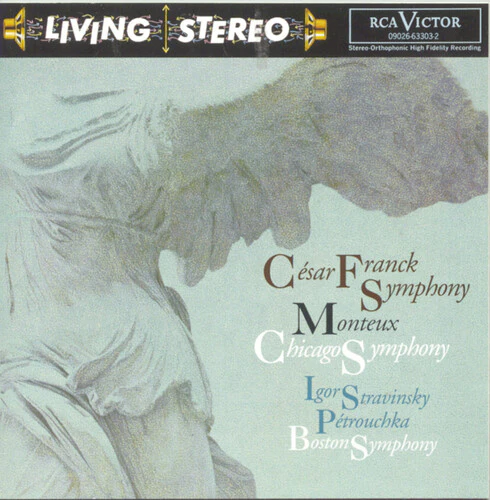
Franck: Symphony; Stravinsky: Petrouchka / Monteux, Et Al
A few decades ago, Franck’s Symphony in D minor was standard repertoire, and every major conductor recorded it. Now, the work’s high romantic sentimentality seems to have fallen out of fashion, and new releases are far less common. Interpretations run the gamut from reasonably strict and “classical”, to totally demented (think: Stokowski). Monteux’s falls decidedly into the “classical” category, but never to the detriment of expressivity.
Consider how he handles the luscious second subject of the first movement, with a singing tone and real urgency, the ensuing accelerando done with passion, excitement, and yes, taste. The Chicago Symphony plays gloriously (this was the Reiner era, let’s not forget), responding to Monteux’s every perfectly judged nuance. It has become fashionable lately to disparage this performance, in addition to dogging the work, but as Tovey once wrote, “All’s not false that’s taught in the public schools.” This recording was the best in its day, both interpretively and sonically, and so it remains 50 years on.
The coupling of Pétrouchka might seem odd–there’s only so much Monteux material available in stereo to RCA, but it’s equally wonderful. Indeed, if I had to choose a single CD to represent the conductor’s art at its best, this would probably be the one. Again, he has a great orchestra at his disposal, one fully at home in the idiom, and he leads a performance at once lovingly detailed but also brilliant and glittering. In the Danse Russe Monteux captures the music’s mechanical, cartoonish qualities to perfection, while the folk dances in the concluding tableau have all the rhythmic bounce and gaiety that one could ask. The sonics are superb even by modern standards. What a joy this disc is!
-- David Hurwitz, ClassicsToday.com
Consider how he handles the luscious second subject of the first movement, with a singing tone and real urgency, the ensuing accelerando done with passion, excitement, and yes, taste. The Chicago Symphony plays gloriously (this was the Reiner era, let’s not forget), responding to Monteux’s every perfectly judged nuance. It has become fashionable lately to disparage this performance, in addition to dogging the work, but as Tovey once wrote, “All’s not false that’s taught in the public schools.” This recording was the best in its day, both interpretively and sonically, and so it remains 50 years on.
The coupling of Pétrouchka might seem odd–there’s only so much Monteux material available in stereo to RCA, but it’s equally wonderful. Indeed, if I had to choose a single CD to represent the conductor’s art at its best, this would probably be the one. Again, he has a great orchestra at his disposal, one fully at home in the idiom, and he leads a performance at once lovingly detailed but also brilliant and glittering. In the Danse Russe Monteux captures the music’s mechanical, cartoonish qualities to perfection, while the folk dances in the concluding tableau have all the rhythmic bounce and gaiety that one could ask. The sonics are superb even by modern standards. What a joy this disc is!
-- David Hurwitz, ClassicsToday.com
A few decades ago, Franck’s Symphony in D minor was standard repertoire, and every major conductor recorded it. Now, the work’s high romantic sentimentality seems to have fallen out of fashion, and new releases are far less common. Interpretations run the gamut from reasonably strict and “classical”, to totally demented (think: Stokowski). Monteux’s falls decidedly into the “classical” category, but never to the detriment of expressivity.
Consider how he handles the luscious second subject of the first movement, with a singing tone and real urgency, the ensuing accelerando done with passion, excitement, and yes, taste. The Chicago Symphony plays gloriously (this was the Reiner era, let’s not forget), responding to Monteux’s every perfectly judged nuance. It has become fashionable lately to disparage this performance, in addition to dogging the work, but as Tovey once wrote, “All’s not false that’s taught in the public schools.” This recording was the best in its day, both interpretively and sonically, and so it remains 50 years on.
The coupling of Pétrouchka might seem odd–there’s only so much Monteux material available in stereo to RCA, but it’s equally wonderful. Indeed, if I had to choose a single CD to represent the conductor’s art at its best, this would probably be the one. Again, he has a great orchestra at his disposal, one fully at home in the idiom, and he leads a performance at once lovingly detailed but also brilliant and glittering. In the Danse Russe Monteux captures the music’s mechanical, cartoonish qualities to perfection, while the folk dances in the concluding tableau have all the rhythmic bounce and gaiety that one could ask. The sonics are superb even by modern standards. What a joy this disc is!
-- David Hurwitz, ClassicsToday.com
Consider how he handles the luscious second subject of the first movement, with a singing tone and real urgency, the ensuing accelerando done with passion, excitement, and yes, taste. The Chicago Symphony plays gloriously (this was the Reiner era, let’s not forget), responding to Monteux’s every perfectly judged nuance. It has become fashionable lately to disparage this performance, in addition to dogging the work, but as Tovey once wrote, “All’s not false that’s taught in the public schools.” This recording was the best in its day, both interpretively and sonically, and so it remains 50 years on.
The coupling of Pétrouchka might seem odd–there’s only so much Monteux material available in stereo to RCA, but it’s equally wonderful. Indeed, if I had to choose a single CD to represent the conductor’s art at its best, this would probably be the one. Again, he has a great orchestra at his disposal, one fully at home in the idiom, and he leads a performance at once lovingly detailed but also brilliant and glittering. In the Danse Russe Monteux captures the music’s mechanical, cartoonish qualities to perfection, while the folk dances in the concluding tableau have all the rhythmic bounce and gaiety that one could ask. The sonics are superb even by modern standards. What a joy this disc is!
-- David Hurwitz, ClassicsToday.com
$8.99
Franck: Symphony; Stravinsky: Petrouchka / Monteux, Et Al—
$8.99
Description
A few decades ago, Franck’s Symphony in D minor was standard repertoire, and every major conductor recorded it. Now, the work’s high romantic sentimentality seems to have fallen out of fashion, and new releases are far less common. Interpretations run the gamut from reasonably strict and “classical”, to totally demented (think: Stokowski). Monteux’s falls decidedly into the “classical” category, but never to the detriment of expressivity.
Consider how he handles the luscious second subject of the first movement, with a singing tone and real urgency, the ensuing accelerando done with passion, excitement, and yes, taste. The Chicago Symphony plays gloriously (this was the Reiner era, let’s not forget), responding to Monteux’s every perfectly judged nuance. It has become fashionable lately to disparage this performance, in addition to dogging the work, but as Tovey once wrote, “All’s not false that’s taught in the public schools.” This recording was the best in its day, both interpretively and sonically, and so it remains 50 years on.
The coupling of Pétrouchka might seem odd–there’s only so much Monteux material available in stereo to RCA, but it’s equally wonderful. Indeed, if I had to choose a single CD to represent the conductor’s art at its best, this would probably be the one. Again, he has a great orchestra at his disposal, one fully at home in the idiom, and he leads a performance at once lovingly detailed but also brilliant and glittering. In the Danse Russe Monteux captures the music’s mechanical, cartoonish qualities to perfection, while the folk dances in the concluding tableau have all the rhythmic bounce and gaiety that one could ask. The sonics are superb even by modern standards. What a joy this disc is!
-- David Hurwitz, ClassicsToday.com
Consider how he handles the luscious second subject of the first movement, with a singing tone and real urgency, the ensuing accelerando done with passion, excitement, and yes, taste. The Chicago Symphony plays gloriously (this was the Reiner era, let’s not forget), responding to Monteux’s every perfectly judged nuance. It has become fashionable lately to disparage this performance, in addition to dogging the work, but as Tovey once wrote, “All’s not false that’s taught in the public schools.” This recording was the best in its day, both interpretively and sonically, and so it remains 50 years on.
The coupling of Pétrouchka might seem odd–there’s only so much Monteux material available in stereo to RCA, but it’s equally wonderful. Indeed, if I had to choose a single CD to represent the conductor’s art at its best, this would probably be the one. Again, he has a great orchestra at his disposal, one fully at home in the idiom, and he leads a performance at once lovingly detailed but also brilliant and glittering. In the Danse Russe Monteux captures the music’s mechanical, cartoonish qualities to perfection, while the folk dances in the concluding tableau have all the rhythmic bounce and gaiety that one could ask. The sonics are superb even by modern standards. What a joy this disc is!
-- David Hurwitz, ClassicsToday.com