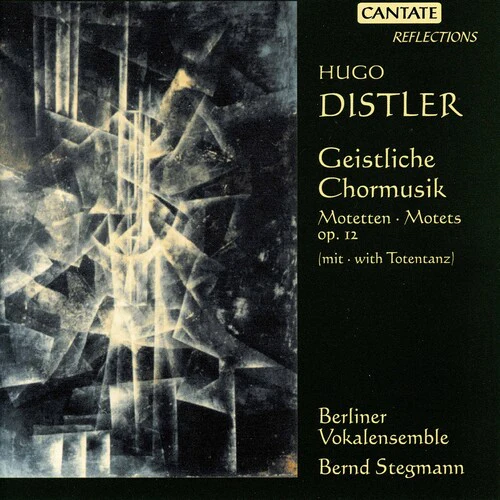
Distler: Geistliche Chormusic - Motets, Op. 12 / Stegmann, Berlin Vocal Ensemble
Nobody has here a lasting place. This line from the spoken text of the Totentanz (Dance of Death) op. 12, No. 2 could serve as the motto for many of Distler’s sacred works. In particular, the motets of the “Geistli che Chormusik” (Sacred Choral Music) op. 12 deal pre dominantly with man’s transiency and his hope for salvation. Only three pieces, not included on the present re cording, deal with other themes. What significance does this all too familiar look at the here after, this “solicitation” for an escape from life have for us? Is this turning away from the world to be emulated, considering that it was set to music by someone who suffered badly from periodically recurring bouts of mental distress, by someone who was unable to deal with the political pressures in a time “in which God has apparently relinquished his power to the Evil One” (Distler), and in the end broke under the strain of this life? That it was not just a matter of inspiring hope in some thing unreachably distant can be seen in the text he wrote for his oratorio “Die Weltalter”: “The human being, in spite of all his faults, at the bottom of his heart still good and strong, summons the arms of the gods... Thus, humanity was saved once again from its imminent down fall through the mercy of the powers above, in that they granted mortals insight into the necessity of an unconditional reconciliation of human beings among them selves, between mankind and all living creatures, and above all between mankind and God.”
Nobody has here a lasting place. This line from the spoken text of the Totentanz (Dance of Death) op. 12, No. 2 could serve as the motto for many of Distler’s sacred works. In particular, the motets of the “Geistli che Chormusik” (Sacred Choral Music) op. 12 deal pre dominantly with man’s transiency and his hope for salvation. Only three pieces, not included on the present re cording, deal with other themes. What significance does this all too familiar look at the here after, this “solicitation” for an escape from life have for us? Is this turning away from the world to be emulated, considering that it was set to music by someone who suffered badly from periodically recurring bouts of mental distress, by someone who was unable to deal with the political pressures in a time “in which God has apparently relinquished his power to the Evil One” (Distler), and in the end broke under the strain of this life? That it was not just a matter of inspiring hope in some thing unreachably distant can be seen in the text he wrote for his oratorio “Die Weltalter”: “The human being, in spite of all his faults, at the bottom of his heart still good and strong, summons the arms of the gods... Thus, humanity was saved once again from its imminent down fall through the mercy of the powers above, in that they granted mortals insight into the necessity of an unconditional reconciliation of human beings among them selves, between mankind and all living creatures, and above all between mankind and God.”
Description
Nobody has here a lasting place. This line from the spoken text of the Totentanz (Dance of Death) op. 12, No. 2 could serve as the motto for many of Distler’s sacred works. In particular, the motets of the “Geistli che Chormusik” (Sacred Choral Music) op. 12 deal pre dominantly with man’s transiency and his hope for salvation. Only three pieces, not included on the present re cording, deal with other themes. What significance does this all too familiar look at the here after, this “solicitation” for an escape from life have for us? Is this turning away from the world to be emulated, considering that it was set to music by someone who suffered badly from periodically recurring bouts of mental distress, by someone who was unable to deal with the political pressures in a time “in which God has apparently relinquished his power to the Evil One” (Distler), and in the end broke under the strain of this life? That it was not just a matter of inspiring hope in some thing unreachably distant can be seen in the text he wrote for his oratorio “Die Weltalter”: “The human being, in spite of all his faults, at the bottom of his heart still good and strong, summons the arms of the gods... Thus, humanity was saved once again from its imminent down fall through the mercy of the powers above, in that they granted mortals insight into the necessity of an unconditional reconciliation of human beings among them selves, between mankind and all living creatures, and above all between mankind and God.”