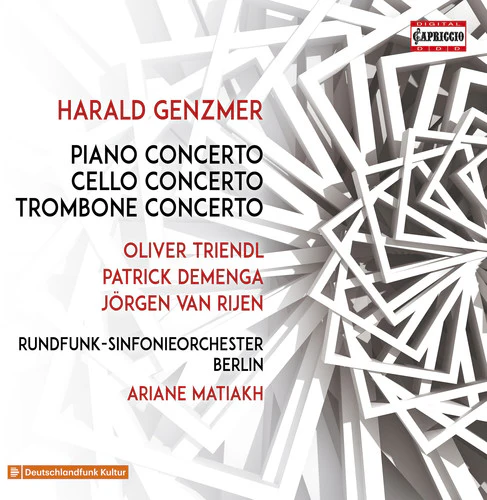
Genzmer: Solo Concertos / Matiakh, Berlin Radio Symphony
Harald Genzmer was a composition pupil of Paul Hindemith in Berlin from 1928 to 1934. Whoever studies Genzmer’s enormous oeuvre in detail will recognize in the pupil’s music many Romantic gestures and a sensual imagination rarely occurring in the teacher’s works. What Genzmer adopted from his mentor was the masterly craftsmanship, an awareness of classicism and form and joy in performing in itself and in the colours of the most differing instruments. The broadly educated scion of an academic family never regarded himself as a genius transcending boundaries, but as the servant of performers and the public: ‘Music should be zestful, artful and comprehensible. As practicable, it may win over the interpreter, and then the listener as graspable’. Musicians have always enjoyed performing Genzmer’s inspired music, which is affectionally adapted to the most varied instrumentations, and are now continuing to do so in increasing measure.
Harald Genzmer was a composition pupil of Paul Hindemith in Berlin from 1928 to 1934. Whoever studies Genzmer’s enormous oeuvre in detail will recognize in the pupil’s music many Romantic gestures and a sensual imagination rarely occurring in the teacher’s works. What Genzmer adopted from his mentor was the masterly craftsmanship, an awareness of classicism and form and joy in performing in itself and in the colours of the most differing instruments. The broadly educated scion of an academic family never regarded himself as a genius transcending boundaries, but as the servant of performers and the public: ‘Music should be zestful, artful and comprehensible. As practicable, it may win over the interpreter, and then the listener as graspable’. Musicians have always enjoyed performing Genzmer’s inspired music, which is affectionally adapted to the most varied instrumentations, and are now continuing to do so in increasing measure.
Original: $16.99
-65%$16.99
$5.95Description
Harald Genzmer was a composition pupil of Paul Hindemith in Berlin from 1928 to 1934. Whoever studies Genzmer’s enormous oeuvre in detail will recognize in the pupil’s music many Romantic gestures and a sensual imagination rarely occurring in the teacher’s works. What Genzmer adopted from his mentor was the masterly craftsmanship, an awareness of classicism and form and joy in performing in itself and in the colours of the most differing instruments. The broadly educated scion of an academic family never regarded himself as a genius transcending boundaries, but as the servant of performers and the public: ‘Music should be zestful, artful and comprehensible. As practicable, it may win over the interpreter, and then the listener as graspable’. Musicians have always enjoyed performing Genzmer’s inspired music, which is affectionally adapted to the most varied instrumentations, and are now continuing to do so in increasing measure.