🎉 Up to 70% Off Selected ItemsShop Sale

1 / 2
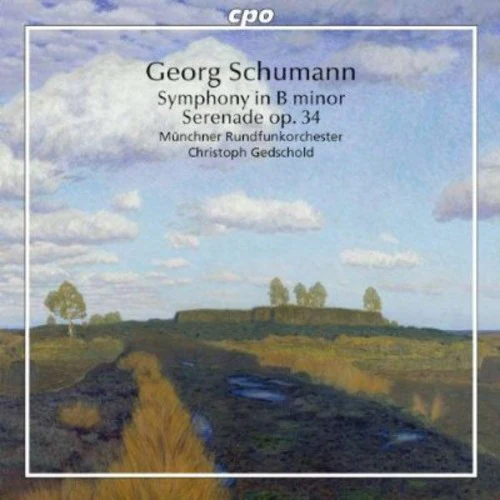
Georg Schumann: Symphony In B Minor; Serenade, Op. 34 / Gedschold, Munich Radio Symphony
G. SCHUMANN Symphony in b. Serenade for Large Orchestra, Op. 34 • Christoph Gedschold, cond; Munich RO • CPO 777464 (73:32)
Having struck pay dirt with another of its exhumations, Georg Schumann—see review of his piano trios in 35: 5—CPO, label of the Long Lost Composers Society—here resurrects Schumann’s Symphony in B Minor and his Serenade, op. 34. Georg Alfred Schumann (1866–1952) is yet another composer that can be added to the list of blue-ribbon winners produced under Carl Reinecke’s tutelage at the Leipzig Conservatory, and the term “blue-ribbon” is not used metaphorically. In 1886, still a student at the conservatory, Schumann composed this B-Minor Symphony, and when he entered it in an orchestral composition competition two years later it took first prize out of 57 entries. It’s doubtful that the award so swelled his head that he actually appended the subtitle, “Prize-winning Symphony” to his score, but CPO does, treating it as if it were a cognomen like “Pathétique” or “The Inextinguishable.” “Oh, have you heard my Symphony in B Minor, the ‘Prize-winning?’”
Schumann’s symphony lends itself to easy description; it’s the Sixth Symphony Mendelssohn might have written had he lived. No disparagement is meant by that. Mendelssohn is the score’s model and its main influence; as much is admitted by the liner note. Even though Mendelssohn was long dead by the time Georg Schumann came to compose his symphony, it’s no surprise that the young composer would pay tribute to the deceased master. It’s both a reflection of Schumann’s youth and the conservative musical training and values fostered by Reinecke and the Leipzig Conservatory, not to mention the reverence accorded Mendelssohn in the very halls of the conservatory he had founded.
While there’s little originality in its pages, Schumann’s symphony is a beautifully written score; its four conventionally laid out movements are filled with tuneful melodies and a mastery of harmony, counterpoint, and orchestration that confirm it as a composition of consummate craft, if not necessarily one of great art. Certainly it can give pleasure and be appreciated by anyone who enjoys mid-19-century Romantic period orchestral works.
The Serenade for Large Orchestra, written around the turn of the century—it was premiered in 1902—is, unsurprisingly, more venturesome in style and musical vocabulary. It’s also unusual in that while more or less adhering to the formal layout of a serenade, the piece is actually a tone poem in five movements, each movement depicting a tableau in the tale of a rejected lover. But if this leads you to expect music of a forlorn, downcast mien, you’re in for a surprise. Schumann’s model now seems to be Richard Strauss’s tone poems. The score is filled with what Schumann describes as “opponents” and “ridiculers” who chirp and chatter away apparently scolding and mocking the lover for whatever he did that got him booted out of the boudoir. The musical effect is not dissimilar to, though nowhere near as barbed as the carping critics in, Strauss’s Ein Heldenleben . Schumann was probably familiar with Strauss’s tone poems, but neither his talent nor his ambition rose to Strauss’s levels of orchestral extravagance and exhibitionism.
Christoph Gedschold leads the Munich Radio Orchestra in convincing performances. I wouldn’t call either the symphony or the serenade a deathless masterpiece, but if you’ve grown a bit jaded listening to the same Romantic period symphonies and tone poems over and over again, here are two new additions to the recorded repertoire that will temporarily relieve your boredom. Recommended.
FANFARE: Jerry Dubins
G. SCHUMANN Symphony in b. Serenade for Large Orchestra, Op. 34 • Christoph Gedschold, cond; Munich RO • CPO 777464 (73:32)
Having struck pay dirt with another of its exhumations, Georg Schumann—see review of his piano trios in 35: 5—CPO, label of the Long Lost Composers Society—here resurrects Schumann’s Symphony in B Minor and his Serenade, op. 34. Georg Alfred Schumann (1866–1952) is yet another composer that can be added to the list of blue-ribbon winners produced under Carl Reinecke’s tutelage at the Leipzig Conservatory, and the term “blue-ribbon” is not used metaphorically. In 1886, still a student at the conservatory, Schumann composed this B-Minor Symphony, and when he entered it in an orchestral composition competition two years later it took first prize out of 57 entries. It’s doubtful that the award so swelled his head that he actually appended the subtitle, “Prize-winning Symphony” to his score, but CPO does, treating it as if it were a cognomen like “Pathétique” or “The Inextinguishable.” “Oh, have you heard my Symphony in B Minor, the ‘Prize-winning?’”
Schumann’s symphony lends itself to easy description; it’s the Sixth Symphony Mendelssohn might have written had he lived. No disparagement is meant by that. Mendelssohn is the score’s model and its main influence; as much is admitted by the liner note. Even though Mendelssohn was long dead by the time Georg Schumann came to compose his symphony, it’s no surprise that the young composer would pay tribute to the deceased master. It’s both a reflection of Schumann’s youth and the conservative musical training and values fostered by Reinecke and the Leipzig Conservatory, not to mention the reverence accorded Mendelssohn in the very halls of the conservatory he had founded.
While there’s little originality in its pages, Schumann’s symphony is a beautifully written score; its four conventionally laid out movements are filled with tuneful melodies and a mastery of harmony, counterpoint, and orchestration that confirm it as a composition of consummate craft, if not necessarily one of great art. Certainly it can give pleasure and be appreciated by anyone who enjoys mid-19-century Romantic period orchestral works.
The Serenade for Large Orchestra, written around the turn of the century—it was premiered in 1902—is, unsurprisingly, more venturesome in style and musical vocabulary. It’s also unusual in that while more or less adhering to the formal layout of a serenade, the piece is actually a tone poem in five movements, each movement depicting a tableau in the tale of a rejected lover. But if this leads you to expect music of a forlorn, downcast mien, you’re in for a surprise. Schumann’s model now seems to be Richard Strauss’s tone poems. The score is filled with what Schumann describes as “opponents” and “ridiculers” who chirp and chatter away apparently scolding and mocking the lover for whatever he did that got him booted out of the boudoir. The musical effect is not dissimilar to, though nowhere near as barbed as the carping critics in, Strauss’s Ein Heldenleben . Schumann was probably familiar with Strauss’s tone poems, but neither his talent nor his ambition rose to Strauss’s levels of orchestral extravagance and exhibitionism.
Christoph Gedschold leads the Munich Radio Orchestra in convincing performances. I wouldn’t call either the symphony or the serenade a deathless masterpiece, but if you’ve grown a bit jaded listening to the same Romantic period symphonies and tone poems over and over again, here are two new additions to the recorded repertoire that will temporarily relieve your boredom. Recommended.
FANFARE: Jerry Dubins
$18.99
Georg Schumann: Symphony In B Minor; Serenade, Op. 34 / Gedschold, Munich Radio Symphony—
$18.99
Description
G. SCHUMANN Symphony in b. Serenade for Large Orchestra, Op. 34 • Christoph Gedschold, cond; Munich RO • CPO 777464 (73:32)
Having struck pay dirt with another of its exhumations, Georg Schumann—see review of his piano trios in 35: 5—CPO, label of the Long Lost Composers Society—here resurrects Schumann’s Symphony in B Minor and his Serenade, op. 34. Georg Alfred Schumann (1866–1952) is yet another composer that can be added to the list of blue-ribbon winners produced under Carl Reinecke’s tutelage at the Leipzig Conservatory, and the term “blue-ribbon” is not used metaphorically. In 1886, still a student at the conservatory, Schumann composed this B-Minor Symphony, and when he entered it in an orchestral composition competition two years later it took first prize out of 57 entries. It’s doubtful that the award so swelled his head that he actually appended the subtitle, “Prize-winning Symphony” to his score, but CPO does, treating it as if it were a cognomen like “Pathétique” or “The Inextinguishable.” “Oh, have you heard my Symphony in B Minor, the ‘Prize-winning?’”
Schumann’s symphony lends itself to easy description; it’s the Sixth Symphony Mendelssohn might have written had he lived. No disparagement is meant by that. Mendelssohn is the score’s model and its main influence; as much is admitted by the liner note. Even though Mendelssohn was long dead by the time Georg Schumann came to compose his symphony, it’s no surprise that the young composer would pay tribute to the deceased master. It’s both a reflection of Schumann’s youth and the conservative musical training and values fostered by Reinecke and the Leipzig Conservatory, not to mention the reverence accorded Mendelssohn in the very halls of the conservatory he had founded.
While there’s little originality in its pages, Schumann’s symphony is a beautifully written score; its four conventionally laid out movements are filled with tuneful melodies and a mastery of harmony, counterpoint, and orchestration that confirm it as a composition of consummate craft, if not necessarily one of great art. Certainly it can give pleasure and be appreciated by anyone who enjoys mid-19-century Romantic period orchestral works.
The Serenade for Large Orchestra, written around the turn of the century—it was premiered in 1902—is, unsurprisingly, more venturesome in style and musical vocabulary. It’s also unusual in that while more or less adhering to the formal layout of a serenade, the piece is actually a tone poem in five movements, each movement depicting a tableau in the tale of a rejected lover. But if this leads you to expect music of a forlorn, downcast mien, you’re in for a surprise. Schumann’s model now seems to be Richard Strauss’s tone poems. The score is filled with what Schumann describes as “opponents” and “ridiculers” who chirp and chatter away apparently scolding and mocking the lover for whatever he did that got him booted out of the boudoir. The musical effect is not dissimilar to, though nowhere near as barbed as the carping critics in, Strauss’s Ein Heldenleben . Schumann was probably familiar with Strauss’s tone poems, but neither his talent nor his ambition rose to Strauss’s levels of orchestral extravagance and exhibitionism.
Christoph Gedschold leads the Munich Radio Orchestra in convincing performances. I wouldn’t call either the symphony or the serenade a deathless masterpiece, but if you’ve grown a bit jaded listening to the same Romantic period symphonies and tone poems over and over again, here are two new additions to the recorded repertoire that will temporarily relieve your boredom. Recommended.
FANFARE: Jerry Dubins