🎉 Up to 70% Off Selected ItemsShop Sale

1 / 2
Gershwin: Complete Music for Piano & Orchestra / McDermott, Brown
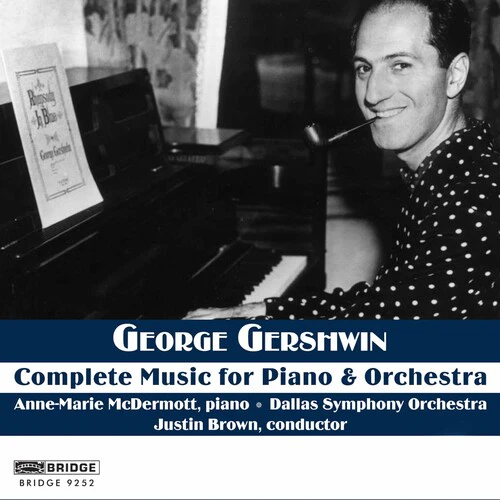
GERSHWIN Rhapsody in Blue. Rhapsody No. 2, “Rhapsody in Rivets.” Variations on “I Got Rhythm.” Piano Concerto in F • Anne-Marie McDermott (pn); Justin Brown, cond; Dallas SO • BRIDGE 9252 (72:53)
Gershwin’s four works for piano and orchestra fit so comfortably on a single CD that it’s surprising how rarely they all show up together. Currently, arkivmusic.com lists only two direct challengers: Sony’s compilation of Levant’s classic but dim-sounding recordings (with the preludes as a bonus) and a Conifer disc with performances by Michael Boriskin, which was tepidly reviewed by Michael Ullman in 22:5. This new Bridge issue, therefore, fills a significant if unexpected discographic gap. Even when held up against less complete collections, though, these classy performances stand high.
On the whole, the performances are characterized by a light (even Gallic) touch, not only on the piano but also in the orchestra, where the brass and percussion are generally kept under control. I don’t want to suggest that McDermott is tame or aloof: with her imaginative articulation and dynamics, coupled with her willingness to tease the rhythms and tone (listen to the Debussian colors before rehearsal 10 in the Concerto’s second movement), she invests the music with plenty of personality. But mercurial though it may be, that personality tends to be suave rather than aggressive, deft rather than determined, snappy rather than assertive. Rarely does she reveal the claws beneath her velvet paws. Thus, for instance, she sets out the big tune in the Rhapsody in Blue with a tenderness that nimbly sidesteps the self-indulgent gush that drowns, say, Leonard Bernstein’s performances; she dances through the climaxes of the Concerto, more apt to impress us with a wink than with a whack; she turns the Second Rhapsody, pushy even under Levant’s sophisticated fingers, into a delectable tin-pan soufflé. Justin Brown is a sympathetic partner, and the orchestra gives us considerable detail without a hint of pedantry (try, as but one example, the nifty upward arpeggio on the bassoon three measures before 7 in the middle movement of the Concerto). Frothy but sassy, these performances will lift your spirits.
I wouldn’t quite say that McDermott sweeps the field. Any lover of Gershwin will want to consider the Levant, too, as well as the Earl Wild/Arthur Fiedler recordings of the Concerto, the Variations , and the Rhapsody in Blue . Jon Nakamatsu’s intently modernist version of the Concerto on Harmonia Mundi (31:1), in state-of-the-art SACD sound, is also well worth knowing. But McDermott’s solidly engineered performances are surely among the front-runners. Enthusiastically recommended.
FANFARE: Peter J. Rabinowitz
GERSHWIN Rhapsody in Blue. Rhapsody No. 2, “Rhapsody in Rivets.” Variations on “I Got Rhythm.” Piano Concerto in F • Anne-Marie McDermott (pn); Justin Brown, cond; Dallas SO • BRIDGE 9252 (72:53)
Gershwin’s four works for piano and orchestra fit so comfortably on a single CD that it’s surprising how rarely they all show up together. Currently, arkivmusic.com lists only two direct challengers: Sony’s compilation of Levant’s classic but dim-sounding recordings (with the preludes as a bonus) and a Conifer disc with performances by Michael Boriskin, which was tepidly reviewed by Michael Ullman in 22:5. This new Bridge issue, therefore, fills a significant if unexpected discographic gap. Even when held up against less complete collections, though, these classy performances stand high.
On the whole, the performances are characterized by a light (even Gallic) touch, not only on the piano but also in the orchestra, where the brass and percussion are generally kept under control. I don’t want to suggest that McDermott is tame or aloof: with her imaginative articulation and dynamics, coupled with her willingness to tease the rhythms and tone (listen to the Debussian colors before rehearsal 10 in the Concerto’s second movement), she invests the music with plenty of personality. But mercurial though it may be, that personality tends to be suave rather than aggressive, deft rather than determined, snappy rather than assertive. Rarely does she reveal the claws beneath her velvet paws. Thus, for instance, she sets out the big tune in the Rhapsody in Blue with a tenderness that nimbly sidesteps the self-indulgent gush that drowns, say, Leonard Bernstein’s performances; she dances through the climaxes of the Concerto, more apt to impress us with a wink than with a whack; she turns the Second Rhapsody, pushy even under Levant’s sophisticated fingers, into a delectable tin-pan soufflé. Justin Brown is a sympathetic partner, and the orchestra gives us considerable detail without a hint of pedantry (try, as but one example, the nifty upward arpeggio on the bassoon three measures before 7 in the middle movement of the Concerto). Frothy but sassy, these performances will lift your spirits.
I wouldn’t quite say that McDermott sweeps the field. Any lover of Gershwin will want to consider the Levant, too, as well as the Earl Wild/Arthur Fiedler recordings of the Concerto, the Variations , and the Rhapsody in Blue . Jon Nakamatsu’s intently modernist version of the Concerto on Harmonia Mundi (31:1), in state-of-the-art SACD sound, is also well worth knowing. But McDermott’s solidly engineered performances are surely among the front-runners. Enthusiastically recommended.
FANFARE: Peter J. Rabinowitz
$18.99
Gershwin: Complete Music for Piano & Orchestra / McDermott, Brown—
$18.99
Description
GERSHWIN Rhapsody in Blue. Rhapsody No. 2, “Rhapsody in Rivets.” Variations on “I Got Rhythm.” Piano Concerto in F • Anne-Marie McDermott (pn); Justin Brown, cond; Dallas SO • BRIDGE 9252 (72:53)
Gershwin’s four works for piano and orchestra fit so comfortably on a single CD that it’s surprising how rarely they all show up together. Currently, arkivmusic.com lists only two direct challengers: Sony’s compilation of Levant’s classic but dim-sounding recordings (with the preludes as a bonus) and a Conifer disc with performances by Michael Boriskin, which was tepidly reviewed by Michael Ullman in 22:5. This new Bridge issue, therefore, fills a significant if unexpected discographic gap. Even when held up against less complete collections, though, these classy performances stand high.
On the whole, the performances are characterized by a light (even Gallic) touch, not only on the piano but also in the orchestra, where the brass and percussion are generally kept under control. I don’t want to suggest that McDermott is tame or aloof: with her imaginative articulation and dynamics, coupled with her willingness to tease the rhythms and tone (listen to the Debussian colors before rehearsal 10 in the Concerto’s second movement), she invests the music with plenty of personality. But mercurial though it may be, that personality tends to be suave rather than aggressive, deft rather than determined, snappy rather than assertive. Rarely does she reveal the claws beneath her velvet paws. Thus, for instance, she sets out the big tune in the Rhapsody in Blue with a tenderness that nimbly sidesteps the self-indulgent gush that drowns, say, Leonard Bernstein’s performances; she dances through the climaxes of the Concerto, more apt to impress us with a wink than with a whack; she turns the Second Rhapsody, pushy even under Levant’s sophisticated fingers, into a delectable tin-pan soufflé. Justin Brown is a sympathetic partner, and the orchestra gives us considerable detail without a hint of pedantry (try, as but one example, the nifty upward arpeggio on the bassoon three measures before 7 in the middle movement of the Concerto). Frothy but sassy, these performances will lift your spirits.
I wouldn’t quite say that McDermott sweeps the field. Any lover of Gershwin will want to consider the Levant, too, as well as the Earl Wild/Arthur Fiedler recordings of the Concerto, the Variations , and the Rhapsody in Blue . Jon Nakamatsu’s intently modernist version of the Concerto on Harmonia Mundi (31:1), in state-of-the-art SACD sound, is also well worth knowing. But McDermott’s solidly engineered performances are surely among the front-runners. Enthusiastically recommended.
FANFARE: Peter J. Rabinowitz