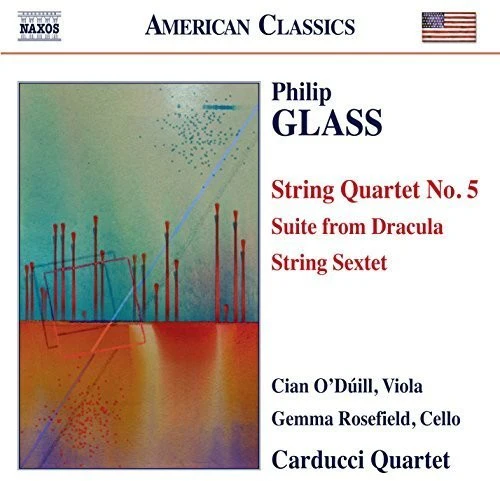
Glass: String Quartet No. 5; Suite from Dracula; String Sextet / Carducci Quartet
Philip Glass’ Fifth String Quartet is the most substantial of his five quartets and the most traditional, using formal structures and expressive contrasts that go far beyond minimalism. While maintaining Glass’ unmistakable personal style, this is a quartet that delivers both driving energy and an unforgettable, threnody-like tenderness. Glass chose a string quartet for his score to the film Dracula to ‘evoke the feeling of the world of the 19th c.’, the music underpinning the film’s visual drama while avoiding obvious ‘horror’ effects. The String Sextet is an arrangement of Glass’s Third Symphony, combining symphonic scale with the intimacy synonymous with the chamber music genre.
REVIEWS:
The Carducci’s performance is imbued with a grainy, almost greyscale patina. In ‘Excellent Mr Renfield’ and ‘Women in White’, moments of eerie anticipation are punctuated by dramatic outbursts. The quartet is joined by Cian O’Dúill (viola) and Gemma Rosefield (cello) for the string sextet arrangement of Glass’s Symphony No 3. Written originally for a 19-piece string orchestra, the Third lends itself well to a chamber setting. There are a few moments when the lines split to one-to-part, but what is lost in weight and depth is more than made up in clarity, focus and forward momentum.
-- Gramophone
…here, at last, is what I’ve awaited. [Carduccis’] performance of the sextet is, hands down, much better than the one with the Glass Chamber Players on Orange Mountain; in fact, I can’t imagine one that could be better. As I think this is one of Glass’s best later compositions, this release warrants immediate purchase. To this there are also just as luminous performances of the Fifth Quartet and a suite from the Dracula score—the latter, again, infinitely more vibrant and passionate than [previous recordings].
-- American Record Guide
Philip Glass’ Fifth String Quartet is the most substantial of his five quartets and the most traditional, using formal structures and expressive contrasts that go far beyond minimalism. While maintaining Glass’ unmistakable personal style, this is a quartet that delivers both driving energy and an unforgettable, threnody-like tenderness. Glass chose a string quartet for his score to the film Dracula to ‘evoke the feeling of the world of the 19th c.’, the music underpinning the film’s visual drama while avoiding obvious ‘horror’ effects. The String Sextet is an arrangement of Glass’s Third Symphony, combining symphonic scale with the intimacy synonymous with the chamber music genre.
REVIEWS:
The Carducci’s performance is imbued with a grainy, almost greyscale patina. In ‘Excellent Mr Renfield’ and ‘Women in White’, moments of eerie anticipation are punctuated by dramatic outbursts. The quartet is joined by Cian O’Dúill (viola) and Gemma Rosefield (cello) for the string sextet arrangement of Glass’s Symphony No 3. Written originally for a 19-piece string orchestra, the Third lends itself well to a chamber setting. There are a few moments when the lines split to one-to-part, but what is lost in weight and depth is more than made up in clarity, focus and forward momentum.
-- Gramophone
…here, at last, is what I’ve awaited. [Carduccis’] performance of the sextet is, hands down, much better than the one with the Glass Chamber Players on Orange Mountain; in fact, I can’t imagine one that could be better. As I think this is one of Glass’s best later compositions, this release warrants immediate purchase. To this there are also just as luminous performances of the Fifth Quartet and a suite from the Dracula score—the latter, again, infinitely more vibrant and passionate than [previous recordings].
-- American Record Guide
Description
Philip Glass’ Fifth String Quartet is the most substantial of his five quartets and the most traditional, using formal structures and expressive contrasts that go far beyond minimalism. While maintaining Glass’ unmistakable personal style, this is a quartet that delivers both driving energy and an unforgettable, threnody-like tenderness. Glass chose a string quartet for his score to the film Dracula to ‘evoke the feeling of the world of the 19th c.’, the music underpinning the film’s visual drama while avoiding obvious ‘horror’ effects. The String Sextet is an arrangement of Glass’s Third Symphony, combining symphonic scale with the intimacy synonymous with the chamber music genre.
REVIEWS:
The Carducci’s performance is imbued with a grainy, almost greyscale patina. In ‘Excellent Mr Renfield’ and ‘Women in White’, moments of eerie anticipation are punctuated by dramatic outbursts. The quartet is joined by Cian O’Dúill (viola) and Gemma Rosefield (cello) for the string sextet arrangement of Glass’s Symphony No 3. Written originally for a 19-piece string orchestra, the Third lends itself well to a chamber setting. There are a few moments when the lines split to one-to-part, but what is lost in weight and depth is more than made up in clarity, focus and forward momentum.
-- Gramophone
…here, at last, is what I’ve awaited. [Carduccis’] performance of the sextet is, hands down, much better than the one with the Glass Chamber Players on Orange Mountain; in fact, I can’t imagine one that could be better. As I think this is one of Glass’s best later compositions, this release warrants immediate purchase. To this there are also just as luminous performances of the Fifth Quartet and a suite from the Dracula score—the latter, again, infinitely more vibrant and passionate than [previous recordings].
-- American Record Guide