Gossec: Thesee / Van Waas, Les Agremens, Namur Chamber Choir
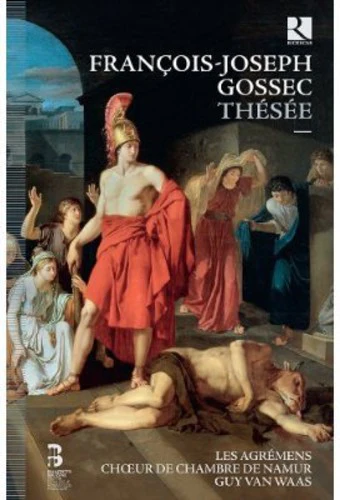
"The father of the symphony"; "bard of the Revolution": these two phrases sufficed to describe Gossec from the beginning of the 19th century onwards and created a reputation for him that musicographers and music historians of the following century made almost unalterable. Gossec had, however, always been interested in the operatic stage, as can be seen from his works in the more modern genre of opéra comique as well as in the more traditional tragédie en musique. Appointed to provide music for the largest musical institutions of his time, Gossec created more than twenty theatrical works; these enjoyed varying degrees of success but nonetheless reveal a dramatic composer of the first water. They were inspired by various sources, the diversity of which can be seen by their titles: Le Périgourdin, Le Tonnelier, Le Faux Lord, Les Pêcheurs, Toinon & Toinette, Le Double Déguisement (opéra comique), Alexis & Daphné, Philémon & Baucis, La Fête de Village (operas in one act), Berthe, Rosine ou l'Épouse abandonnée (opera semiseria), Les Scythes enchaînés (an addition to Gluck's Iphigénie en Tauride), Les Petits Riens, Mirza (ballets in collaboration with Gardel and Noverre), intermezzi for Racine's Athalie and, when the moment arrived, operas of the Revolution such as L'Offrande à la Liberté and Le Triomphe de la République. His operatic masterpieces, however, are indisputably the two tragédies lyriques Sabinus (1773) and Thésée (1782). Thanks to a superb cast and the talent of Guy Van Waas in this repertoire, Gossec's tragedy here reveals its full dramatic power.
"The father of the symphony"; "bard of the Revolution": these two phrases sufficed to describe Gossec from the beginning of the 19th century onwards and created a reputation for him that musicographers and music historians of the following century made almost unalterable. Gossec had, however, always been interested in the operatic stage, as can be seen from his works in the more modern genre of opéra comique as well as in the more traditional tragédie en musique. Appointed to provide music for the largest musical institutions of his time, Gossec created more than twenty theatrical works; these enjoyed varying degrees of success but nonetheless reveal a dramatic composer of the first water. They were inspired by various sources, the diversity of which can be seen by their titles: Le Périgourdin, Le Tonnelier, Le Faux Lord, Les Pêcheurs, Toinon & Toinette, Le Double Déguisement (opéra comique), Alexis & Daphné, Philémon & Baucis, La Fête de Village (operas in one act), Berthe, Rosine ou l'Épouse abandonnée (opera semiseria), Les Scythes enchaînés (an addition to Gluck's Iphigénie en Tauride), Les Petits Riens, Mirza (ballets in collaboration with Gardel and Noverre), intermezzi for Racine's Athalie and, when the moment arrived, operas of the Revolution such as L'Offrande à la Liberté and Le Triomphe de la République. His operatic masterpieces, however, are indisputably the two tragédies lyriques Sabinus (1773) and Thésée (1782). Thanks to a superb cast and the talent of Guy Van Waas in this repertoire, Gossec's tragedy here reveals its full dramatic power.
Description
"The father of the symphony"; "bard of the Revolution": these two phrases sufficed to describe Gossec from the beginning of the 19th century onwards and created a reputation for him that musicographers and music historians of the following century made almost unalterable. Gossec had, however, always been interested in the operatic stage, as can be seen from his works in the more modern genre of opéra comique as well as in the more traditional tragédie en musique. Appointed to provide music for the largest musical institutions of his time, Gossec created more than twenty theatrical works; these enjoyed varying degrees of success but nonetheless reveal a dramatic composer of the first water. They were inspired by various sources, the diversity of which can be seen by their titles: Le Périgourdin, Le Tonnelier, Le Faux Lord, Les Pêcheurs, Toinon & Toinette, Le Double Déguisement (opéra comique), Alexis & Daphné, Philémon & Baucis, La Fête de Village (operas in one act), Berthe, Rosine ou l'Épouse abandonnée (opera semiseria), Les Scythes enchaînés (an addition to Gluck's Iphigénie en Tauride), Les Petits Riens, Mirza (ballets in collaboration with Gardel and Noverre), intermezzi for Racine's Athalie and, when the moment arrived, operas of the Revolution such as L'Offrande à la Liberté and Le Triomphe de la République. His operatic masterpieces, however, are indisputably the two tragédies lyriques Sabinus (1773) and Thésée (1782). Thanks to a superb cast and the talent of Guy Van Waas in this repertoire, Gossec's tragedy here reveals its full dramatic power.