🎉 Up to 70% Off Selected ItemsShop Sale

1 / 2
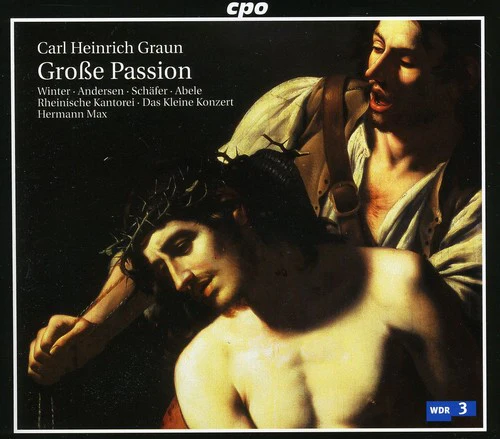
Graun: Grosse Passion / Max, Winter, Andersen, Schafer, Abele, Et Al
GRAUN Grosse Passion • Hermann Max, cond; Veronika Winter (sop); Hilke Andersen (mez); Markus Schäfer (ten); Ekkehard Abele (bbar); Das Kleine Konzert; Rheinische Kantorei (period instruments) • cpo 777 452 (2 CDs: 122:28 Text and Translation) Live: Dusseldorf 9/2008
This is my third exposure to Carl Henrich Graun’s music, the other two being his operas Montezuma (libretto by Friedrich II, King of Prussia) and Cleopatra and Cesare (libretto by Giovanni Gualberto Bottarelli). He is best known for his passion oratorio Der Tod Jesu (1755), which was so popular it rivaled Messiah . Graun wrote two other passions: Ein Lämmlein geht und träght die Schuld and this Grosse Passion that is often referred to by its opening lyric “Kommt her und schaut” (Come here and see). It is a large-scale work: 66 numbers, with some alternatives available, calling for a large chorus and orchestra with the usual quartet of soprano, alto, tenor, bass. Supplementing the recitative-aria combinations are 10 choral numbers, five duets, and one quartet.
The libretto is somewhat of a rambling affair. Unlike Messiah , there are only a few Biblical quotes; instead, the narrative flow is often interrupted by reflections and even some lyrics that are redundant of previously expressed sentiments. Much of the libretto is over-written doggerel, especially in the early pages. The music, however, is a different matter.
Graun was in his mid-twenties when he composed this Grand Passion . It is a surprisingly mature work, full of subtle gems. When first listening to this two-CD album, I wrote: “The music is very pleasant. Although it is quite tuneful, little of it is memorable and at two hours tends to wear out its welcome. There is almost a monotonous similarity of one number to the next. It needs something rousing like the ‘Hallelujah’ chorus.” Repeated hearings of this album have increased my appreciation considerably. Even Handel liked this Passion , and quoted some of its music in his own works.
Graun establishes a musical mood and varies little from it. The music in the Grosse Passion is not as flamboyant as Graun’s operatic work, but careful listening to the Passion reveals a wealth of interesting details, especially in the orchestrations. The textures are very clean and transparent and occasionally command more of the listener’s attention than do the vocal lines. One number (CD 1, track 22, Choral: “Die Lust des Fleisches dämpf in mir”) sounds like a distant cousin to the familiar Doxology, Praise God from whom all blessings flow . Instead of the virtuoso showpieces found in Graun’s operas, the Grosse Passion is very reflective and subdued.
Conductor Hermann Max and his musical forces deliver a sincere and beautifully sung and played performance. The soloists have attractive voices and pay devout attention to the musical details. If you like this musical genre, you’re likely to find this a lovely recording, performed with sensitivity and expression.
FANFARE: David L. Kirk
GRAUN Grosse Passion • Hermann Max, cond; Veronika Winter (sop); Hilke Andersen (mez); Markus Schäfer (ten); Ekkehard Abele (bbar); Das Kleine Konzert; Rheinische Kantorei (period instruments) • cpo 777 452 (2 CDs: 122:28 Text and Translation) Live: Dusseldorf 9/2008
This is my third exposure to Carl Henrich Graun’s music, the other two being his operas Montezuma (libretto by Friedrich II, King of Prussia) and Cleopatra and Cesare (libretto by Giovanni Gualberto Bottarelli). He is best known for his passion oratorio Der Tod Jesu (1755), which was so popular it rivaled Messiah . Graun wrote two other passions: Ein Lämmlein geht und träght die Schuld and this Grosse Passion that is often referred to by its opening lyric “Kommt her und schaut” (Come here and see). It is a large-scale work: 66 numbers, with some alternatives available, calling for a large chorus and orchestra with the usual quartet of soprano, alto, tenor, bass. Supplementing the recitative-aria combinations are 10 choral numbers, five duets, and one quartet.
The libretto is somewhat of a rambling affair. Unlike Messiah , there are only a few Biblical quotes; instead, the narrative flow is often interrupted by reflections and even some lyrics that are redundant of previously expressed sentiments. Much of the libretto is over-written doggerel, especially in the early pages. The music, however, is a different matter.
Graun was in his mid-twenties when he composed this Grand Passion . It is a surprisingly mature work, full of subtle gems. When first listening to this two-CD album, I wrote: “The music is very pleasant. Although it is quite tuneful, little of it is memorable and at two hours tends to wear out its welcome. There is almost a monotonous similarity of one number to the next. It needs something rousing like the ‘Hallelujah’ chorus.” Repeated hearings of this album have increased my appreciation considerably. Even Handel liked this Passion , and quoted some of its music in his own works.
Graun establishes a musical mood and varies little from it. The music in the Grosse Passion is not as flamboyant as Graun’s operatic work, but careful listening to the Passion reveals a wealth of interesting details, especially in the orchestrations. The textures are very clean and transparent and occasionally command more of the listener’s attention than do the vocal lines. One number (CD 1, track 22, Choral: “Die Lust des Fleisches dämpf in mir”) sounds like a distant cousin to the familiar Doxology, Praise God from whom all blessings flow . Instead of the virtuoso showpieces found in Graun’s operas, the Grosse Passion is very reflective and subdued.
Conductor Hermann Max and his musical forces deliver a sincere and beautifully sung and played performance. The soloists have attractive voices and pay devout attention to the musical details. If you like this musical genre, you’re likely to find this a lovely recording, performed with sensitivity and expression.
FANFARE: David L. Kirk
$9.10
Original: $25.99
-65%Graun: Grosse Passion / Max, Winter, Andersen, Schafer, Abele, Et Al—
$25.99
$9.10Description
GRAUN Grosse Passion • Hermann Max, cond; Veronika Winter (sop); Hilke Andersen (mez); Markus Schäfer (ten); Ekkehard Abele (bbar); Das Kleine Konzert; Rheinische Kantorei (period instruments) • cpo 777 452 (2 CDs: 122:28 Text and Translation) Live: Dusseldorf 9/2008
This is my third exposure to Carl Henrich Graun’s music, the other two being his operas Montezuma (libretto by Friedrich II, King of Prussia) and Cleopatra and Cesare (libretto by Giovanni Gualberto Bottarelli). He is best known for his passion oratorio Der Tod Jesu (1755), which was so popular it rivaled Messiah . Graun wrote two other passions: Ein Lämmlein geht und träght die Schuld and this Grosse Passion that is often referred to by its opening lyric “Kommt her und schaut” (Come here and see). It is a large-scale work: 66 numbers, with some alternatives available, calling for a large chorus and orchestra with the usual quartet of soprano, alto, tenor, bass. Supplementing the recitative-aria combinations are 10 choral numbers, five duets, and one quartet.
The libretto is somewhat of a rambling affair. Unlike Messiah , there are only a few Biblical quotes; instead, the narrative flow is often interrupted by reflections and even some lyrics that are redundant of previously expressed sentiments. Much of the libretto is over-written doggerel, especially in the early pages. The music, however, is a different matter.
Graun was in his mid-twenties when he composed this Grand Passion . It is a surprisingly mature work, full of subtle gems. When first listening to this two-CD album, I wrote: “The music is very pleasant. Although it is quite tuneful, little of it is memorable and at two hours tends to wear out its welcome. There is almost a monotonous similarity of one number to the next. It needs something rousing like the ‘Hallelujah’ chorus.” Repeated hearings of this album have increased my appreciation considerably. Even Handel liked this Passion , and quoted some of its music in his own works.
Graun establishes a musical mood and varies little from it. The music in the Grosse Passion is not as flamboyant as Graun’s operatic work, but careful listening to the Passion reveals a wealth of interesting details, especially in the orchestrations. The textures are very clean and transparent and occasionally command more of the listener’s attention than do the vocal lines. One number (CD 1, track 22, Choral: “Die Lust des Fleisches dämpf in mir”) sounds like a distant cousin to the familiar Doxology, Praise God from whom all blessings flow . Instead of the virtuoso showpieces found in Graun’s operas, the Grosse Passion is very reflective and subdued.
Conductor Hermann Max and his musical forces deliver a sincere and beautifully sung and played performance. The soloists have attractive voices and pay devout attention to the musical details. If you like this musical genre, you’re likely to find this a lovely recording, performed with sensitivity and expression.
FANFARE: David L. Kirk