🎉 Up to 70% Off Selected ItemsShop Sale

1 / 2
Gretry: Le Magnifique / Ryan Brown, Opera Lafayette
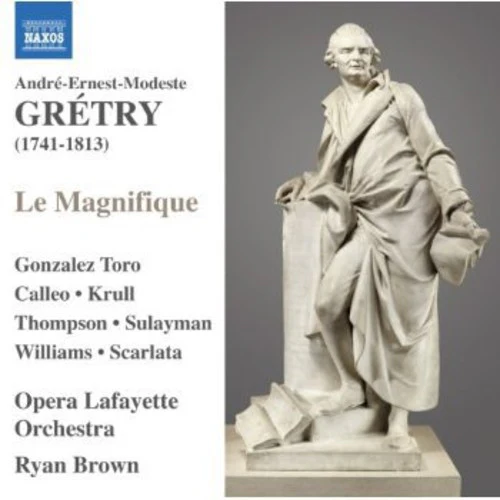
GRÉTRY Le magnifique • Ryan Brown, cond; Emiliano Gonzalez Toro ( Octave, Le Magnifique ); Elizabeth Calleo ( Clémentine ); Jeffrey Thompson ( Aldobrandin ); Karim Sulayman ( Fabio ); Marguerite Krull ( Alix ); Douglas Williams ( Laurence ); Opera Lafayette • NAXOS 8.660305 (80:00)
The operas of André-Ernest-Modeste Grétry, once wildly popular, are virtually unknown today—this is the world premiere recording of this 1773 work—even though his most famous work, Richard Cœur de Lion of 1784 was still occasionally performed in the late 19th century. In order to fit the whole opera on one CD, conductor Ryan Brown and his forces chose to omit all of the spoken dialogue, which some may see as a demerit and others a plus.
This CD production duplicates the cast that Brown used when he gave the modern world premiere of the opera at the Kennedy Center Terrace Theater in February 2011, reviewed by Charles T. Downey in Ionarts. Interestingly, the descriptions of the singers in that review virtually matched my own reaction, particularly the description of soprano Elizabeth Calleo as having “some lovely high notes but an overall vocal production that was tight in the jaw…and sounded a little shallow at the top,” but overall this cast is good.
The plot is a typically silly “rescue” opera mixed up with the usual love triangle. Put as simply as possible, the dashing young Octave, known as “Le Magnifique,” has just rescued the wealthy merchant Horace and his servant Laurence from the slave market where they mysteriously appeared. Meanwhile Horace’s daughter, Clémentine, is being wooed towards marriage by her tutor, Aldobrandin, while Alix, Clémentine’s servant and confidante, has rushed into the street having spotted Laurence (who is also her husband) marching with the slaves. Le Magnifique offers his best racing horse as a free gift to Aldobrandin if he is allowed 15 minutes alone with Clémentine, which the latter agrees to. Clémentine tacitly agrees to marry him, and in the course of time, of course, it is revealed that Aldobrandin and his servant Fabio actually kidnapped Horace and Laurence and sold them into slavery nine years ago. Reunions occur, Aldobrandin is dismissed, and Octave/Magnifique gets the girl.
What makes this opera interesting, however, is the music. Stuck stylistically somewhere between the baroque and classical styles, Le Magnifique has some very innovative and interesting moments, such as the slow march of the slaves which acts as the overture, a splendid duet for Clémentine and Aldobrandin, and a wonderful comic aria for Fabio, who sings of the glories of the horse Octave has promised his master. In fact, there ensues a trio for Octave, Fabio, and Aldobrandin—all of whom, incidentally, are tenors—singing for four minutes of how they’re going to go out and have a look at that horse! (All I could think of at that moment was Mr. Ed. ) By and large, Le Magnifique ’s style is that of a comic opera but, as I say, the style is very forward-looking. It much closer resembles Nicolai’s Merry Wives of Windsor than it does Mozart’s Die Entführung aus dem Serail. I was particularly struck by the musical invention in his extended act II finale, which lasts an astounding 17:22. Not until Mozart wrote the act I finale to Le nozze di Figaro did a composer, particularly in a comic opera, write something even more involved and complex.
All the singers have excellent voices, bright yet full (save Calleo whose voice is not bright on top but constricted). Sulayman has a rather over-bright and somewhat unsteady tenor, but since Fabio is a comic-comprimario role, Sulayman does a good enough job. In fact, his rendering of the “horse aria” is absolutely delightful. Brown conducts with a light, deft hand: He evidently understands the French galante style very well. Despite her slight vocal deficiencies, Calleo is called on to drop an octave into what would be her contralto range in her aria “Quelle contrainte!” Both the first and second acts end with an ensemble for the three tenors (I’m a little surprised that Plácido Domingo never dug this up for his Three Tenors concerts), and here one can discern the tonal difference between their three voices. This recording is an unexpected delight, and I commend both Ryan Brown for his superb musical direction and the foresight of Naxos to record this. Bravo, one and all!
FANFARE: Lynn René Bayley
GRÉTRY Le magnifique • Ryan Brown, cond; Emiliano Gonzalez Toro ( Octave, Le Magnifique ); Elizabeth Calleo ( Clémentine ); Jeffrey Thompson ( Aldobrandin ); Karim Sulayman ( Fabio ); Marguerite Krull ( Alix ); Douglas Williams ( Laurence ); Opera Lafayette • NAXOS 8.660305 (80:00)
The operas of André-Ernest-Modeste Grétry, once wildly popular, are virtually unknown today—this is the world premiere recording of this 1773 work—even though his most famous work, Richard Cœur de Lion of 1784 was still occasionally performed in the late 19th century. In order to fit the whole opera on one CD, conductor Ryan Brown and his forces chose to omit all of the spoken dialogue, which some may see as a demerit and others a plus.
This CD production duplicates the cast that Brown used when he gave the modern world premiere of the opera at the Kennedy Center Terrace Theater in February 2011, reviewed by Charles T. Downey in Ionarts. Interestingly, the descriptions of the singers in that review virtually matched my own reaction, particularly the description of soprano Elizabeth Calleo as having “some lovely high notes but an overall vocal production that was tight in the jaw…and sounded a little shallow at the top,” but overall this cast is good.
The plot is a typically silly “rescue” opera mixed up with the usual love triangle. Put as simply as possible, the dashing young Octave, known as “Le Magnifique,” has just rescued the wealthy merchant Horace and his servant Laurence from the slave market where they mysteriously appeared. Meanwhile Horace’s daughter, Clémentine, is being wooed towards marriage by her tutor, Aldobrandin, while Alix, Clémentine’s servant and confidante, has rushed into the street having spotted Laurence (who is also her husband) marching with the slaves. Le Magnifique offers his best racing horse as a free gift to Aldobrandin if he is allowed 15 minutes alone with Clémentine, which the latter agrees to. Clémentine tacitly agrees to marry him, and in the course of time, of course, it is revealed that Aldobrandin and his servant Fabio actually kidnapped Horace and Laurence and sold them into slavery nine years ago. Reunions occur, Aldobrandin is dismissed, and Octave/Magnifique gets the girl.
What makes this opera interesting, however, is the music. Stuck stylistically somewhere between the baroque and classical styles, Le Magnifique has some very innovative and interesting moments, such as the slow march of the slaves which acts as the overture, a splendid duet for Clémentine and Aldobrandin, and a wonderful comic aria for Fabio, who sings of the glories of the horse Octave has promised his master. In fact, there ensues a trio for Octave, Fabio, and Aldobrandin—all of whom, incidentally, are tenors—singing for four minutes of how they’re going to go out and have a look at that horse! (All I could think of at that moment was Mr. Ed. ) By and large, Le Magnifique ’s style is that of a comic opera but, as I say, the style is very forward-looking. It much closer resembles Nicolai’s Merry Wives of Windsor than it does Mozart’s Die Entführung aus dem Serail. I was particularly struck by the musical invention in his extended act II finale, which lasts an astounding 17:22. Not until Mozart wrote the act I finale to Le nozze di Figaro did a composer, particularly in a comic opera, write something even more involved and complex.
All the singers have excellent voices, bright yet full (save Calleo whose voice is not bright on top but constricted). Sulayman has a rather over-bright and somewhat unsteady tenor, but since Fabio is a comic-comprimario role, Sulayman does a good enough job. In fact, his rendering of the “horse aria” is absolutely delightful. Brown conducts with a light, deft hand: He evidently understands the French galante style very well. Despite her slight vocal deficiencies, Calleo is called on to drop an octave into what would be her contralto range in her aria “Quelle contrainte!” Both the first and second acts end with an ensemble for the three tenors (I’m a little surprised that Plácido Domingo never dug this up for his Three Tenors concerts), and here one can discern the tonal difference between their three voices. This recording is an unexpected delight, and I commend both Ryan Brown for his superb musical direction and the foresight of Naxos to record this. Bravo, one and all!
FANFARE: Lynn René Bayley
$3.50
Original: $9.99
-65%Gretry: Le Magnifique / Ryan Brown, Opera Lafayette—
$9.99
$3.50Description
GRÉTRY Le magnifique • Ryan Brown, cond; Emiliano Gonzalez Toro ( Octave, Le Magnifique ); Elizabeth Calleo ( Clémentine ); Jeffrey Thompson ( Aldobrandin ); Karim Sulayman ( Fabio ); Marguerite Krull ( Alix ); Douglas Williams ( Laurence ); Opera Lafayette • NAXOS 8.660305 (80:00)
The operas of André-Ernest-Modeste Grétry, once wildly popular, are virtually unknown today—this is the world premiere recording of this 1773 work—even though his most famous work, Richard Cœur de Lion of 1784 was still occasionally performed in the late 19th century. In order to fit the whole opera on one CD, conductor Ryan Brown and his forces chose to omit all of the spoken dialogue, which some may see as a demerit and others a plus.
This CD production duplicates the cast that Brown used when he gave the modern world premiere of the opera at the Kennedy Center Terrace Theater in February 2011, reviewed by Charles T. Downey in Ionarts. Interestingly, the descriptions of the singers in that review virtually matched my own reaction, particularly the description of soprano Elizabeth Calleo as having “some lovely high notes but an overall vocal production that was tight in the jaw…and sounded a little shallow at the top,” but overall this cast is good.
The plot is a typically silly “rescue” opera mixed up with the usual love triangle. Put as simply as possible, the dashing young Octave, known as “Le Magnifique,” has just rescued the wealthy merchant Horace and his servant Laurence from the slave market where they mysteriously appeared. Meanwhile Horace’s daughter, Clémentine, is being wooed towards marriage by her tutor, Aldobrandin, while Alix, Clémentine’s servant and confidante, has rushed into the street having spotted Laurence (who is also her husband) marching with the slaves. Le Magnifique offers his best racing horse as a free gift to Aldobrandin if he is allowed 15 minutes alone with Clémentine, which the latter agrees to. Clémentine tacitly agrees to marry him, and in the course of time, of course, it is revealed that Aldobrandin and his servant Fabio actually kidnapped Horace and Laurence and sold them into slavery nine years ago. Reunions occur, Aldobrandin is dismissed, and Octave/Magnifique gets the girl.
What makes this opera interesting, however, is the music. Stuck stylistically somewhere between the baroque and classical styles, Le Magnifique has some very innovative and interesting moments, such as the slow march of the slaves which acts as the overture, a splendid duet for Clémentine and Aldobrandin, and a wonderful comic aria for Fabio, who sings of the glories of the horse Octave has promised his master. In fact, there ensues a trio for Octave, Fabio, and Aldobrandin—all of whom, incidentally, are tenors—singing for four minutes of how they’re going to go out and have a look at that horse! (All I could think of at that moment was Mr. Ed. ) By and large, Le Magnifique ’s style is that of a comic opera but, as I say, the style is very forward-looking. It much closer resembles Nicolai’s Merry Wives of Windsor than it does Mozart’s Die Entführung aus dem Serail. I was particularly struck by the musical invention in his extended act II finale, which lasts an astounding 17:22. Not until Mozart wrote the act I finale to Le nozze di Figaro did a composer, particularly in a comic opera, write something even more involved and complex.
All the singers have excellent voices, bright yet full (save Calleo whose voice is not bright on top but constricted). Sulayman has a rather over-bright and somewhat unsteady tenor, but since Fabio is a comic-comprimario role, Sulayman does a good enough job. In fact, his rendering of the “horse aria” is absolutely delightful. Brown conducts with a light, deft hand: He evidently understands the French galante style very well. Despite her slight vocal deficiencies, Calleo is called on to drop an octave into what would be her contralto range in her aria “Quelle contrainte!” Both the first and second acts end with an ensemble for the three tenors (I’m a little surprised that Plácido Domingo never dug this up for his Three Tenors concerts), and here one can discern the tonal difference between their three voices. This recording is an unexpected delight, and I commend both Ryan Brown for his superb musical direction and the foresight of Naxos to record this. Bravo, one and all!
FANFARE: Lynn René Bayley