🎉 Up to 70% Off Selected ItemsShop Sale

1 / 2
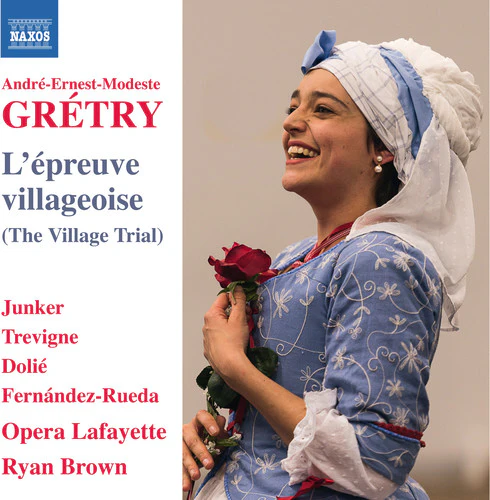
Gretry: L'epreuve villageoise / Brown, Opera Lafayette
Listen to the Naxos Podcast to learn more about this release
L’épreuve villageoise – which, in its original form, was first performed before Marie Antoinette at Versailles - was one of André-Ernest-Modeste Grétry’s most popular works. For a century after its 1784 premiere it enjoyed huge acclaim across Europe and even travelled to the New World, where it captivated audiences in New York. Grétry was a master of eighteenth-century opéra comique and his crisp and lively farce centres on a clever farmer’s daughter and her two competing suitors. Employing divergent stylistic registers – finesse and naiveté, music reminiscent of popular song, and extended ensembles – Grétry fashioned a score of sophisticated wit and huge charm.
-----
REVIEW:
Every so often it’s nice to take a break from operas with deep meanings and just feel like a bit of French royalty at Versailles in 1784, where this sweet, fluffy operetta was first performed. L’épreuve villageoise (The Village Trial) has simple country folk in a sitcom situation: soprano Denise is engaged to tenor André, but his jealousy, recently ignited by the attentions being shown Denise by the more sophisticated Monsieur de la France, is really getting on her nerves.
Soprano Madame Hubert, Denise’s mother, until recently was being wooed by de la France, so mother and daughter plot to get back at both men. Denise pretends to care for de la France and André claims to have found another girlfriend, which makes Denise sad and reflective (in a lovely aria). She then overhears de la France tell the town’s finer ladies that he has found a “rural” girl, and this angers her and her mother. Denise publicly denounces de la France and he leaves, making way for André and Denise to live a jolly life. Dancing ensues.
Sophie Junker’s bright voice is ideal for Denise; Talise Trevigne’s more darkly colored tone gives Mme Hubert a certain wisdom. Thomas Dolié sings with “attitude” and a fine baritone, while André is sung by a rather timid Francisco Fernandez-Rueda.
Nothing here will change your life, and you’ll be happy to learn that all we get on this 54-minute CD is the opera’s music, shorn of its spoken dialogue. There are two fine ensembles and a duet or two. Nothing outstays its welcome. A bon-bon, nothing deep, that’s good for you. Ryan Brown leads his Opera Lafayette–24 strong, with lovely flutes–and small chorus spiritedly.
– ClassicsToday (Robert Levine)
L’épreuve villageoise – which, in its original form, was first performed before Marie Antoinette at Versailles - was one of André-Ernest-Modeste Grétry’s most popular works. For a century after its 1784 premiere it enjoyed huge acclaim across Europe and even travelled to the New World, where it captivated audiences in New York. Grétry was a master of eighteenth-century opéra comique and his crisp and lively farce centres on a clever farmer’s daughter and her two competing suitors. Employing divergent stylistic registers – finesse and naiveté, music reminiscent of popular song, and extended ensembles – Grétry fashioned a score of sophisticated wit and huge charm.
-----
REVIEW:
Every so often it’s nice to take a break from operas with deep meanings and just feel like a bit of French royalty at Versailles in 1784, where this sweet, fluffy operetta was first performed. L’épreuve villageoise (The Village Trial) has simple country folk in a sitcom situation: soprano Denise is engaged to tenor André, but his jealousy, recently ignited by the attentions being shown Denise by the more sophisticated Monsieur de la France, is really getting on her nerves.
Soprano Madame Hubert, Denise’s mother, until recently was being wooed by de la France, so mother and daughter plot to get back at both men. Denise pretends to care for de la France and André claims to have found another girlfriend, which makes Denise sad and reflective (in a lovely aria). She then overhears de la France tell the town’s finer ladies that he has found a “rural” girl, and this angers her and her mother. Denise publicly denounces de la France and he leaves, making way for André and Denise to live a jolly life. Dancing ensues.
Sophie Junker’s bright voice is ideal for Denise; Talise Trevigne’s more darkly colored tone gives Mme Hubert a certain wisdom. Thomas Dolié sings with “attitude” and a fine baritone, while André is sung by a rather timid Francisco Fernandez-Rueda.
Nothing here will change your life, and you’ll be happy to learn that all we get on this 54-minute CD is the opera’s music, shorn of its spoken dialogue. There are two fine ensembles and a duet or two. Nothing outstays its welcome. A bon-bon, nothing deep, that’s good for you. Ryan Brown leads his Opera Lafayette–24 strong, with lovely flutes–and small chorus spiritedly.
– ClassicsToday (Robert Levine)
Listen to the Naxos Podcast to learn more about this release
L’épreuve villageoise – which, in its original form, was first performed before Marie Antoinette at Versailles - was one of André-Ernest-Modeste Grétry’s most popular works. For a century after its 1784 premiere it enjoyed huge acclaim across Europe and even travelled to the New World, where it captivated audiences in New York. Grétry was a master of eighteenth-century opéra comique and his crisp and lively farce centres on a clever farmer’s daughter and her two competing suitors. Employing divergent stylistic registers – finesse and naiveté, music reminiscent of popular song, and extended ensembles – Grétry fashioned a score of sophisticated wit and huge charm.
-----
REVIEW:
Every so often it’s nice to take a break from operas with deep meanings and just feel like a bit of French royalty at Versailles in 1784, where this sweet, fluffy operetta was first performed. L’épreuve villageoise (The Village Trial) has simple country folk in a sitcom situation: soprano Denise is engaged to tenor André, but his jealousy, recently ignited by the attentions being shown Denise by the more sophisticated Monsieur de la France, is really getting on her nerves.
Soprano Madame Hubert, Denise’s mother, until recently was being wooed by de la France, so mother and daughter plot to get back at both men. Denise pretends to care for de la France and André claims to have found another girlfriend, which makes Denise sad and reflective (in a lovely aria). She then overhears de la France tell the town’s finer ladies that he has found a “rural” girl, and this angers her and her mother. Denise publicly denounces de la France and he leaves, making way for André and Denise to live a jolly life. Dancing ensues.
Sophie Junker’s bright voice is ideal for Denise; Talise Trevigne’s more darkly colored tone gives Mme Hubert a certain wisdom. Thomas Dolié sings with “attitude” and a fine baritone, while André is sung by a rather timid Francisco Fernandez-Rueda.
Nothing here will change your life, and you’ll be happy to learn that all we get on this 54-minute CD is the opera’s music, shorn of its spoken dialogue. There are two fine ensembles and a duet or two. Nothing outstays its welcome. A bon-bon, nothing deep, that’s good for you. Ryan Brown leads his Opera Lafayette–24 strong, with lovely flutes–and small chorus spiritedly.
– ClassicsToday (Robert Levine)
L’épreuve villageoise – which, in its original form, was first performed before Marie Antoinette at Versailles - was one of André-Ernest-Modeste Grétry’s most popular works. For a century after its 1784 premiere it enjoyed huge acclaim across Europe and even travelled to the New World, where it captivated audiences in New York. Grétry was a master of eighteenth-century opéra comique and his crisp and lively farce centres on a clever farmer’s daughter and her two competing suitors. Employing divergent stylistic registers – finesse and naiveté, music reminiscent of popular song, and extended ensembles – Grétry fashioned a score of sophisticated wit and huge charm.
-----
REVIEW:
Every so often it’s nice to take a break from operas with deep meanings and just feel like a bit of French royalty at Versailles in 1784, where this sweet, fluffy operetta was first performed. L’épreuve villageoise (The Village Trial) has simple country folk in a sitcom situation: soprano Denise is engaged to tenor André, but his jealousy, recently ignited by the attentions being shown Denise by the more sophisticated Monsieur de la France, is really getting on her nerves.
Soprano Madame Hubert, Denise’s mother, until recently was being wooed by de la France, so mother and daughter plot to get back at both men. Denise pretends to care for de la France and André claims to have found another girlfriend, which makes Denise sad and reflective (in a lovely aria). She then overhears de la France tell the town’s finer ladies that he has found a “rural” girl, and this angers her and her mother. Denise publicly denounces de la France and he leaves, making way for André and Denise to live a jolly life. Dancing ensues.
Sophie Junker’s bright voice is ideal for Denise; Talise Trevigne’s more darkly colored tone gives Mme Hubert a certain wisdom. Thomas Dolié sings with “attitude” and a fine baritone, while André is sung by a rather timid Francisco Fernandez-Rueda.
Nothing here will change your life, and you’ll be happy to learn that all we get on this 54-minute CD is the opera’s music, shorn of its spoken dialogue. There are two fine ensembles and a duet or two. Nothing outstays its welcome. A bon-bon, nothing deep, that’s good for you. Ryan Brown leads his Opera Lafayette–24 strong, with lovely flutes–and small chorus spiritedly.
– ClassicsToday (Robert Levine)
$3.50
Original: $9.99
-65%Gretry: L'epreuve villageoise / Brown, Opera Lafayette—
$9.99
$3.50Description
Listen to the Naxos Podcast to learn more about this release
L’épreuve villageoise – which, in its original form, was first performed before Marie Antoinette at Versailles - was one of André-Ernest-Modeste Grétry’s most popular works. For a century after its 1784 premiere it enjoyed huge acclaim across Europe and even travelled to the New World, where it captivated audiences in New York. Grétry was a master of eighteenth-century opéra comique and his crisp and lively farce centres on a clever farmer’s daughter and her two competing suitors. Employing divergent stylistic registers – finesse and naiveté, music reminiscent of popular song, and extended ensembles – Grétry fashioned a score of sophisticated wit and huge charm.
-----
REVIEW:
Every so often it’s nice to take a break from operas with deep meanings and just feel like a bit of French royalty at Versailles in 1784, where this sweet, fluffy operetta was first performed. L’épreuve villageoise (The Village Trial) has simple country folk in a sitcom situation: soprano Denise is engaged to tenor André, but his jealousy, recently ignited by the attentions being shown Denise by the more sophisticated Monsieur de la France, is really getting on her nerves.
Soprano Madame Hubert, Denise’s mother, until recently was being wooed by de la France, so mother and daughter plot to get back at both men. Denise pretends to care for de la France and André claims to have found another girlfriend, which makes Denise sad and reflective (in a lovely aria). She then overhears de la France tell the town’s finer ladies that he has found a “rural” girl, and this angers her and her mother. Denise publicly denounces de la France and he leaves, making way for André and Denise to live a jolly life. Dancing ensues.
Sophie Junker’s bright voice is ideal for Denise; Talise Trevigne’s more darkly colored tone gives Mme Hubert a certain wisdom. Thomas Dolié sings with “attitude” and a fine baritone, while André is sung by a rather timid Francisco Fernandez-Rueda.
Nothing here will change your life, and you’ll be happy to learn that all we get on this 54-minute CD is the opera’s music, shorn of its spoken dialogue. There are two fine ensembles and a duet or two. Nothing outstays its welcome. A bon-bon, nothing deep, that’s good for you. Ryan Brown leads his Opera Lafayette–24 strong, with lovely flutes–and small chorus spiritedly.
– ClassicsToday (Robert Levine)
L’épreuve villageoise – which, in its original form, was first performed before Marie Antoinette at Versailles - was one of André-Ernest-Modeste Grétry’s most popular works. For a century after its 1784 premiere it enjoyed huge acclaim across Europe and even travelled to the New World, where it captivated audiences in New York. Grétry was a master of eighteenth-century opéra comique and his crisp and lively farce centres on a clever farmer’s daughter and her two competing suitors. Employing divergent stylistic registers – finesse and naiveté, music reminiscent of popular song, and extended ensembles – Grétry fashioned a score of sophisticated wit and huge charm.
-----
REVIEW:
Every so often it’s nice to take a break from operas with deep meanings and just feel like a bit of French royalty at Versailles in 1784, where this sweet, fluffy operetta was first performed. L’épreuve villageoise (The Village Trial) has simple country folk in a sitcom situation: soprano Denise is engaged to tenor André, but his jealousy, recently ignited by the attentions being shown Denise by the more sophisticated Monsieur de la France, is really getting on her nerves.
Soprano Madame Hubert, Denise’s mother, until recently was being wooed by de la France, so mother and daughter plot to get back at both men. Denise pretends to care for de la France and André claims to have found another girlfriend, which makes Denise sad and reflective (in a lovely aria). She then overhears de la France tell the town’s finer ladies that he has found a “rural” girl, and this angers her and her mother. Denise publicly denounces de la France and he leaves, making way for André and Denise to live a jolly life. Dancing ensues.
Sophie Junker’s bright voice is ideal for Denise; Talise Trevigne’s more darkly colored tone gives Mme Hubert a certain wisdom. Thomas Dolié sings with “attitude” and a fine baritone, while André is sung by a rather timid Francisco Fernandez-Rueda.
Nothing here will change your life, and you’ll be happy to learn that all we get on this 54-minute CD is the opera’s music, shorn of its spoken dialogue. There are two fine ensembles and a duet or two. Nothing outstays its welcome. A bon-bon, nothing deep, that’s good for you. Ryan Brown leads his Opera Lafayette–24 strong, with lovely flutes–and small chorus spiritedly.
– ClassicsToday (Robert Levine)