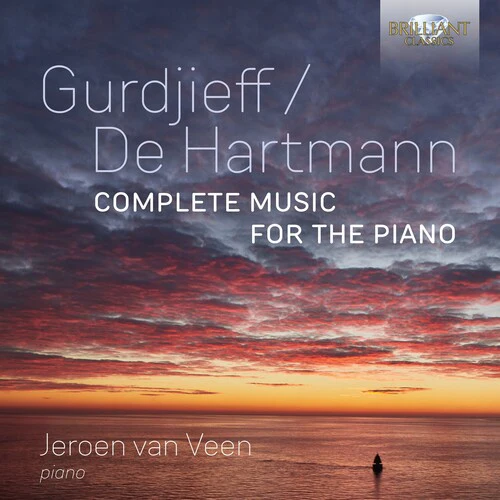
Gurdjieff, De Hartmann: Complete Music for the Piano / Veen
The Ukrainian composer Thomas De Hartmann (1885-1956) had undertaken a classic musical training with Anton Arensky and then Nikolai Taneyev before the death of his mother in 1912 prompted him to begin searching for a spiritual teacher. Four years later he made the encounter that would change his life, with the Armenian philosopher and mystic George Gurdjieff (1877-1949). Gurdjieff had his own musical training, as well as a sharp ear and retentive memory for the folk melodies which he heard on his long travels through central Asia and the middle East. De Hartmann and his wife joined Gurdjieff’s circle of followers, and the two men began to write music to accompany their spiritual exercises. This body of music eventually amounted to around 300 short pieces, of which the indefatigable Jeroen van Veen has recorded the entire published corpus of 170 divided into four volumes.
During lockdown, Jeroen van Veen found himself with the time to immerse himself in this music, which ranges across Asian, Arabic and European systems of rhythm, harmony and tuning, so that he could capture its perfumed mysticism and improvisational character. There are solemn hymns of an Orthodox nobility, atmospheric tone poems such as the ‘Night Procession’, freely pianistic transcriptions of melodies from early-Christian sects such as the Essenes, modal-pentatonic melodies to accompany a ‘Sacred Reading from the Koran’ and to aid an awakening of consciousness in an elevated state of awareness, and then pieces simply titled after their date of composition. While overall meditative in mood, there is a tremendous variety to the Gurdjieff/De Hartmann collection, and Jeroen van Veen’s new recording is an ideally comprehensive way to dive into its riches.
REVIEW:
One can approach these pieces as being parallel to the Magyar folk music that Bartók and Kodály collected in the early 20th century and used as a basis for their own music, except that for the most part Gurdjieff and de Hartmann tried to keep the tunes intact as they stood and didn’t try to develop them in a standard Western classical manner.
Taken a few pieces at a time, the music isn’t bad to listen to, but prolonged exposure to the whole six CDs can bore the more imaginative listener. Despite the intriguing Eastern harmonies, the music is repetitive and tiresome. This is not van Veen’s fault; he is a splendid pianist who plays the slow pieces with great atmosphere and the quicker ones with a lively rhythm; he does his best to engage your interest, and there are certainly some very cute and interesting pieces in this collection, but the lack of any development and the unvarying rhythm of each piece eventually take their toll on the listener. If there is such a thing as high quality background music, this is it. I would also recommend this music in the main as an aid to meditation so long as you realize that every so often there are upbeat numbers in the set and this may spoil your getting deeper into yourself (CD 2 has the most uptempo music).
Of course, the real value of this set is to give a pianist, professional or amateur, who may wish to play some of these pieces the chance to hear them performed. There are other recordings out there of some of this repertoire, but having it all in one place is clearly helpful. A second pianist, Daff by Van Veen, plays with Jeroen on nine numbers if Series II of the Asian Songs and Rhythms, five pieces in Music of the Sayyids and Dervishes First Series, and a few other pieces thereafter.
-- The Art Music Lounge (Lynn René Bayley)
The Ukrainian composer Thomas De Hartmann (1885-1956) had undertaken a classic musical training with Anton Arensky and then Nikolai Taneyev before the death of his mother in 1912 prompted him to begin searching for a spiritual teacher. Four years later he made the encounter that would change his life, with the Armenian philosopher and mystic George Gurdjieff (1877-1949). Gurdjieff had his own musical training, as well as a sharp ear and retentive memory for the folk melodies which he heard on his long travels through central Asia and the middle East. De Hartmann and his wife joined Gurdjieff’s circle of followers, and the two men began to write music to accompany their spiritual exercises. This body of music eventually amounted to around 300 short pieces, of which the indefatigable Jeroen van Veen has recorded the entire published corpus of 170 divided into four volumes.
During lockdown, Jeroen van Veen found himself with the time to immerse himself in this music, which ranges across Asian, Arabic and European systems of rhythm, harmony and tuning, so that he could capture its perfumed mysticism and improvisational character. There are solemn hymns of an Orthodox nobility, atmospheric tone poems such as the ‘Night Procession’, freely pianistic transcriptions of melodies from early-Christian sects such as the Essenes, modal-pentatonic melodies to accompany a ‘Sacred Reading from the Koran’ and to aid an awakening of consciousness in an elevated state of awareness, and then pieces simply titled after their date of composition. While overall meditative in mood, there is a tremendous variety to the Gurdjieff/De Hartmann collection, and Jeroen van Veen’s new recording is an ideally comprehensive way to dive into its riches.
REVIEW:
One can approach these pieces as being parallel to the Magyar folk music that Bartók and Kodály collected in the early 20th century and used as a basis for their own music, except that for the most part Gurdjieff and de Hartmann tried to keep the tunes intact as they stood and didn’t try to develop them in a standard Western classical manner.
Taken a few pieces at a time, the music isn’t bad to listen to, but prolonged exposure to the whole six CDs can bore the more imaginative listener. Despite the intriguing Eastern harmonies, the music is repetitive and tiresome. This is not van Veen’s fault; he is a splendid pianist who plays the slow pieces with great atmosphere and the quicker ones with a lively rhythm; he does his best to engage your interest, and there are certainly some very cute and interesting pieces in this collection, but the lack of any development and the unvarying rhythm of each piece eventually take their toll on the listener. If there is such a thing as high quality background music, this is it. I would also recommend this music in the main as an aid to meditation so long as you realize that every so often there are upbeat numbers in the set and this may spoil your getting deeper into yourself (CD 2 has the most uptempo music).
Of course, the real value of this set is to give a pianist, professional or amateur, who may wish to play some of these pieces the chance to hear them performed. There are other recordings out there of some of this repertoire, but having it all in one place is clearly helpful. A second pianist, Daff by Van Veen, plays with Jeroen on nine numbers if Series II of the Asian Songs and Rhythms, five pieces in Music of the Sayyids and Dervishes First Series, and a few other pieces thereafter.
-- The Art Music Lounge (Lynn René Bayley)
Original: $25.99
-65%$25.99
$9.10Description
The Ukrainian composer Thomas De Hartmann (1885-1956) had undertaken a classic musical training with Anton Arensky and then Nikolai Taneyev before the death of his mother in 1912 prompted him to begin searching for a spiritual teacher. Four years later he made the encounter that would change his life, with the Armenian philosopher and mystic George Gurdjieff (1877-1949). Gurdjieff had his own musical training, as well as a sharp ear and retentive memory for the folk melodies which he heard on his long travels through central Asia and the middle East. De Hartmann and his wife joined Gurdjieff’s circle of followers, and the two men began to write music to accompany their spiritual exercises. This body of music eventually amounted to around 300 short pieces, of which the indefatigable Jeroen van Veen has recorded the entire published corpus of 170 divided into four volumes.
During lockdown, Jeroen van Veen found himself with the time to immerse himself in this music, which ranges across Asian, Arabic and European systems of rhythm, harmony and tuning, so that he could capture its perfumed mysticism and improvisational character. There are solemn hymns of an Orthodox nobility, atmospheric tone poems such as the ‘Night Procession’, freely pianistic transcriptions of melodies from early-Christian sects such as the Essenes, modal-pentatonic melodies to accompany a ‘Sacred Reading from the Koran’ and to aid an awakening of consciousness in an elevated state of awareness, and then pieces simply titled after their date of composition. While overall meditative in mood, there is a tremendous variety to the Gurdjieff/De Hartmann collection, and Jeroen van Veen’s new recording is an ideally comprehensive way to dive into its riches.
REVIEW:
One can approach these pieces as being parallel to the Magyar folk music that Bartók and Kodály collected in the early 20th century and used as a basis for their own music, except that for the most part Gurdjieff and de Hartmann tried to keep the tunes intact as they stood and didn’t try to develop them in a standard Western classical manner.
Taken a few pieces at a time, the music isn’t bad to listen to, but prolonged exposure to the whole six CDs can bore the more imaginative listener. Despite the intriguing Eastern harmonies, the music is repetitive and tiresome. This is not van Veen’s fault; he is a splendid pianist who plays the slow pieces with great atmosphere and the quicker ones with a lively rhythm; he does his best to engage your interest, and there are certainly some very cute and interesting pieces in this collection, but the lack of any development and the unvarying rhythm of each piece eventually take their toll on the listener. If there is such a thing as high quality background music, this is it. I would also recommend this music in the main as an aid to meditation so long as you realize that every so often there are upbeat numbers in the set and this may spoil your getting deeper into yourself (CD 2 has the most uptempo music).
Of course, the real value of this set is to give a pianist, professional or amateur, who may wish to play some of these pieces the chance to hear them performed. There are other recordings out there of some of this repertoire, but having it all in one place is clearly helpful. A second pianist, Daff by Van Veen, plays with Jeroen on nine numbers if Series II of the Asian Songs and Rhythms, five pieces in Music of the Sayyids and Dervishes First Series, and a few other pieces thereafter.
-- The Art Music Lounge (Lynn René Bayley)