🎉 Up to 70% Off Selected ItemsShop Sale

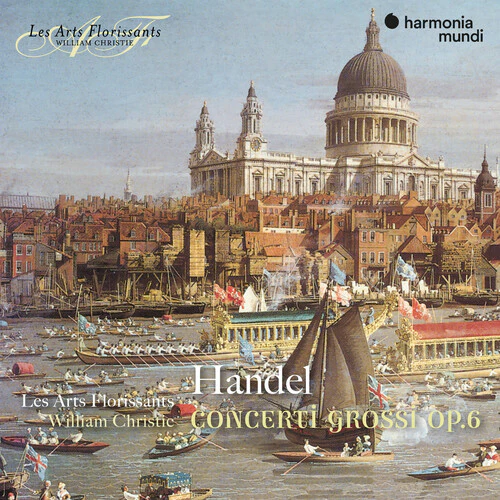
Handel: Concerti grossi, Op. 6 / Christie, Les Arts Florissants
This is William Christie's valedictory disc for Harmonia Mundi before seeking pastures new with Erato. All five works belong to Handel's last and greatest set of concertos, Op. 6, printed in London in 1740. They are splendid pieces and I never tire of listening to them. Christie has chosen three of the four concertos for which optional oboe parts have survived (Nos. I. 2 and 6), as well as the seventh and tenth concertos of the set. It is as good a choice as any if choices have to be made and Christie brings the music to life with all his characteristic enthusiasm and feeling for Handelian idiom. The orchestra of Les Arts Florissants sound on good form, too, achieving a pleasant warmth of string timbre and a greater unanimity of sound than has sometimes been the case in earlier issues.
On the whole I like the presence of oboes in the aforementioned concertos, though the music loses nothing by their absence. Perhaps they are a shade too prominent in the G major Concerto (Op. 6 No. I) but I doubt if this seemingly slight imbalance will bother readers. What I did find more disconcerting, though, were some of the embellishments and cadential elaborations which felt too extended or spun out. One such instance occurs at the close of the Larghetto andante e piano of the F major Concerto (Op. 6 No. 2), where the continuo archlute launches into a veritable solo, albeit in miniature; and again, at the conclusion of the following Allegro the oboes, aided and abetted by the archlute, indulge in imitative flights of fancy. Such moments are neither unimaginative nor lacking in taste but my ears tell me that they are really not necessary. Perhaps I'm just being too English about it—beware of Channel tunnels!
Apart from this reservation, I found Christie's approach refreshing and full of vitality. The playing is wonderfully articulated and the rhythms clear-cut without being at all stiff or unyielding. There are moments, too, of great delicacy as, for example, in the languorous Musette of the G minor Concerto (Op. 6 No. 6), which is eloquently shaped and plentifully endowed with affecting contrasts. Then, at the opposite end of the scale, so to speak, are infectious movements like the Hornpipe of the B flat Concerto (Op. 6 No. 7), and the robust French overture which begins the D minor Concerto (Op. 6 No. 10). Christie enlivens these admirably—though the Hornpipe is, perhaps, a little restrained---responding with spontaneity to Handel's engagingly wide terms of stylistic reference. In short, a stimulating and enjoyable performance, notwithstanding reservations which may worry some ears much less than others.
-- Gramophone [5/1995]
reviewing the original release of this title
On the whole I like the presence of oboes in the aforementioned concertos, though the music loses nothing by their absence. Perhaps they are a shade too prominent in the G major Concerto (Op. 6 No. I) but I doubt if this seemingly slight imbalance will bother readers. What I did find more disconcerting, though, were some of the embellishments and cadential elaborations which felt too extended or spun out. One such instance occurs at the close of the Larghetto andante e piano of the F major Concerto (Op. 6 No. 2), where the continuo archlute launches into a veritable solo, albeit in miniature; and again, at the conclusion of the following Allegro the oboes, aided and abetted by the archlute, indulge in imitative flights of fancy. Such moments are neither unimaginative nor lacking in taste but my ears tell me that they are really not necessary. Perhaps I'm just being too English about it—beware of Channel tunnels!
Apart from this reservation, I found Christie's approach refreshing and full of vitality. The playing is wonderfully articulated and the rhythms clear-cut without being at all stiff or unyielding. There are moments, too, of great delicacy as, for example, in the languorous Musette of the G minor Concerto (Op. 6 No. 6), which is eloquently shaped and plentifully endowed with affecting contrasts. Then, at the opposite end of the scale, so to speak, are infectious movements like the Hornpipe of the B flat Concerto (Op. 6 No. 7), and the robust French overture which begins the D minor Concerto (Op. 6 No. 10). Christie enlivens these admirably—though the Hornpipe is, perhaps, a little restrained---responding with spontaneity to Handel's engagingly wide terms of stylistic reference. In short, a stimulating and enjoyable performance, notwithstanding reservations which may worry some ears much less than others.
-- Gramophone [5/1995]
reviewing the original release of this title
This is William Christie's valedictory disc for Harmonia Mundi before seeking pastures new with Erato. All five works belong to Handel's last and greatest set of concertos, Op. 6, printed in London in 1740. They are splendid pieces and I never tire of listening to them. Christie has chosen three of the four concertos for which optional oboe parts have survived (Nos. I. 2 and 6), as well as the seventh and tenth concertos of the set. It is as good a choice as any if choices have to be made and Christie brings the music to life with all his characteristic enthusiasm and feeling for Handelian idiom. The orchestra of Les Arts Florissants sound on good form, too, achieving a pleasant warmth of string timbre and a greater unanimity of sound than has sometimes been the case in earlier issues.
On the whole I like the presence of oboes in the aforementioned concertos, though the music loses nothing by their absence. Perhaps they are a shade too prominent in the G major Concerto (Op. 6 No. I) but I doubt if this seemingly slight imbalance will bother readers. What I did find more disconcerting, though, were some of the embellishments and cadential elaborations which felt too extended or spun out. One such instance occurs at the close of the Larghetto andante e piano of the F major Concerto (Op. 6 No. 2), where the continuo archlute launches into a veritable solo, albeit in miniature; and again, at the conclusion of the following Allegro the oboes, aided and abetted by the archlute, indulge in imitative flights of fancy. Such moments are neither unimaginative nor lacking in taste but my ears tell me that they are really not necessary. Perhaps I'm just being too English about it—beware of Channel tunnels!
Apart from this reservation, I found Christie's approach refreshing and full of vitality. The playing is wonderfully articulated and the rhythms clear-cut without being at all stiff or unyielding. There are moments, too, of great delicacy as, for example, in the languorous Musette of the G minor Concerto (Op. 6 No. 6), which is eloquently shaped and plentifully endowed with affecting contrasts. Then, at the opposite end of the scale, so to speak, are infectious movements like the Hornpipe of the B flat Concerto (Op. 6 No. 7), and the robust French overture which begins the D minor Concerto (Op. 6 No. 10). Christie enlivens these admirably—though the Hornpipe is, perhaps, a little restrained---responding with spontaneity to Handel's engagingly wide terms of stylistic reference. In short, a stimulating and enjoyable performance, notwithstanding reservations which may worry some ears much less than others.
-- Gramophone [5/1995]
reviewing the original release of this title
On the whole I like the presence of oboes in the aforementioned concertos, though the music loses nothing by their absence. Perhaps they are a shade too prominent in the G major Concerto (Op. 6 No. I) but I doubt if this seemingly slight imbalance will bother readers. What I did find more disconcerting, though, were some of the embellishments and cadential elaborations which felt too extended or spun out. One such instance occurs at the close of the Larghetto andante e piano of the F major Concerto (Op. 6 No. 2), where the continuo archlute launches into a veritable solo, albeit in miniature; and again, at the conclusion of the following Allegro the oboes, aided and abetted by the archlute, indulge in imitative flights of fancy. Such moments are neither unimaginative nor lacking in taste but my ears tell me that they are really not necessary. Perhaps I'm just being too English about it—beware of Channel tunnels!
Apart from this reservation, I found Christie's approach refreshing and full of vitality. The playing is wonderfully articulated and the rhythms clear-cut without being at all stiff or unyielding. There are moments, too, of great delicacy as, for example, in the languorous Musette of the G minor Concerto (Op. 6 No. 6), which is eloquently shaped and plentifully endowed with affecting contrasts. Then, at the opposite end of the scale, so to speak, are infectious movements like the Hornpipe of the B flat Concerto (Op. 6 No. 7), and the robust French overture which begins the D minor Concerto (Op. 6 No. 10). Christie enlivens these admirably—though the Hornpipe is, perhaps, a little restrained---responding with spontaneity to Handel's engagingly wide terms of stylistic reference. In short, a stimulating and enjoyable performance, notwithstanding reservations which may worry some ears much less than others.
-- Gramophone [5/1995]
reviewing the original release of this title
$7.92
Original: $22.64
-65%Handel: Concerti grossi, Op. 6 / Christie, Les Arts Florissants—
$22.64
$7.92Description
This is William Christie's valedictory disc for Harmonia Mundi before seeking pastures new with Erato. All five works belong to Handel's last and greatest set of concertos, Op. 6, printed in London in 1740. They are splendid pieces and I never tire of listening to them. Christie has chosen three of the four concertos for which optional oboe parts have survived (Nos. I. 2 and 6), as well as the seventh and tenth concertos of the set. It is as good a choice as any if choices have to be made and Christie brings the music to life with all his characteristic enthusiasm and feeling for Handelian idiom. The orchestra of Les Arts Florissants sound on good form, too, achieving a pleasant warmth of string timbre and a greater unanimity of sound than has sometimes been the case in earlier issues.
On the whole I like the presence of oboes in the aforementioned concertos, though the music loses nothing by their absence. Perhaps they are a shade too prominent in the G major Concerto (Op. 6 No. I) but I doubt if this seemingly slight imbalance will bother readers. What I did find more disconcerting, though, were some of the embellishments and cadential elaborations which felt too extended or spun out. One such instance occurs at the close of the Larghetto andante e piano of the F major Concerto (Op. 6 No. 2), where the continuo archlute launches into a veritable solo, albeit in miniature; and again, at the conclusion of the following Allegro the oboes, aided and abetted by the archlute, indulge in imitative flights of fancy. Such moments are neither unimaginative nor lacking in taste but my ears tell me that they are really not necessary. Perhaps I'm just being too English about it—beware of Channel tunnels!
Apart from this reservation, I found Christie's approach refreshing and full of vitality. The playing is wonderfully articulated and the rhythms clear-cut without being at all stiff or unyielding. There are moments, too, of great delicacy as, for example, in the languorous Musette of the G minor Concerto (Op. 6 No. 6), which is eloquently shaped and plentifully endowed with affecting contrasts. Then, at the opposite end of the scale, so to speak, are infectious movements like the Hornpipe of the B flat Concerto (Op. 6 No. 7), and the robust French overture which begins the D minor Concerto (Op. 6 No. 10). Christie enlivens these admirably—though the Hornpipe is, perhaps, a little restrained---responding with spontaneity to Handel's engagingly wide terms of stylistic reference. In short, a stimulating and enjoyable performance, notwithstanding reservations which may worry some ears much less than others.
-- Gramophone [5/1995]
reviewing the original release of this title
On the whole I like the presence of oboes in the aforementioned concertos, though the music loses nothing by their absence. Perhaps they are a shade too prominent in the G major Concerto (Op. 6 No. I) but I doubt if this seemingly slight imbalance will bother readers. What I did find more disconcerting, though, were some of the embellishments and cadential elaborations which felt too extended or spun out. One such instance occurs at the close of the Larghetto andante e piano of the F major Concerto (Op. 6 No. 2), where the continuo archlute launches into a veritable solo, albeit in miniature; and again, at the conclusion of the following Allegro the oboes, aided and abetted by the archlute, indulge in imitative flights of fancy. Such moments are neither unimaginative nor lacking in taste but my ears tell me that they are really not necessary. Perhaps I'm just being too English about it—beware of Channel tunnels!
Apart from this reservation, I found Christie's approach refreshing and full of vitality. The playing is wonderfully articulated and the rhythms clear-cut without being at all stiff or unyielding. There are moments, too, of great delicacy as, for example, in the languorous Musette of the G minor Concerto (Op. 6 No. 6), which is eloquently shaped and plentifully endowed with affecting contrasts. Then, at the opposite end of the scale, so to speak, are infectious movements like the Hornpipe of the B flat Concerto (Op. 6 No. 7), and the robust French overture which begins the D minor Concerto (Op. 6 No. 10). Christie enlivens these admirably—though the Hornpipe is, perhaps, a little restrained---responding with spontaneity to Handel's engagingly wide terms of stylistic reference. In short, a stimulating and enjoyable performance, notwithstanding reservations which may worry some ears much less than others.
-- Gramophone [5/1995]
reviewing the original release of this title