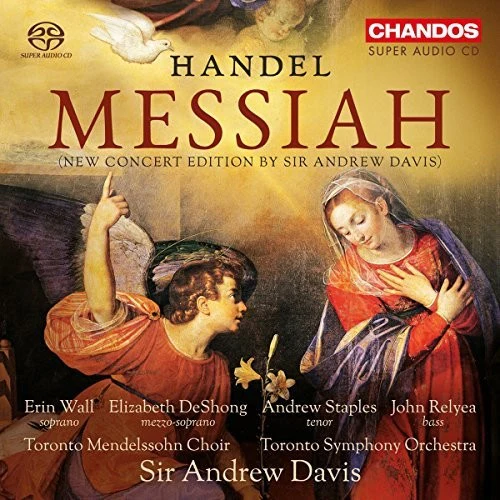
Handel: Messiah / Davis, Toronto Symphony
Experience the transcendent glory of Messiah in Sir Andrew Davis’s majestic, must-hear edition of Handel’s beloved classic. Recorded live on SACD, this unique version makes use of all the colours available from the modern symphony orchestra to underline the mood and meaning of the individual movements. Without detracting from the innate power of the original, the conductor’s score calls for moments of drama, pathos, and even, sometimes, whimsicality. It is supported by substantial brass and woodwind forces, and several percussion instruments (including marimba!).
REVIEW:
The performance is lightly cut, mainly toward the ends of Parts II and III, and both da capo arias (‘He was despised’ and ‘The trumpet shall sound’) have only the A section. Most of the ornamentation, including simple appoggiaturas, is omitted, as well as most occasions for what I call justified rhythms, where, say, upbeat eighth notes are taken as sixteenths to match other parts. Where choices are available, the common ones prevail, as in the 4/4 ‘Rejoice’ and the duet version of ‘He shall feed his flock’.
Tempos are crisp and modern, and the performers are all very good. The four soloists (with mezzo, not countertenor) are first rate; and the choir, which must number around 150, sings with the agility of much smaller groups. This is a “big” Messiah with none of the problems we normally associate with such endeavors. I guess we could call it “historically informed” because tempos are brisk and the spirit is not at all romantic. It also struck me as a gentle repudiation of Musicological Correctness—and that is no doubt a good thing. I dare say that if you had a contest lining up all the approaches to Messiah and had a review panel consisting of people with no musicological prejudices, this would be the winner.
-- American Record Guide
Experience the transcendent glory of Messiah in Sir Andrew Davis’s majestic, must-hear edition of Handel’s beloved classic. Recorded live on SACD, this unique version makes use of all the colours available from the modern symphony orchestra to underline the mood and meaning of the individual movements. Without detracting from the innate power of the original, the conductor’s score calls for moments of drama, pathos, and even, sometimes, whimsicality. It is supported by substantial brass and woodwind forces, and several percussion instruments (including marimba!).
REVIEW:
The performance is lightly cut, mainly toward the ends of Parts II and III, and both da capo arias (‘He was despised’ and ‘The trumpet shall sound’) have only the A section. Most of the ornamentation, including simple appoggiaturas, is omitted, as well as most occasions for what I call justified rhythms, where, say, upbeat eighth notes are taken as sixteenths to match other parts. Where choices are available, the common ones prevail, as in the 4/4 ‘Rejoice’ and the duet version of ‘He shall feed his flock’.
Tempos are crisp and modern, and the performers are all very good. The four soloists (with mezzo, not countertenor) are first rate; and the choir, which must number around 150, sings with the agility of much smaller groups. This is a “big” Messiah with none of the problems we normally associate with such endeavors. I guess we could call it “historically informed” because tempos are brisk and the spirit is not at all romantic. It also struck me as a gentle repudiation of Musicological Correctness—and that is no doubt a good thing. I dare say that if you had a contest lining up all the approaches to Messiah and had a review panel consisting of people with no musicological prejudices, this would be the winner.
-- American Record Guide
Description
Experience the transcendent glory of Messiah in Sir Andrew Davis’s majestic, must-hear edition of Handel’s beloved classic. Recorded live on SACD, this unique version makes use of all the colours available from the modern symphony orchestra to underline the mood and meaning of the individual movements. Without detracting from the innate power of the original, the conductor’s score calls for moments of drama, pathos, and even, sometimes, whimsicality. It is supported by substantial brass and woodwind forces, and several percussion instruments (including marimba!).
REVIEW:
The performance is lightly cut, mainly toward the ends of Parts II and III, and both da capo arias (‘He was despised’ and ‘The trumpet shall sound’) have only the A section. Most of the ornamentation, including simple appoggiaturas, is omitted, as well as most occasions for what I call justified rhythms, where, say, upbeat eighth notes are taken as sixteenths to match other parts. Where choices are available, the common ones prevail, as in the 4/4 ‘Rejoice’ and the duet version of ‘He shall feed his flock’.
Tempos are crisp and modern, and the performers are all very good. The four soloists (with mezzo, not countertenor) are first rate; and the choir, which must number around 150, sings with the agility of much smaller groups. This is a “big” Messiah with none of the problems we normally associate with such endeavors. I guess we could call it “historically informed” because tempos are brisk and the spirit is not at all romantic. It also struck me as a gentle repudiation of Musicological Correctness—and that is no doubt a good thing. I dare say that if you had a contest lining up all the approaches to Messiah and had a review panel consisting of people with no musicological prejudices, this would be the winner.
-- American Record Guide