🎉 Up to 70% Off Selected ItemsShop Sale

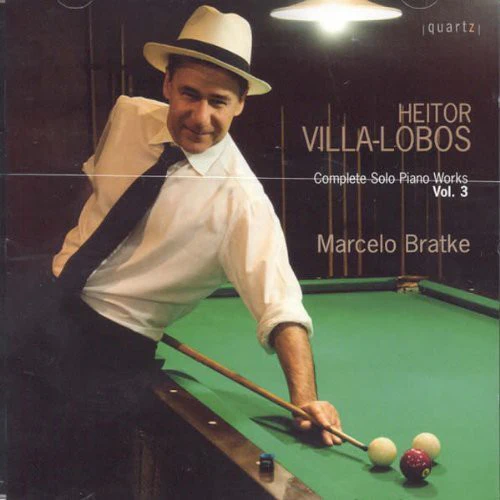
Heitor Villa-lobos: Complete Solo Piano Works, Vol. 3 / Marcelo Bratke
Marcelo Bratke continues with Volume 3 of his series devoted to the complete solo piano works of Heitor Villa-Lobos.
"...Villa-Lobos gained significant prestige in the Paris of the 1920s, the period of his boldest and most creative work, before returning to a more orderly approach in the 1930s. In 1928, when the publisher Max Eschig commissioned a few works for students of the celebrated professor and pianist Marguerite Long at the Paris Conservatory, Villa-Lobos wrote one of his most charming and most original compositions, Francette et Pià. He imagined a little Indian boy called Pià befriending a little French girl, Francette. There is a “barbarian” mood from the beginning, with syncopated jazz à la Revue Nègre bringing in French children’s songs such as Au Clair de la Lune or Marlbrough s’en va-t-en guerre, reflections of Brazilian themes, the Marseillaise, and many other references scored in miraculously straightforward language." - Quartz Records, (From the album liner notes.)
"...Villa-Lobos gained significant prestige in the Paris of the 1920s, the period of his boldest and most creative work, before returning to a more orderly approach in the 1930s. In 1928, when the publisher Max Eschig commissioned a few works for students of the celebrated professor and pianist Marguerite Long at the Paris Conservatory, Villa-Lobos wrote one of his most charming and most original compositions, Francette et Pià. He imagined a little Indian boy called Pià befriending a little French girl, Francette. There is a “barbarian” mood from the beginning, with syncopated jazz à la Revue Nègre bringing in French children’s songs such as Au Clair de la Lune or Marlbrough s’en va-t-en guerre, reflections of Brazilian themes, the Marseillaise, and many other references scored in miraculously straightforward language." - Quartz Records, (From the album liner notes.)
Marcelo Bratke continues with Volume 3 of his series devoted to the complete solo piano works of Heitor Villa-Lobos.
"...Villa-Lobos gained significant prestige in the Paris of the 1920s, the period of his boldest and most creative work, before returning to a more orderly approach in the 1930s. In 1928, when the publisher Max Eschig commissioned a few works for students of the celebrated professor and pianist Marguerite Long at the Paris Conservatory, Villa-Lobos wrote one of his most charming and most original compositions, Francette et Pià. He imagined a little Indian boy called Pià befriending a little French girl, Francette. There is a “barbarian” mood from the beginning, with syncopated jazz à la Revue Nègre bringing in French children’s songs such as Au Clair de la Lune or Marlbrough s’en va-t-en guerre, reflections of Brazilian themes, the Marseillaise, and many other references scored in miraculously straightforward language." - Quartz Records, (From the album liner notes.)
"...Villa-Lobos gained significant prestige in the Paris of the 1920s, the period of his boldest and most creative work, before returning to a more orderly approach in the 1930s. In 1928, when the publisher Max Eschig commissioned a few works for students of the celebrated professor and pianist Marguerite Long at the Paris Conservatory, Villa-Lobos wrote one of his most charming and most original compositions, Francette et Pià. He imagined a little Indian boy called Pià befriending a little French girl, Francette. There is a “barbarian” mood from the beginning, with syncopated jazz à la Revue Nègre bringing in French children’s songs such as Au Clair de la Lune or Marlbrough s’en va-t-en guerre, reflections of Brazilian themes, the Marseillaise, and many other references scored in miraculously straightforward language." - Quartz Records, (From the album liner notes.)
$6.65
Original: $18.99
-65%Heitor Villa-lobos: Complete Solo Piano Works, Vol. 3 / Marcelo Bratke—
$18.99
$6.65Description
Marcelo Bratke continues with Volume 3 of his series devoted to the complete solo piano works of Heitor Villa-Lobos.
"...Villa-Lobos gained significant prestige in the Paris of the 1920s, the period of his boldest and most creative work, before returning to a more orderly approach in the 1930s. In 1928, when the publisher Max Eschig commissioned a few works for students of the celebrated professor and pianist Marguerite Long at the Paris Conservatory, Villa-Lobos wrote one of his most charming and most original compositions, Francette et Pià. He imagined a little Indian boy called Pià befriending a little French girl, Francette. There is a “barbarian” mood from the beginning, with syncopated jazz à la Revue Nègre bringing in French children’s songs such as Au Clair de la Lune or Marlbrough s’en va-t-en guerre, reflections of Brazilian themes, the Marseillaise, and many other references scored in miraculously straightforward language." - Quartz Records, (From the album liner notes.)
"...Villa-Lobos gained significant prestige in the Paris of the 1920s, the period of his boldest and most creative work, before returning to a more orderly approach in the 1930s. In 1928, when the publisher Max Eschig commissioned a few works for students of the celebrated professor and pianist Marguerite Long at the Paris Conservatory, Villa-Lobos wrote one of his most charming and most original compositions, Francette et Pià. He imagined a little Indian boy called Pià befriending a little French girl, Francette. There is a “barbarian” mood from the beginning, with syncopated jazz à la Revue Nègre bringing in French children’s songs such as Au Clair de la Lune or Marlbrough s’en va-t-en guerre, reflections of Brazilian themes, the Marseillaise, and many other references scored in miraculously straightforward language." - Quartz Records, (From the album liner notes.)