🎉 Up to 70% Off Selected ItemsShop Sale

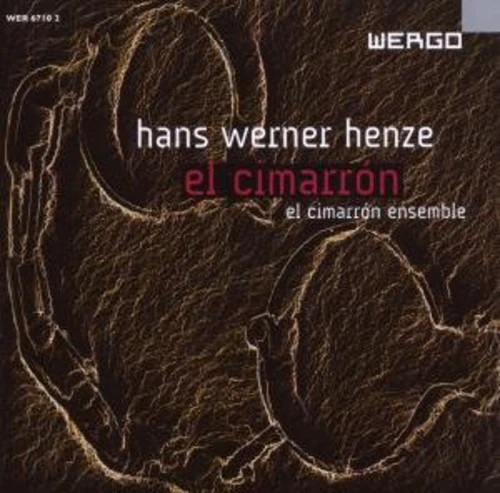
Henze: El Cimarrón / El Cimarrón Ensemble
" 3161500.az_HENZE_El_Cimarron_Angelo.html
HENZE El Cimarrón • Angelo de Leonardis (bar); Gundl Aggermann (fl); Christina Schorn (gtr); Ivan Mancinelli (perc) • WERGO 6710 (2 CDs: 84:22 Text and Translation)
"I made my case for El Cimarrón in Fanfare 31:2; I think it is a potent work, perhaps Henze’s masterpiece, but I didn’t like that Stradivarius recording by Nicholas Isherwood. That issue is too recent to merit quoting at length; if you don’t know the work, please refer to that review. The piece falls into a musical no-man’s-land between song and speech. Henze’s singing actors are given far more freedom than Schoenberg’s—there is little of Sprechstimme here, unless a performer so chooses—which is both the glory and the curse of El Cimarrón . Early recordings (there have been four that I know of) concentrated on the music; baritone William Pearson sang in the 1971 DG recording led by Henze himself, which remains my favorite. One might say that those performers (at the composer’s direction, of course) followed the score, trusting in the words and music to make the full dramatic impact. More recent productions, the Stradivarius and now this one, take advantage of the aleatoric elements of the score and lean toward a chewing-the-scenery style of acting—screaming, ranting, and raging—which puts me off. For one thing, it makes the protagonist less sympathetic; we are less likely to take his life experiences seriously, which is the main point of the work. Henze’s complete title (translated) is El Cimarrón, The Autobiography of the Runaway Slave Esteban Montejo; Recital for Four Musicians . Henze met Esteban Montejo; at age 108 “he radiated dignity.” There is little dignity here, whereas Pearson’s deep bass speaking voice and overall formality delivered dignity in spades. This wild acting style also tends to obscure some wonderful music, turning it into background accompaniment instead of full participant. This issue credits an artistic director/dramaturge (Michael Kerstan) rather than a conductor. Does the composer approve of this recent trend? He attended a rehearsal for the staged production that led to this studio recording, and was “very impressed by the energy, the artistic élan, and the human commitment they manifested.” I interpret that as damning with faint praise, as he has always raved about any performers who tackle his œuvre.
De Leonardis starts off very much as Isherwood did, using many voices from bass to falsetto, crooning and moaning, shouting and whispering; he calms down a bit as Esteban’s life progresses and is a fine singer when required, which Isherwood was not. More of the music comes to life this time; I like the slow tempos very much. The big surprise is that de Leonardis sings an English version by Christopher Keene; the booklet gives no hint as to why. Wergo is the recording division of Schott Music & Media, Henze’s publishers; one would expect it to use Hans Magnus Enzensberger’s original German libretto for this “official” documentation. Texts appear in both languages, on facing pages. De Leonardis makes every word clear, though he sings with an unidentifiable accent; at least it is not that of an upper class, educated white man. The English grows on me at repeated hearings; it’s nice not to have one’s nose buried in the libretto. The other three musicians are excellent, and an impactful digital recording is especially effective in reproducing Henze’s wide variety of exotic percussion."
FANFARE: James H. North
HENZE El Cimarrón • Angelo de Leonardis (bar); Gundl Aggermann (fl); Christina Schorn (gtr); Ivan Mancinelli (perc) • WERGO 6710 (2 CDs: 84:22 Text and Translation)
"I made my case for El Cimarrón in Fanfare 31:2; I think it is a potent work, perhaps Henze’s masterpiece, but I didn’t like that Stradivarius recording by Nicholas Isherwood. That issue is too recent to merit quoting at length; if you don’t know the work, please refer to that review. The piece falls into a musical no-man’s-land between song and speech. Henze’s singing actors are given far more freedom than Schoenberg’s—there is little of Sprechstimme here, unless a performer so chooses—which is both the glory and the curse of El Cimarrón . Early recordings (there have been four that I know of) concentrated on the music; baritone William Pearson sang in the 1971 DG recording led by Henze himself, which remains my favorite. One might say that those performers (at the composer’s direction, of course) followed the score, trusting in the words and music to make the full dramatic impact. More recent productions, the Stradivarius and now this one, take advantage of the aleatoric elements of the score and lean toward a chewing-the-scenery style of acting—screaming, ranting, and raging—which puts me off. For one thing, it makes the protagonist less sympathetic; we are less likely to take his life experiences seriously, which is the main point of the work. Henze’s complete title (translated) is El Cimarrón, The Autobiography of the Runaway Slave Esteban Montejo; Recital for Four Musicians . Henze met Esteban Montejo; at age 108 “he radiated dignity.” There is little dignity here, whereas Pearson’s deep bass speaking voice and overall formality delivered dignity in spades. This wild acting style also tends to obscure some wonderful music, turning it into background accompaniment instead of full participant. This issue credits an artistic director/dramaturge (Michael Kerstan) rather than a conductor. Does the composer approve of this recent trend? He attended a rehearsal for the staged production that led to this studio recording, and was “very impressed by the energy, the artistic élan, and the human commitment they manifested.” I interpret that as damning with faint praise, as he has always raved about any performers who tackle his œuvre.
De Leonardis starts off very much as Isherwood did, using many voices from bass to falsetto, crooning and moaning, shouting and whispering; he calms down a bit as Esteban’s life progresses and is a fine singer when required, which Isherwood was not. More of the music comes to life this time; I like the slow tempos very much. The big surprise is that de Leonardis sings an English version by Christopher Keene; the booklet gives no hint as to why. Wergo is the recording division of Schott Music & Media, Henze’s publishers; one would expect it to use Hans Magnus Enzensberger’s original German libretto for this “official” documentation. Texts appear in both languages, on facing pages. De Leonardis makes every word clear, though he sings with an unidentifiable accent; at least it is not that of an upper class, educated white man. The English grows on me at repeated hearings; it’s nice not to have one’s nose buried in the libretto. The other three musicians are excellent, and an impactful digital recording is especially effective in reproducing Henze’s wide variety of exotic percussion."
FANFARE: James H. North
" 3161500.az_HENZE_El_Cimarron_Angelo.html
HENZE El Cimarrón • Angelo de Leonardis (bar); Gundl Aggermann (fl); Christina Schorn (gtr); Ivan Mancinelli (perc) • WERGO 6710 (2 CDs: 84:22 Text and Translation)
"I made my case for El Cimarrón in Fanfare 31:2; I think it is a potent work, perhaps Henze’s masterpiece, but I didn’t like that Stradivarius recording by Nicholas Isherwood. That issue is too recent to merit quoting at length; if you don’t know the work, please refer to that review. The piece falls into a musical no-man’s-land between song and speech. Henze’s singing actors are given far more freedom than Schoenberg’s—there is little of Sprechstimme here, unless a performer so chooses—which is both the glory and the curse of El Cimarrón . Early recordings (there have been four that I know of) concentrated on the music; baritone William Pearson sang in the 1971 DG recording led by Henze himself, which remains my favorite. One might say that those performers (at the composer’s direction, of course) followed the score, trusting in the words and music to make the full dramatic impact. More recent productions, the Stradivarius and now this one, take advantage of the aleatoric elements of the score and lean toward a chewing-the-scenery style of acting—screaming, ranting, and raging—which puts me off. For one thing, it makes the protagonist less sympathetic; we are less likely to take his life experiences seriously, which is the main point of the work. Henze’s complete title (translated) is El Cimarrón, The Autobiography of the Runaway Slave Esteban Montejo; Recital for Four Musicians . Henze met Esteban Montejo; at age 108 “he radiated dignity.” There is little dignity here, whereas Pearson’s deep bass speaking voice and overall formality delivered dignity in spades. This wild acting style also tends to obscure some wonderful music, turning it into background accompaniment instead of full participant. This issue credits an artistic director/dramaturge (Michael Kerstan) rather than a conductor. Does the composer approve of this recent trend? He attended a rehearsal for the staged production that led to this studio recording, and was “very impressed by the energy, the artistic élan, and the human commitment they manifested.” I interpret that as damning with faint praise, as he has always raved about any performers who tackle his œuvre.
De Leonardis starts off very much as Isherwood did, using many voices from bass to falsetto, crooning and moaning, shouting and whispering; he calms down a bit as Esteban’s life progresses and is a fine singer when required, which Isherwood was not. More of the music comes to life this time; I like the slow tempos very much. The big surprise is that de Leonardis sings an English version by Christopher Keene; the booklet gives no hint as to why. Wergo is the recording division of Schott Music & Media, Henze’s publishers; one would expect it to use Hans Magnus Enzensberger’s original German libretto for this “official” documentation. Texts appear in both languages, on facing pages. De Leonardis makes every word clear, though he sings with an unidentifiable accent; at least it is not that of an upper class, educated white man. The English grows on me at repeated hearings; it’s nice not to have one’s nose buried in the libretto. The other three musicians are excellent, and an impactful digital recording is especially effective in reproducing Henze’s wide variety of exotic percussion."
FANFARE: James H. North
HENZE El Cimarrón • Angelo de Leonardis (bar); Gundl Aggermann (fl); Christina Schorn (gtr); Ivan Mancinelli (perc) • WERGO 6710 (2 CDs: 84:22 Text and Translation)
"I made my case for El Cimarrón in Fanfare 31:2; I think it is a potent work, perhaps Henze’s masterpiece, but I didn’t like that Stradivarius recording by Nicholas Isherwood. That issue is too recent to merit quoting at length; if you don’t know the work, please refer to that review. The piece falls into a musical no-man’s-land between song and speech. Henze’s singing actors are given far more freedom than Schoenberg’s—there is little of Sprechstimme here, unless a performer so chooses—which is both the glory and the curse of El Cimarrón . Early recordings (there have been four that I know of) concentrated on the music; baritone William Pearson sang in the 1971 DG recording led by Henze himself, which remains my favorite. One might say that those performers (at the composer’s direction, of course) followed the score, trusting in the words and music to make the full dramatic impact. More recent productions, the Stradivarius and now this one, take advantage of the aleatoric elements of the score and lean toward a chewing-the-scenery style of acting—screaming, ranting, and raging—which puts me off. For one thing, it makes the protagonist less sympathetic; we are less likely to take his life experiences seriously, which is the main point of the work. Henze’s complete title (translated) is El Cimarrón, The Autobiography of the Runaway Slave Esteban Montejo; Recital for Four Musicians . Henze met Esteban Montejo; at age 108 “he radiated dignity.” There is little dignity here, whereas Pearson’s deep bass speaking voice and overall formality delivered dignity in spades. This wild acting style also tends to obscure some wonderful music, turning it into background accompaniment instead of full participant. This issue credits an artistic director/dramaturge (Michael Kerstan) rather than a conductor. Does the composer approve of this recent trend? He attended a rehearsal for the staged production that led to this studio recording, and was “very impressed by the energy, the artistic élan, and the human commitment they manifested.” I interpret that as damning with faint praise, as he has always raved about any performers who tackle his œuvre.
De Leonardis starts off very much as Isherwood did, using many voices from bass to falsetto, crooning and moaning, shouting and whispering; he calms down a bit as Esteban’s life progresses and is a fine singer when required, which Isherwood was not. More of the music comes to life this time; I like the slow tempos very much. The big surprise is that de Leonardis sings an English version by Christopher Keene; the booklet gives no hint as to why. Wergo is the recording division of Schott Music & Media, Henze’s publishers; one would expect it to use Hans Magnus Enzensberger’s original German libretto for this “official” documentation. Texts appear in both languages, on facing pages. De Leonardis makes every word clear, though he sings with an unidentifiable accent; at least it is not that of an upper class, educated white man. The English grows on me at repeated hearings; it’s nice not to have one’s nose buried in the libretto. The other three musicians are excellent, and an impactful digital recording is especially effective in reproducing Henze’s wide variety of exotic percussion."
FANFARE: James H. North
$9.45
Original: $26.99
-65%Henze: El Cimarrón / El Cimarrón Ensemble—
$26.99
$9.45Description
" 3161500.az_HENZE_El_Cimarron_Angelo.html
HENZE El Cimarrón • Angelo de Leonardis (bar); Gundl Aggermann (fl); Christina Schorn (gtr); Ivan Mancinelli (perc) • WERGO 6710 (2 CDs: 84:22 Text and Translation)
"I made my case for El Cimarrón in Fanfare 31:2; I think it is a potent work, perhaps Henze’s masterpiece, but I didn’t like that Stradivarius recording by Nicholas Isherwood. That issue is too recent to merit quoting at length; if you don’t know the work, please refer to that review. The piece falls into a musical no-man’s-land between song and speech. Henze’s singing actors are given far more freedom than Schoenberg’s—there is little of Sprechstimme here, unless a performer so chooses—which is both the glory and the curse of El Cimarrón . Early recordings (there have been four that I know of) concentrated on the music; baritone William Pearson sang in the 1971 DG recording led by Henze himself, which remains my favorite. One might say that those performers (at the composer’s direction, of course) followed the score, trusting in the words and music to make the full dramatic impact. More recent productions, the Stradivarius and now this one, take advantage of the aleatoric elements of the score and lean toward a chewing-the-scenery style of acting—screaming, ranting, and raging—which puts me off. For one thing, it makes the protagonist less sympathetic; we are less likely to take his life experiences seriously, which is the main point of the work. Henze’s complete title (translated) is El Cimarrón, The Autobiography of the Runaway Slave Esteban Montejo; Recital for Four Musicians . Henze met Esteban Montejo; at age 108 “he radiated dignity.” There is little dignity here, whereas Pearson’s deep bass speaking voice and overall formality delivered dignity in spades. This wild acting style also tends to obscure some wonderful music, turning it into background accompaniment instead of full participant. This issue credits an artistic director/dramaturge (Michael Kerstan) rather than a conductor. Does the composer approve of this recent trend? He attended a rehearsal for the staged production that led to this studio recording, and was “very impressed by the energy, the artistic élan, and the human commitment they manifested.” I interpret that as damning with faint praise, as he has always raved about any performers who tackle his œuvre.
De Leonardis starts off very much as Isherwood did, using many voices from bass to falsetto, crooning and moaning, shouting and whispering; he calms down a bit as Esteban’s life progresses and is a fine singer when required, which Isherwood was not. More of the music comes to life this time; I like the slow tempos very much. The big surprise is that de Leonardis sings an English version by Christopher Keene; the booklet gives no hint as to why. Wergo is the recording division of Schott Music & Media, Henze’s publishers; one would expect it to use Hans Magnus Enzensberger’s original German libretto for this “official” documentation. Texts appear in both languages, on facing pages. De Leonardis makes every word clear, though he sings with an unidentifiable accent; at least it is not that of an upper class, educated white man. The English grows on me at repeated hearings; it’s nice not to have one’s nose buried in the libretto. The other three musicians are excellent, and an impactful digital recording is especially effective in reproducing Henze’s wide variety of exotic percussion."
FANFARE: James H. North
HENZE El Cimarrón • Angelo de Leonardis (bar); Gundl Aggermann (fl); Christina Schorn (gtr); Ivan Mancinelli (perc) • WERGO 6710 (2 CDs: 84:22 Text and Translation)
"I made my case for El Cimarrón in Fanfare 31:2; I think it is a potent work, perhaps Henze’s masterpiece, but I didn’t like that Stradivarius recording by Nicholas Isherwood. That issue is too recent to merit quoting at length; if you don’t know the work, please refer to that review. The piece falls into a musical no-man’s-land between song and speech. Henze’s singing actors are given far more freedom than Schoenberg’s—there is little of Sprechstimme here, unless a performer so chooses—which is both the glory and the curse of El Cimarrón . Early recordings (there have been four that I know of) concentrated on the music; baritone William Pearson sang in the 1971 DG recording led by Henze himself, which remains my favorite. One might say that those performers (at the composer’s direction, of course) followed the score, trusting in the words and music to make the full dramatic impact. More recent productions, the Stradivarius and now this one, take advantage of the aleatoric elements of the score and lean toward a chewing-the-scenery style of acting—screaming, ranting, and raging—which puts me off. For one thing, it makes the protagonist less sympathetic; we are less likely to take his life experiences seriously, which is the main point of the work. Henze’s complete title (translated) is El Cimarrón, The Autobiography of the Runaway Slave Esteban Montejo; Recital for Four Musicians . Henze met Esteban Montejo; at age 108 “he radiated dignity.” There is little dignity here, whereas Pearson’s deep bass speaking voice and overall formality delivered dignity in spades. This wild acting style also tends to obscure some wonderful music, turning it into background accompaniment instead of full participant. This issue credits an artistic director/dramaturge (Michael Kerstan) rather than a conductor. Does the composer approve of this recent trend? He attended a rehearsal for the staged production that led to this studio recording, and was “very impressed by the energy, the artistic élan, and the human commitment they manifested.” I interpret that as damning with faint praise, as he has always raved about any performers who tackle his œuvre.
De Leonardis starts off very much as Isherwood did, using many voices from bass to falsetto, crooning and moaning, shouting and whispering; he calms down a bit as Esteban’s life progresses and is a fine singer when required, which Isherwood was not. More of the music comes to life this time; I like the slow tempos very much. The big surprise is that de Leonardis sings an English version by Christopher Keene; the booklet gives no hint as to why. Wergo is the recording division of Schott Music & Media, Henze’s publishers; one would expect it to use Hans Magnus Enzensberger’s original German libretto for this “official” documentation. Texts appear in both languages, on facing pages. De Leonardis makes every word clear, though he sings with an unidentifiable accent; at least it is not that of an upper class, educated white man. The English grows on me at repeated hearings; it’s nice not to have one’s nose buried in the libretto. The other three musicians are excellent, and an impactful digital recording is especially effective in reproducing Henze’s wide variety of exotic percussion."
FANFARE: James H. North