🎉 Up to 70% Off Selected ItemsShop Sale

1 / 2
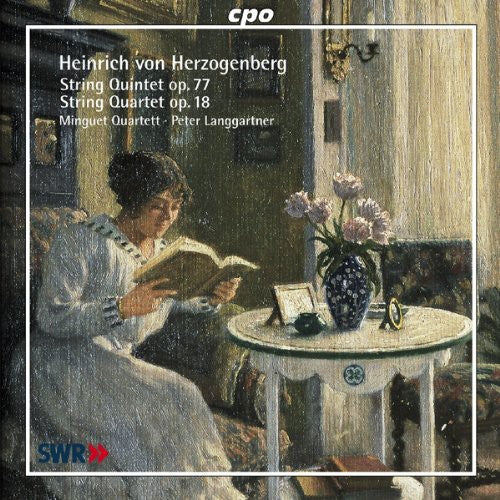
Herzogenberg: String Quintet Op 77, String Quartet Op 18 / Minguet Quartett
HERZOGENBERG String Quartet, op. 18. String Quintet, op. 77 1 • Minguet Qrt; 1 Peter Langgartner (va) • CPO 777 083-2 (58:40)
If Brahms’s name had been attached to Heinrich von Herzogenberg’s String Quintet, that work might be in the basic repertoire by now. Perhaps that is an exaggeration, but not by very much. In fact, Herzogenberg’s String Quintet (1892) is the next best thing to a newly discovered work by Brahms. If one were to present it as such, no doubt many listeners wouldn’t question the attribution. For music to be more Brahmsian, it would have to be by Brahms himself.
None of this is terribly surprising, as Herzogenberg and his wife, Elisabeth, were more than simply passing acquaintances with Brahms. Elisabeth had been Brahms’s piano pupil, and some have argued that the elder composer had a crush on his young student, and when Elisabeth married Heinrich in 1866, Brahms became jealous, in spite of himself. The couple kept up correspondence with Brahms, and Heinrich, an accomplished composer himself, shared his work with Brahms, whose approval was at best grudging. Herzogenberg’s music isn’t exclusively an imitation of Brahms’s, but many of his works—the op. 77 String Quintet in particular—are in a decidedly Brahmsian style. I was tempted to add “for better or worse” to the last sentence, but the stylistic similarities are very much for the better. It is amusing to hear the last movement trace a similar path as the analogous movement in Brahms’s First Symphony. The “big tune,” which appears after considerable preparation, could even be a variant of Brahms’s melody (which in turn, as “any ass can see,” was a variant of Beethoven’s “Ode to Joy”). Alas, this work was written in the wake of Elisabeth’s death early in 1892, but of mourning there is little trace. I don’t know what Elizabeth Kübler-Ross would have thought about this quintet, but Herzogenberg hardly wallows in grief here, apparently preferring to work through his feelings in a more positive fashion.
If anything, the D-Minor String Quartet, which dates from 1876, is more tragic. Up until this point in his life, Herzogenberg had been a devotee of Wagner, but it was around this time that he turned from Wagner to Brahms. This quartet doesn’t sound like Wagner, and it sounds much less like Brahms than the Piano Quintet. With Herzogenberg lacking a strong musical personality, it also fails to sound like Herzogenberg (whatever that might be), but in every other way it is an assured and respectable work. Hearing it is not a waste of one’s time, although I expect that most listeners will focus their attention on the later work. (As if to foil those same listeners, cpo has placed op. 77 before op. 18. I suspect I am not the only listener too lazy or too passive to switch the CD halfway through.)
These recordings date from 2008 (op. 77) and 2005 (op. 18), and are the Minguet Quartet’s second Herzogenberg disc for this label. (Cpo 777 082-2 contains the op. 17 Piano Quintet and the op. 63 String Quartet.) This is a German ensemble, formed in 1988, and named after a Spanish philosopher who believed that the fine arts should be made accessible to the general populace. The Minguet Quartet does just that, performing these works with the sort of fervor that makes even casual listeners pay attention. They don’t overdo it, however, and those who deplore emotionally sloppy performances of Brahms (as well they should) will not be turned off by the playing here, which is eloquent, masculine, and always in control. In the String Quintet, violist Peter Langgartner’s addition is seamless—so much so that one can’t tell where he begins and where the Minguets leave off. The booklet notes are brief, but only by cpo’s standards, and the engineering is all one could wish for. Strongly recommended to those who love Brahms, mostly for the yummy String Quintet.
FANFARE: Raymond Tuttle
HERZOGENBERG String Quartet, op. 18. String Quintet, op. 77 1 • Minguet Qrt; 1 Peter Langgartner (va) • CPO 777 083-2 (58:40)
If Brahms’s name had been attached to Heinrich von Herzogenberg’s String Quintet, that work might be in the basic repertoire by now. Perhaps that is an exaggeration, but not by very much. In fact, Herzogenberg’s String Quintet (1892) is the next best thing to a newly discovered work by Brahms. If one were to present it as such, no doubt many listeners wouldn’t question the attribution. For music to be more Brahmsian, it would have to be by Brahms himself.
None of this is terribly surprising, as Herzogenberg and his wife, Elisabeth, were more than simply passing acquaintances with Brahms. Elisabeth had been Brahms’s piano pupil, and some have argued that the elder composer had a crush on his young student, and when Elisabeth married Heinrich in 1866, Brahms became jealous, in spite of himself. The couple kept up correspondence with Brahms, and Heinrich, an accomplished composer himself, shared his work with Brahms, whose approval was at best grudging. Herzogenberg’s music isn’t exclusively an imitation of Brahms’s, but many of his works—the op. 77 String Quintet in particular—are in a decidedly Brahmsian style. I was tempted to add “for better or worse” to the last sentence, but the stylistic similarities are very much for the better. It is amusing to hear the last movement trace a similar path as the analogous movement in Brahms’s First Symphony. The “big tune,” which appears after considerable preparation, could even be a variant of Brahms’s melody (which in turn, as “any ass can see,” was a variant of Beethoven’s “Ode to Joy”). Alas, this work was written in the wake of Elisabeth’s death early in 1892, but of mourning there is little trace. I don’t know what Elizabeth Kübler-Ross would have thought about this quintet, but Herzogenberg hardly wallows in grief here, apparently preferring to work through his feelings in a more positive fashion.
If anything, the D-Minor String Quartet, which dates from 1876, is more tragic. Up until this point in his life, Herzogenberg had been a devotee of Wagner, but it was around this time that he turned from Wagner to Brahms. This quartet doesn’t sound like Wagner, and it sounds much less like Brahms than the Piano Quintet. With Herzogenberg lacking a strong musical personality, it also fails to sound like Herzogenberg (whatever that might be), but in every other way it is an assured and respectable work. Hearing it is not a waste of one’s time, although I expect that most listeners will focus their attention on the later work. (As if to foil those same listeners, cpo has placed op. 77 before op. 18. I suspect I am not the only listener too lazy or too passive to switch the CD halfway through.)
These recordings date from 2008 (op. 77) and 2005 (op. 18), and are the Minguet Quartet’s second Herzogenberg disc for this label. (Cpo 777 082-2 contains the op. 17 Piano Quintet and the op. 63 String Quartet.) This is a German ensemble, formed in 1988, and named after a Spanish philosopher who believed that the fine arts should be made accessible to the general populace. The Minguet Quartet does just that, performing these works with the sort of fervor that makes even casual listeners pay attention. They don’t overdo it, however, and those who deplore emotionally sloppy performances of Brahms (as well they should) will not be turned off by the playing here, which is eloquent, masculine, and always in control. In the String Quintet, violist Peter Langgartner’s addition is seamless—so much so that one can’t tell where he begins and where the Minguets leave off. The booklet notes are brief, but only by cpo’s standards, and the engineering is all one could wish for. Strongly recommended to those who love Brahms, mostly for the yummy String Quintet.
FANFARE: Raymond Tuttle
$13.99
Herzogenberg: String Quintet Op 77, String Quartet Op 18 / Minguet Quartett—
$13.99
Description
HERZOGENBERG String Quartet, op. 18. String Quintet, op. 77 1 • Minguet Qrt; 1 Peter Langgartner (va) • CPO 777 083-2 (58:40)
If Brahms’s name had been attached to Heinrich von Herzogenberg’s String Quintet, that work might be in the basic repertoire by now. Perhaps that is an exaggeration, but not by very much. In fact, Herzogenberg’s String Quintet (1892) is the next best thing to a newly discovered work by Brahms. If one were to present it as such, no doubt many listeners wouldn’t question the attribution. For music to be more Brahmsian, it would have to be by Brahms himself.
None of this is terribly surprising, as Herzogenberg and his wife, Elisabeth, were more than simply passing acquaintances with Brahms. Elisabeth had been Brahms’s piano pupil, and some have argued that the elder composer had a crush on his young student, and when Elisabeth married Heinrich in 1866, Brahms became jealous, in spite of himself. The couple kept up correspondence with Brahms, and Heinrich, an accomplished composer himself, shared his work with Brahms, whose approval was at best grudging. Herzogenberg’s music isn’t exclusively an imitation of Brahms’s, but many of his works—the op. 77 String Quintet in particular—are in a decidedly Brahmsian style. I was tempted to add “for better or worse” to the last sentence, but the stylistic similarities are very much for the better. It is amusing to hear the last movement trace a similar path as the analogous movement in Brahms’s First Symphony. The “big tune,” which appears after considerable preparation, could even be a variant of Brahms’s melody (which in turn, as “any ass can see,” was a variant of Beethoven’s “Ode to Joy”). Alas, this work was written in the wake of Elisabeth’s death early in 1892, but of mourning there is little trace. I don’t know what Elizabeth Kübler-Ross would have thought about this quintet, but Herzogenberg hardly wallows in grief here, apparently preferring to work through his feelings in a more positive fashion.
If anything, the D-Minor String Quartet, which dates from 1876, is more tragic. Up until this point in his life, Herzogenberg had been a devotee of Wagner, but it was around this time that he turned from Wagner to Brahms. This quartet doesn’t sound like Wagner, and it sounds much less like Brahms than the Piano Quintet. With Herzogenberg lacking a strong musical personality, it also fails to sound like Herzogenberg (whatever that might be), but in every other way it is an assured and respectable work. Hearing it is not a waste of one’s time, although I expect that most listeners will focus their attention on the later work. (As if to foil those same listeners, cpo has placed op. 77 before op. 18. I suspect I am not the only listener too lazy or too passive to switch the CD halfway through.)
These recordings date from 2008 (op. 77) and 2005 (op. 18), and are the Minguet Quartet’s second Herzogenberg disc for this label. (Cpo 777 082-2 contains the op. 17 Piano Quintet and the op. 63 String Quartet.) This is a German ensemble, formed in 1988, and named after a Spanish philosopher who believed that the fine arts should be made accessible to the general populace. The Minguet Quartet does just that, performing these works with the sort of fervor that makes even casual listeners pay attention. They don’t overdo it, however, and those who deplore emotionally sloppy performances of Brahms (as well they should) will not be turned off by the playing here, which is eloquent, masculine, and always in control. In the String Quintet, violist Peter Langgartner’s addition is seamless—so much so that one can’t tell where he begins and where the Minguets leave off. The booklet notes are brief, but only by cpo’s standards, and the engineering is all one could wish for. Strongly recommended to those who love Brahms, mostly for the yummy String Quintet.
FANFARE: Raymond Tuttle