🎉 Up to 70% Off Selected ItemsShop Sale

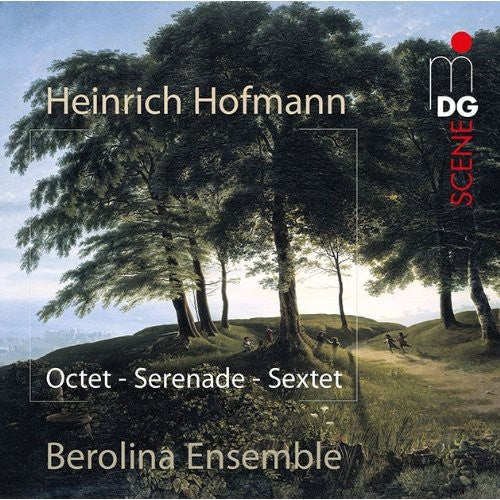
Hofmann: Octet, Op. 80; Serenade, Op. 65; Sextett, Op. 25
HOFMANN Octet. Serenade. Sextet • Berolina Ens • MDG 948 18086 (SACD: 78:03)
There are some 20 composers named Hofmann or Hofman or Hoffman or Hoffmann listed in ArkivMusic.com. This one is Heinrich Karl J. Hofmann (one “f,” two “n”s). I find only one other listing of a piece by this composer on ArkivMusic, and nothing in the Fanfare Archive. Hence, this 78-minute program of three substantial chamber works fills a need.
The music is conservatively romantic in style, coming from a composer (1842–1902) who lived through the ages of Berlioz, Liszt, Wagner, and early Mahler, seemingly without being touched by any of them. Does that mean Hofmann is not worth remembering? The extensive program notes by Michael Wittmann make a strong case for the composer, noting that music need not be “metaphysical” to be eminently enjoyable and worthy, and that Hofmann “was one of the most frequently performed German composers during his lifetime.” Wittmann goes on to make the almost unbelievable claims that the Symphony, op. 22, of 1874 was “for a time the most frequently performed symphony in the German empire,” and that “the cantata Märchen von der schönen Melusine was performed more than 1,500 times” between 1875 and 1895 in Germany, England, and the U.S.A.
Weber, Spohr, Reinecke, and Bruch are the names that come to mind when listening to Hofmann’s chamber music. It is invariably pleasant, easy-going, lyrical, and melodious without being remarkable. It does not reach out and grab you, but then neither does Beethoven’s Septet, which was one of that composer’s most popular works during his lifetime. As a measure of Hofmann’s standing in the U.S. in the late 19th century, it was the New York Philharmonic Club that commissioned his Serenade for Flute and Strings. The Serenade impresses not so much for its melodic ideas, but for the skill with which Hofmann handles his material. The addition of a double bass to the standard string quartet gives the music an almost symphonic weight. The sonata-form first movement is full of sparkle, the second has an elegiac quality, the scherzo makes its mark with unusual rhythmic patterns, and the energetic finale is imbued with strong dance-like impulses.
Asked to name an octet for the mixed ensemble of strings and winds, most music lovers would have no trouble citing Schubert’s. But beyond his, what else is there? Not counting those that include piano, I can come up with the paltry list of only Spohr, Rheinberger, Hindemith, Sigismund Neukomm, and now Hofmann. (I’ve probably missed an obvious one; perhaps some kind reader will send a letter to the editor.) Hofmann’s Octet is not for quite the same forces as Schubert’s (Hofmann has a flute, Schubert a double bass). Purely by coincidence, I would assume, Hofmann’s Octet opens with a subject that seems almost a clone of Mendelssohn’s Octet for Strings. The movement breezes along in a most genial vein, and is followed a bucolic slow movement, a gavotte that will inevitably set faces smiling and feet tapping, and a finale that romps along with Brahmsian vigor.
The 11-member Berlin-based Berolina Ensemble is a first-class group that turns in committed performances full of vitality, dynamic contrast, and color. Hofmann may not be a composer on the order of a Schubert or a Weber, but the Berolinas make such a strong case for him that while listening one cannot but fully enjoy the experience. Excellent sound.
FANFARE: Robert Markow
HOFMANN Octet. Serenade. Sextet • Berolina Ens • MDG 948 18086 (SACD: 78:03)
There are some 20 composers named Hofmann or Hofman or Hoffman or Hoffmann listed in ArkivMusic.com. This one is Heinrich Karl J. Hofmann (one “f,” two “n”s). I find only one other listing of a piece by this composer on ArkivMusic, and nothing in the Fanfare Archive. Hence, this 78-minute program of three substantial chamber works fills a need.
The music is conservatively romantic in style, coming from a composer (1842–1902) who lived through the ages of Berlioz, Liszt, Wagner, and early Mahler, seemingly without being touched by any of them. Does that mean Hofmann is not worth remembering? The extensive program notes by Michael Wittmann make a strong case for the composer, noting that music need not be “metaphysical” to be eminently enjoyable and worthy, and that Hofmann “was one of the most frequently performed German composers during his lifetime.” Wittmann goes on to make the almost unbelievable claims that the Symphony, op. 22, of 1874 was “for a time the most frequently performed symphony in the German empire,” and that “the cantata Märchen von der schönen Melusine was performed more than 1,500 times” between 1875 and 1895 in Germany, England, and the U.S.A.
Weber, Spohr, Reinecke, and Bruch are the names that come to mind when listening to Hofmann’s chamber music. It is invariably pleasant, easy-going, lyrical, and melodious without being remarkable. It does not reach out and grab you, but then neither does Beethoven’s Septet, which was one of that composer’s most popular works during his lifetime. As a measure of Hofmann’s standing in the U.S. in the late 19th century, it was the New York Philharmonic Club that commissioned his Serenade for Flute and Strings. The Serenade impresses not so much for its melodic ideas, but for the skill with which Hofmann handles his material. The addition of a double bass to the standard string quartet gives the music an almost symphonic weight. The sonata-form first movement is full of sparkle, the second has an elegiac quality, the scherzo makes its mark with unusual rhythmic patterns, and the energetic finale is imbued with strong dance-like impulses.
Asked to name an octet for the mixed ensemble of strings and winds, most music lovers would have no trouble citing Schubert’s. But beyond his, what else is there? Not counting those that include piano, I can come up with the paltry list of only Spohr, Rheinberger, Hindemith, Sigismund Neukomm, and now Hofmann. (I’ve probably missed an obvious one; perhaps some kind reader will send a letter to the editor.) Hofmann’s Octet is not for quite the same forces as Schubert’s (Hofmann has a flute, Schubert a double bass). Purely by coincidence, I would assume, Hofmann’s Octet opens with a subject that seems almost a clone of Mendelssohn’s Octet for Strings. The movement breezes along in a most genial vein, and is followed a bucolic slow movement, a gavotte that will inevitably set faces smiling and feet tapping, and a finale that romps along with Brahmsian vigor.
The 11-member Berlin-based Berolina Ensemble is a first-class group that turns in committed performances full of vitality, dynamic contrast, and color. Hofmann may not be a composer on the order of a Schubert or a Weber, but the Berolinas make such a strong case for him that while listening one cannot but fully enjoy the experience. Excellent sound.
FANFARE: Robert Markow
$8.75
Original: $24.99
-65%Hofmann: Octet, Op. 80; Serenade, Op. 65; Sextett, Op. 25—
$24.99
$8.75Description
HOFMANN Octet. Serenade. Sextet • Berolina Ens • MDG 948 18086 (SACD: 78:03)
There are some 20 composers named Hofmann or Hofman or Hoffman or Hoffmann listed in ArkivMusic.com. This one is Heinrich Karl J. Hofmann (one “f,” two “n”s). I find only one other listing of a piece by this composer on ArkivMusic, and nothing in the Fanfare Archive. Hence, this 78-minute program of three substantial chamber works fills a need.
The music is conservatively romantic in style, coming from a composer (1842–1902) who lived through the ages of Berlioz, Liszt, Wagner, and early Mahler, seemingly without being touched by any of them. Does that mean Hofmann is not worth remembering? The extensive program notes by Michael Wittmann make a strong case for the composer, noting that music need not be “metaphysical” to be eminently enjoyable and worthy, and that Hofmann “was one of the most frequently performed German composers during his lifetime.” Wittmann goes on to make the almost unbelievable claims that the Symphony, op. 22, of 1874 was “for a time the most frequently performed symphony in the German empire,” and that “the cantata Märchen von der schönen Melusine was performed more than 1,500 times” between 1875 and 1895 in Germany, England, and the U.S.A.
Weber, Spohr, Reinecke, and Bruch are the names that come to mind when listening to Hofmann’s chamber music. It is invariably pleasant, easy-going, lyrical, and melodious without being remarkable. It does not reach out and grab you, but then neither does Beethoven’s Septet, which was one of that composer’s most popular works during his lifetime. As a measure of Hofmann’s standing in the U.S. in the late 19th century, it was the New York Philharmonic Club that commissioned his Serenade for Flute and Strings. The Serenade impresses not so much for its melodic ideas, but for the skill with which Hofmann handles his material. The addition of a double bass to the standard string quartet gives the music an almost symphonic weight. The sonata-form first movement is full of sparkle, the second has an elegiac quality, the scherzo makes its mark with unusual rhythmic patterns, and the energetic finale is imbued with strong dance-like impulses.
Asked to name an octet for the mixed ensemble of strings and winds, most music lovers would have no trouble citing Schubert’s. But beyond his, what else is there? Not counting those that include piano, I can come up with the paltry list of only Spohr, Rheinberger, Hindemith, Sigismund Neukomm, and now Hofmann. (I’ve probably missed an obvious one; perhaps some kind reader will send a letter to the editor.) Hofmann’s Octet is not for quite the same forces as Schubert’s (Hofmann has a flute, Schubert a double bass). Purely by coincidence, I would assume, Hofmann’s Octet opens with a subject that seems almost a clone of Mendelssohn’s Octet for Strings. The movement breezes along in a most genial vein, and is followed a bucolic slow movement, a gavotte that will inevitably set faces smiling and feet tapping, and a finale that romps along with Brahmsian vigor.
The 11-member Berlin-based Berolina Ensemble is a first-class group that turns in committed performances full of vitality, dynamic contrast, and color. Hofmann may not be a composer on the order of a Schubert or a Weber, but the Berolinas make such a strong case for him that while listening one cannot but fully enjoy the experience. Excellent sound.
FANFARE: Robert Markow