🎉 Up to 70% Off Selected ItemsShop Sale

1 / 2
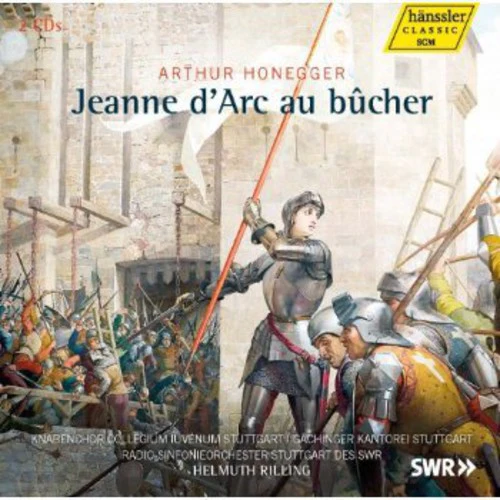
Honegger: Jeanne D'arc Au Bucher / Rilling, Stuttgart Radio Symphony
HONEGGER Jeanne d’Arc au bûcher • Helmuth Rilling, cond; Sylvie Rohrer ( Jeanne d’Arc ); Eörs Kisfaludy ( Fr. Dominique ); Karen Wierzba ( La Vierge ); Letizia Scherrer ( Marguerite ); Kismara Pessatti ( Cathérine ); Jean-Noël Briend (ten); François Le Roux (bs); Stuttgart College Boys’ Ch; Gächinger Kantorei Stuttgart; Stuttgart RSO des SWR • HÄNSSLER 098.636 (2 CDs: 84:30 & French only) Live: Stuttgart 4/2–3/2011
Here is, truly, an unusual release: the little-known but extremely powerful dramatic cantata by Arthur Honegger, Joan of Arc at the Stake, conducted by one of the world’s leading baroque specialists, Helmuth Rilling. This combination, which seems on the surface a mismatch, in fact results in one of the most emotionally powerful and musically atmospheric realizations on record in my entire memory.
The drawback, of course, is that the libretto is in French only. Certainly one is aware enough of Joan’s story to be able to follow what is going on in generalizations, yet the highly literate subtleties of Paul Claudel’s libretto are lost on the non-French speaker. Thus we must rely on the few words we can pick out of the booklet and rely on the emotional and dramatic power of the speakers, singers, chorus, and orchestra. Even within those parameters, this is pretty powerful music. Behind the spoken dialogue, at one point, the chorus enters singing strophic lines in almost Stravinsky-like neoclassicism, which then leads directly into a baritone solo with choral interjections. Honegger’s orchestra slashes and burns throughout: sometimes as an undercurrent, at other times in the foreground, moving from staccato brass chords to stabbing or swirling figures, underlining the drama of the situation—confined to the time of Joan’s trial and execution—in the most dramatic terms possible.
Conductor Marin Alsop has given us this synopsis of the oratorio at npr.org/2011/11/05/142021891/arthur-honeggers-joan-of-arc-for-the-ages:
“Claudel wanted to look at Joan’s life in a series of flashbacks—starting at the end. The piece opens with darkness setting over all of France. Is this the France of 1400 or the France of 1935? Perhaps that’s the point. Joan meets Frère Dominic in the afterlife and recognizes him, at which point they look back on what led to her trial and death. When Joan asks, ‘How did this happen?,’ Frère Dominic replies, ‘It was a game of cards that decided your fate,’ alluding to the political quagmire in which Joan, an illiterate peasant teenager, found herself immersed. The adjudicator at Joan’s trial was aptly named Cauchon (pig), and Claudel goes wild with the possibilities. The assessors are all depicted as animals, with the ass leading the pack and sheep commenting on the proceedings. And then there’s Honegger’s instrumentation, which creates a vibrant and unique sound world. He includes three saxophones plus an ondes martenot —a spooky-sounding instrument, invented in 1928, that sounds like its cousin the theremin. Honegger and Claudel’s collaboration brings Joan to life in a vivid and emotional drama that concludes with the line, ‘There is no greater love than the person who gives his life for a friend.’”
Alsop, as well as other commentators, allude to the “cinematic” quality of this opera-oratorio, mentioning that Honegger was also a film music composer. But if this is film music, it is extremely dominant in mood and structure, which to my ears is far too aggressive a composition to work well in that mode. Yet there is a certain “cinematic” structure to the work, which in effect makes it a “movie for the ears.” (One constantly hears nowadays that we “listen with our eyes,” so why not at least one piece where we “see with our ears”?) Alsop conducted a live performance of this work at the Barbican in 2011, but according to one online commentator the program notes for that performance were also spotty and indistinct.
I’ve been unable to track down an English translation of the text anywhere online. From what I can judge, between the French-only text and my slight grasp of the language, the actors in this recording are all extremely good, bringing out Joan’s combination of confusion, defiance, and fear perfectly. Much of the credit for this goes to Sylvie Rohrer, whose reading of the text is both dramatic and natural-sounding—a rare combination indeed. The singers are all excellent in both vocal quality and—more importantly—diction, as is the chorus itself. Despite being German, Rilling is to be highly commended for his persistence in bringing out the proper idiomatic Frenchness of the music as well as his insistence on clarity of pronunciation.
Particular credit for the success of this recording goes to engineer Friedemann Trumpp for capturing such incredible 3D sound.
There appear to be three other recordings available on CD: Supraphon 11 0557/58 featuring narrators Nelly Borgeaud and Michel Favory, sopranos Christiane Château and Anne-Marie Rodde, alto Huguette Brachet, and the Kühn Children’s Chorus, Czech Philharmonic Chorus and Orchestra conducted by Serge Baudo; a single-disc version (meaning under 80 minutes) with narrators Anne-Marie Ferrière, René Piloy, and Madeleine Joris, sopranos Marthe Dugard and Ria Lenssens, tenor Frédéric Anspach, and conductor Louis de Vocht (Opera d’Oro 1223); and another one-disc version conducted by Siegfried Heinrich (VMS Musical Treasures 152), none of which I’ve heard. I have, however, heard the recording by Sonia Petrovna, Michaël Lonsdale, Christian Papis, Anne-Marie Blanzat, other soloists, the Choeur de Rouen-Haute-Normande, and Orchestre Symphonique Français conducted by Laurent Petitgirard on Cascavelle OSF 49008/09. This was also a live performance, given on June 26 and 27, 1992 at the Salle Wagram in Paris. I could only find references to this recording on French CD sites like Price Minister and Amazon.fr. The sound quality is also excellent, and this performance, too, is wonderfully atmospheric, but none of the actors are recorded particularly well—they sound like they’re behind the choir. The actress playing Joan (Petrovna) is good, but does not declaim her text with as much feeling (perhaps she was an excellent actress visually, but on CDs you can’t see her). A very good performance, then, but this new Hänssler release is just as fine musically, better in the placement of the actors, and of course much easier to obtain, making it well worth getting. With the odd running time of this work, one could possibly combine it with the equally excellent but seldom-heard L’Amore de tre re of Montemezzi for a superb evening of dramatic works that will challenge and not just entertain you.
FANFARE: Lynn René Bayley
HONEGGER Jeanne d’Arc au bûcher • Helmuth Rilling, cond; Sylvie Rohrer ( Jeanne d’Arc ); Eörs Kisfaludy ( Fr. Dominique ); Karen Wierzba ( La Vierge ); Letizia Scherrer ( Marguerite ); Kismara Pessatti ( Cathérine ); Jean-Noël Briend (ten); François Le Roux (bs); Stuttgart College Boys’ Ch; Gächinger Kantorei Stuttgart; Stuttgart RSO des SWR • HÄNSSLER 098.636 (2 CDs: 84:30 & French only) Live: Stuttgart 4/2–3/2011
Here is, truly, an unusual release: the little-known but extremely powerful dramatic cantata by Arthur Honegger, Joan of Arc at the Stake, conducted by one of the world’s leading baroque specialists, Helmuth Rilling. This combination, which seems on the surface a mismatch, in fact results in one of the most emotionally powerful and musically atmospheric realizations on record in my entire memory.
The drawback, of course, is that the libretto is in French only. Certainly one is aware enough of Joan’s story to be able to follow what is going on in generalizations, yet the highly literate subtleties of Paul Claudel’s libretto are lost on the non-French speaker. Thus we must rely on the few words we can pick out of the booklet and rely on the emotional and dramatic power of the speakers, singers, chorus, and orchestra. Even within those parameters, this is pretty powerful music. Behind the spoken dialogue, at one point, the chorus enters singing strophic lines in almost Stravinsky-like neoclassicism, which then leads directly into a baritone solo with choral interjections. Honegger’s orchestra slashes and burns throughout: sometimes as an undercurrent, at other times in the foreground, moving from staccato brass chords to stabbing or swirling figures, underlining the drama of the situation—confined to the time of Joan’s trial and execution—in the most dramatic terms possible.
Conductor Marin Alsop has given us this synopsis of the oratorio at npr.org/2011/11/05/142021891/arthur-honeggers-joan-of-arc-for-the-ages:
“Claudel wanted to look at Joan’s life in a series of flashbacks—starting at the end. The piece opens with darkness setting over all of France. Is this the France of 1400 or the France of 1935? Perhaps that’s the point. Joan meets Frère Dominic in the afterlife and recognizes him, at which point they look back on what led to her trial and death. When Joan asks, ‘How did this happen?,’ Frère Dominic replies, ‘It was a game of cards that decided your fate,’ alluding to the political quagmire in which Joan, an illiterate peasant teenager, found herself immersed. The adjudicator at Joan’s trial was aptly named Cauchon (pig), and Claudel goes wild with the possibilities. The assessors are all depicted as animals, with the ass leading the pack and sheep commenting on the proceedings. And then there’s Honegger’s instrumentation, which creates a vibrant and unique sound world. He includes three saxophones plus an ondes martenot —a spooky-sounding instrument, invented in 1928, that sounds like its cousin the theremin. Honegger and Claudel’s collaboration brings Joan to life in a vivid and emotional drama that concludes with the line, ‘There is no greater love than the person who gives his life for a friend.’”
Alsop, as well as other commentators, allude to the “cinematic” quality of this opera-oratorio, mentioning that Honegger was also a film music composer. But if this is film music, it is extremely dominant in mood and structure, which to my ears is far too aggressive a composition to work well in that mode. Yet there is a certain “cinematic” structure to the work, which in effect makes it a “movie for the ears.” (One constantly hears nowadays that we “listen with our eyes,” so why not at least one piece where we “see with our ears”?) Alsop conducted a live performance of this work at the Barbican in 2011, but according to one online commentator the program notes for that performance were also spotty and indistinct.
I’ve been unable to track down an English translation of the text anywhere online. From what I can judge, between the French-only text and my slight grasp of the language, the actors in this recording are all extremely good, bringing out Joan’s combination of confusion, defiance, and fear perfectly. Much of the credit for this goes to Sylvie Rohrer, whose reading of the text is both dramatic and natural-sounding—a rare combination indeed. The singers are all excellent in both vocal quality and—more importantly—diction, as is the chorus itself. Despite being German, Rilling is to be highly commended for his persistence in bringing out the proper idiomatic Frenchness of the music as well as his insistence on clarity of pronunciation.
Particular credit for the success of this recording goes to engineer Friedemann Trumpp for capturing such incredible 3D sound.
There appear to be three other recordings available on CD: Supraphon 11 0557/58 featuring narrators Nelly Borgeaud and Michel Favory, sopranos Christiane Château and Anne-Marie Rodde, alto Huguette Brachet, and the Kühn Children’s Chorus, Czech Philharmonic Chorus and Orchestra conducted by Serge Baudo; a single-disc version (meaning under 80 minutes) with narrators Anne-Marie Ferrière, René Piloy, and Madeleine Joris, sopranos Marthe Dugard and Ria Lenssens, tenor Frédéric Anspach, and conductor Louis de Vocht (Opera d’Oro 1223); and another one-disc version conducted by Siegfried Heinrich (VMS Musical Treasures 152), none of which I’ve heard. I have, however, heard the recording by Sonia Petrovna, Michaël Lonsdale, Christian Papis, Anne-Marie Blanzat, other soloists, the Choeur de Rouen-Haute-Normande, and Orchestre Symphonique Français conducted by Laurent Petitgirard on Cascavelle OSF 49008/09. This was also a live performance, given on June 26 and 27, 1992 at the Salle Wagram in Paris. I could only find references to this recording on French CD sites like Price Minister and Amazon.fr. The sound quality is also excellent, and this performance, too, is wonderfully atmospheric, but none of the actors are recorded particularly well—they sound like they’re behind the choir. The actress playing Joan (Petrovna) is good, but does not declaim her text with as much feeling (perhaps she was an excellent actress visually, but on CDs you can’t see her). A very good performance, then, but this new Hänssler release is just as fine musically, better in the placement of the actors, and of course much easier to obtain, making it well worth getting. With the odd running time of this work, one could possibly combine it with the equally excellent but seldom-heard L’Amore de tre re of Montemezzi for a superb evening of dramatic works that will challenge and not just entertain you.
FANFARE: Lynn René Bayley
$20.99
Honegger: Jeanne D'arc Au Bucher / Rilling, Stuttgart Radio Symphony—
$20.99
Description
HONEGGER Jeanne d’Arc au bûcher • Helmuth Rilling, cond; Sylvie Rohrer ( Jeanne d’Arc ); Eörs Kisfaludy ( Fr. Dominique ); Karen Wierzba ( La Vierge ); Letizia Scherrer ( Marguerite ); Kismara Pessatti ( Cathérine ); Jean-Noël Briend (ten); François Le Roux (bs); Stuttgart College Boys’ Ch; Gächinger Kantorei Stuttgart; Stuttgart RSO des SWR • HÄNSSLER 098.636 (2 CDs: 84:30 & French only) Live: Stuttgart 4/2–3/2011
Here is, truly, an unusual release: the little-known but extremely powerful dramatic cantata by Arthur Honegger, Joan of Arc at the Stake, conducted by one of the world’s leading baroque specialists, Helmuth Rilling. This combination, which seems on the surface a mismatch, in fact results in one of the most emotionally powerful and musically atmospheric realizations on record in my entire memory.
The drawback, of course, is that the libretto is in French only. Certainly one is aware enough of Joan’s story to be able to follow what is going on in generalizations, yet the highly literate subtleties of Paul Claudel’s libretto are lost on the non-French speaker. Thus we must rely on the few words we can pick out of the booklet and rely on the emotional and dramatic power of the speakers, singers, chorus, and orchestra. Even within those parameters, this is pretty powerful music. Behind the spoken dialogue, at one point, the chorus enters singing strophic lines in almost Stravinsky-like neoclassicism, which then leads directly into a baritone solo with choral interjections. Honegger’s orchestra slashes and burns throughout: sometimes as an undercurrent, at other times in the foreground, moving from staccato brass chords to stabbing or swirling figures, underlining the drama of the situation—confined to the time of Joan’s trial and execution—in the most dramatic terms possible.
Conductor Marin Alsop has given us this synopsis of the oratorio at npr.org/2011/11/05/142021891/arthur-honeggers-joan-of-arc-for-the-ages:
“Claudel wanted to look at Joan’s life in a series of flashbacks—starting at the end. The piece opens with darkness setting over all of France. Is this the France of 1400 or the France of 1935? Perhaps that’s the point. Joan meets Frère Dominic in the afterlife and recognizes him, at which point they look back on what led to her trial and death. When Joan asks, ‘How did this happen?,’ Frère Dominic replies, ‘It was a game of cards that decided your fate,’ alluding to the political quagmire in which Joan, an illiterate peasant teenager, found herself immersed. The adjudicator at Joan’s trial was aptly named Cauchon (pig), and Claudel goes wild with the possibilities. The assessors are all depicted as animals, with the ass leading the pack and sheep commenting on the proceedings. And then there’s Honegger’s instrumentation, which creates a vibrant and unique sound world. He includes three saxophones plus an ondes martenot —a spooky-sounding instrument, invented in 1928, that sounds like its cousin the theremin. Honegger and Claudel’s collaboration brings Joan to life in a vivid and emotional drama that concludes with the line, ‘There is no greater love than the person who gives his life for a friend.’”
Alsop, as well as other commentators, allude to the “cinematic” quality of this opera-oratorio, mentioning that Honegger was also a film music composer. But if this is film music, it is extremely dominant in mood and structure, which to my ears is far too aggressive a composition to work well in that mode. Yet there is a certain “cinematic” structure to the work, which in effect makes it a “movie for the ears.” (One constantly hears nowadays that we “listen with our eyes,” so why not at least one piece where we “see with our ears”?) Alsop conducted a live performance of this work at the Barbican in 2011, but according to one online commentator the program notes for that performance were also spotty and indistinct.
I’ve been unable to track down an English translation of the text anywhere online. From what I can judge, between the French-only text and my slight grasp of the language, the actors in this recording are all extremely good, bringing out Joan’s combination of confusion, defiance, and fear perfectly. Much of the credit for this goes to Sylvie Rohrer, whose reading of the text is both dramatic and natural-sounding—a rare combination indeed. The singers are all excellent in both vocal quality and—more importantly—diction, as is the chorus itself. Despite being German, Rilling is to be highly commended for his persistence in bringing out the proper idiomatic Frenchness of the music as well as his insistence on clarity of pronunciation.
Particular credit for the success of this recording goes to engineer Friedemann Trumpp for capturing such incredible 3D sound.
There appear to be three other recordings available on CD: Supraphon 11 0557/58 featuring narrators Nelly Borgeaud and Michel Favory, sopranos Christiane Château and Anne-Marie Rodde, alto Huguette Brachet, and the Kühn Children’s Chorus, Czech Philharmonic Chorus and Orchestra conducted by Serge Baudo; a single-disc version (meaning under 80 minutes) with narrators Anne-Marie Ferrière, René Piloy, and Madeleine Joris, sopranos Marthe Dugard and Ria Lenssens, tenor Frédéric Anspach, and conductor Louis de Vocht (Opera d’Oro 1223); and another one-disc version conducted by Siegfried Heinrich (VMS Musical Treasures 152), none of which I’ve heard. I have, however, heard the recording by Sonia Petrovna, Michaël Lonsdale, Christian Papis, Anne-Marie Blanzat, other soloists, the Choeur de Rouen-Haute-Normande, and Orchestre Symphonique Français conducted by Laurent Petitgirard on Cascavelle OSF 49008/09. This was also a live performance, given on June 26 and 27, 1992 at the Salle Wagram in Paris. I could only find references to this recording on French CD sites like Price Minister and Amazon.fr. The sound quality is also excellent, and this performance, too, is wonderfully atmospheric, but none of the actors are recorded particularly well—they sound like they’re behind the choir. The actress playing Joan (Petrovna) is good, but does not declaim her text with as much feeling (perhaps she was an excellent actress visually, but on CDs you can’t see her). A very good performance, then, but this new Hänssler release is just as fine musically, better in the placement of the actors, and of course much easier to obtain, making it well worth getting. With the odd running time of this work, one could possibly combine it with the equally excellent but seldom-heard L’Amore de tre re of Montemezzi for a superb evening of dramatic works that will challenge and not just entertain you.
FANFARE: Lynn René Bayley