🎉 Up to 70% Off Selected ItemsShop Sale

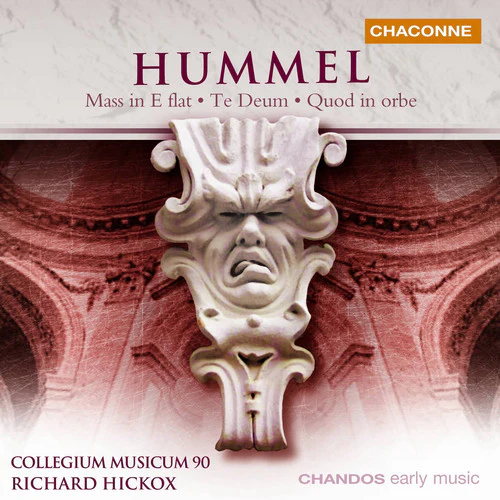
Hummel: Mass, Etc / Richard Hickox, Et Al
This is the second volume in Chandos’s series devoted to the masses of Johann Nepomuk Hummel (1778–1837), following on a stirring recording of masses in D and B flat (CHAN 0681). The only competition for this E??Mass with which I am familiar is a Koch Schwann recording led by Martin Haselbock (317792) and I find somewhat more energy and an improved sense of shaping here from Hickox.
The problem for me is that this is decent, good, pleasant music—but not more than that. I find a bit more of a creative spark in the two masses on the earlier recording, but to my ears, none of this music has about it the originality and depth of Hummel’s best piano music. When one hears one of his piano concertos (particularly those in B Minor and A Minor), one hears a distinctive voice—music that stays in the memory after the sounds have ended. His piano music may not have about it the greatness of stature of Beethoven or Chopin (between whom he was an interesting stylistic bridge), but it is music of presence, music of immediate appeal and lasting impact. To my ears, at least, the same cannot be said for his religious music.
The E flat?Mass was composed in 1804, and is apparently one of the first important works by the composer after he became Konzertmeister at the Esterhazy court, taking over the Kapellmeister title after Haydn’s death in 1809. (Hummel left the court in 1811, and was not replaced—the beginning of the end of the importance of music at the court). Hummel was considered by contemporaries to be one of the most important musicians of his time, and he was a prolific composer in many forms. But when set against the religious choral works of Mozart, Haydn, Beethoven, and even Schumann or Mendelssohn, the music on this disc pales, its impression evaporating almost immediately after it sounds.
The strongest work is actually the Gradual “Quod in orbe,” probably written for the Esterhazy court in 1806. It is scored for chorus and orchestra (no soloists), and has an energy and spark about it that raises it above the rest of the music here. The weakest music is found in the Te Deum, a 10-minute piece that even Chandos’s annotator describes as “one dimensional.”
Hickox does all he can with the music, shaping it tautly and eliciting involved, spirited singing and playing. The soloists are excellent, Chandos’s recorded sound is what we’ve come to expect from the company—rich, warm, reverberant, but not muddy. Informative notes and full texts accompany the disc.
Henry Fogel, FANFARE
The problem for me is that this is decent, good, pleasant music—but not more than that. I find a bit more of a creative spark in the two masses on the earlier recording, but to my ears, none of this music has about it the originality and depth of Hummel’s best piano music. When one hears one of his piano concertos (particularly those in B Minor and A Minor), one hears a distinctive voice—music that stays in the memory after the sounds have ended. His piano music may not have about it the greatness of stature of Beethoven or Chopin (between whom he was an interesting stylistic bridge), but it is music of presence, music of immediate appeal and lasting impact. To my ears, at least, the same cannot be said for his religious music.
The E flat?Mass was composed in 1804, and is apparently one of the first important works by the composer after he became Konzertmeister at the Esterhazy court, taking over the Kapellmeister title after Haydn’s death in 1809. (Hummel left the court in 1811, and was not replaced—the beginning of the end of the importance of music at the court). Hummel was considered by contemporaries to be one of the most important musicians of his time, and he was a prolific composer in many forms. But when set against the religious choral works of Mozart, Haydn, Beethoven, and even Schumann or Mendelssohn, the music on this disc pales, its impression evaporating almost immediately after it sounds.
The strongest work is actually the Gradual “Quod in orbe,” probably written for the Esterhazy court in 1806. It is scored for chorus and orchestra (no soloists), and has an energy and spark about it that raises it above the rest of the music here. The weakest music is found in the Te Deum, a 10-minute piece that even Chandos’s annotator describes as “one dimensional.”
Hickox does all he can with the music, shaping it tautly and eliciting involved, spirited singing and playing. The soloists are excellent, Chandos’s recorded sound is what we’ve come to expect from the company—rich, warm, reverberant, but not muddy. Informative notes and full texts accompany the disc.
Henry Fogel, FANFARE
This is the second volume in Chandos’s series devoted to the masses of Johann Nepomuk Hummel (1778–1837), following on a stirring recording of masses in D and B flat (CHAN 0681). The only competition for this E??Mass with which I am familiar is a Koch Schwann recording led by Martin Haselbock (317792) and I find somewhat more energy and an improved sense of shaping here from Hickox.
The problem for me is that this is decent, good, pleasant music—but not more than that. I find a bit more of a creative spark in the two masses on the earlier recording, but to my ears, none of this music has about it the originality and depth of Hummel’s best piano music. When one hears one of his piano concertos (particularly those in B Minor and A Minor), one hears a distinctive voice—music that stays in the memory after the sounds have ended. His piano music may not have about it the greatness of stature of Beethoven or Chopin (between whom he was an interesting stylistic bridge), but it is music of presence, music of immediate appeal and lasting impact. To my ears, at least, the same cannot be said for his religious music.
The E flat?Mass was composed in 1804, and is apparently one of the first important works by the composer after he became Konzertmeister at the Esterhazy court, taking over the Kapellmeister title after Haydn’s death in 1809. (Hummel left the court in 1811, and was not replaced—the beginning of the end of the importance of music at the court). Hummel was considered by contemporaries to be one of the most important musicians of his time, and he was a prolific composer in many forms. But when set against the religious choral works of Mozart, Haydn, Beethoven, and even Schumann or Mendelssohn, the music on this disc pales, its impression evaporating almost immediately after it sounds.
The strongest work is actually the Gradual “Quod in orbe,” probably written for the Esterhazy court in 1806. It is scored for chorus and orchestra (no soloists), and has an energy and spark about it that raises it above the rest of the music here. The weakest music is found in the Te Deum, a 10-minute piece that even Chandos’s annotator describes as “one dimensional.”
Hickox does all he can with the music, shaping it tautly and eliciting involved, spirited singing and playing. The soloists are excellent, Chandos’s recorded sound is what we’ve come to expect from the company—rich, warm, reverberant, but not muddy. Informative notes and full texts accompany the disc.
Henry Fogel, FANFARE
The problem for me is that this is decent, good, pleasant music—but not more than that. I find a bit more of a creative spark in the two masses on the earlier recording, but to my ears, none of this music has about it the originality and depth of Hummel’s best piano music. When one hears one of his piano concertos (particularly those in B Minor and A Minor), one hears a distinctive voice—music that stays in the memory after the sounds have ended. His piano music may not have about it the greatness of stature of Beethoven or Chopin (between whom he was an interesting stylistic bridge), but it is music of presence, music of immediate appeal and lasting impact. To my ears, at least, the same cannot be said for his religious music.
The E flat?Mass was composed in 1804, and is apparently one of the first important works by the composer after he became Konzertmeister at the Esterhazy court, taking over the Kapellmeister title after Haydn’s death in 1809. (Hummel left the court in 1811, and was not replaced—the beginning of the end of the importance of music at the court). Hummel was considered by contemporaries to be one of the most important musicians of his time, and he was a prolific composer in many forms. But when set against the religious choral works of Mozart, Haydn, Beethoven, and even Schumann or Mendelssohn, the music on this disc pales, its impression evaporating almost immediately after it sounds.
The strongest work is actually the Gradual “Quod in orbe,” probably written for the Esterhazy court in 1806. It is scored for chorus and orchestra (no soloists), and has an energy and spark about it that raises it above the rest of the music here. The weakest music is found in the Te Deum, a 10-minute piece that even Chandos’s annotator describes as “one dimensional.”
Hickox does all he can with the music, shaping it tautly and eliciting involved, spirited singing and playing. The soloists are excellent, Chandos’s recorded sound is what we’ve come to expect from the company—rich, warm, reverberant, but not muddy. Informative notes and full texts accompany the disc.
Henry Fogel, FANFARE
$5.95
Original: $16.99
-65%Hummel: Mass, Etc / Richard Hickox, Et Al—
$16.99
$5.95Description
This is the second volume in Chandos’s series devoted to the masses of Johann Nepomuk Hummel (1778–1837), following on a stirring recording of masses in D and B flat (CHAN 0681). The only competition for this E??Mass with which I am familiar is a Koch Schwann recording led by Martin Haselbock (317792) and I find somewhat more energy and an improved sense of shaping here from Hickox.
The problem for me is that this is decent, good, pleasant music—but not more than that. I find a bit more of a creative spark in the two masses on the earlier recording, but to my ears, none of this music has about it the originality and depth of Hummel’s best piano music. When one hears one of his piano concertos (particularly those in B Minor and A Minor), one hears a distinctive voice—music that stays in the memory after the sounds have ended. His piano music may not have about it the greatness of stature of Beethoven or Chopin (between whom he was an interesting stylistic bridge), but it is music of presence, music of immediate appeal and lasting impact. To my ears, at least, the same cannot be said for his religious music.
The E flat?Mass was composed in 1804, and is apparently one of the first important works by the composer after he became Konzertmeister at the Esterhazy court, taking over the Kapellmeister title after Haydn’s death in 1809. (Hummel left the court in 1811, and was not replaced—the beginning of the end of the importance of music at the court). Hummel was considered by contemporaries to be one of the most important musicians of his time, and he was a prolific composer in many forms. But when set against the religious choral works of Mozart, Haydn, Beethoven, and even Schumann or Mendelssohn, the music on this disc pales, its impression evaporating almost immediately after it sounds.
The strongest work is actually the Gradual “Quod in orbe,” probably written for the Esterhazy court in 1806. It is scored for chorus and orchestra (no soloists), and has an energy and spark about it that raises it above the rest of the music here. The weakest music is found in the Te Deum, a 10-minute piece that even Chandos’s annotator describes as “one dimensional.”
Hickox does all he can with the music, shaping it tautly and eliciting involved, spirited singing and playing. The soloists are excellent, Chandos’s recorded sound is what we’ve come to expect from the company—rich, warm, reverberant, but not muddy. Informative notes and full texts accompany the disc.
Henry Fogel, FANFARE
The problem for me is that this is decent, good, pleasant music—but not more than that. I find a bit more of a creative spark in the two masses on the earlier recording, but to my ears, none of this music has about it the originality and depth of Hummel’s best piano music. When one hears one of his piano concertos (particularly those in B Minor and A Minor), one hears a distinctive voice—music that stays in the memory after the sounds have ended. His piano music may not have about it the greatness of stature of Beethoven or Chopin (between whom he was an interesting stylistic bridge), but it is music of presence, music of immediate appeal and lasting impact. To my ears, at least, the same cannot be said for his religious music.
The E flat?Mass was composed in 1804, and is apparently one of the first important works by the composer after he became Konzertmeister at the Esterhazy court, taking over the Kapellmeister title after Haydn’s death in 1809. (Hummel left the court in 1811, and was not replaced—the beginning of the end of the importance of music at the court). Hummel was considered by contemporaries to be one of the most important musicians of his time, and he was a prolific composer in many forms. But when set against the religious choral works of Mozart, Haydn, Beethoven, and even Schumann or Mendelssohn, the music on this disc pales, its impression evaporating almost immediately after it sounds.
The strongest work is actually the Gradual “Quod in orbe,” probably written for the Esterhazy court in 1806. It is scored for chorus and orchestra (no soloists), and has an energy and spark about it that raises it above the rest of the music here. The weakest music is found in the Te Deum, a 10-minute piece that even Chandos’s annotator describes as “one dimensional.”
Hickox does all he can with the music, shaping it tautly and eliciting involved, spirited singing and playing. The soloists are excellent, Chandos’s recorded sound is what we’ve come to expect from the company—rich, warm, reverberant, but not muddy. Informative notes and full texts accompany the disc.
Henry Fogel, FANFARE