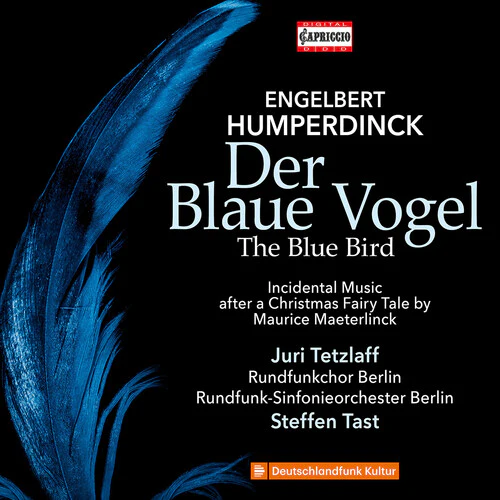
Humperdinck: The Blue Bird / J. Tetzlaff, Tast, Berlin RSO
In 1908, Maurice Maeterlinck wrote his play The Blue Bird (L’Oiseau bleu). Having proved a good source of operatic subjects before (Pelléas et Mélisande, Ariane et Barbe-Bleue), it is no surprise that composers jumped at the opportunity to write music to this latest. The French composer Albert Wolff made an opera of it that, though premiered at the MET, has since been forgotten. But even before that, in 1912, Max Reinhardt put it on as an adapted Christmas play in Berlin and he had none less than Engelbert Humperdinck write the incidental music to it. The music was never published until Steffen Tast found the score and salvaged it for us to hear. A sweet story and sweeter still music by Humperdinck newly discovered? Why, that’s in and of itself as though it was Christmas!
REVIEW:
Steffen Tast really deserves credit for restoring this work to the repertoire and for giving such a fine and dedicated traversal of the music. One only has to listen to the stately but regretful theme as the children take leave of their grandparents in the land of memories to get a sense of Mr Tast’s rapport with the Rundfunk-Sinfonieorchester Berlin. This music bears a strong resemblance to Mahler, but just until the solo violin takes over with a sentimental theme that is lusciously played by the un-named concertmaster. Tast elegantly shapes the beautifully sketched musical themes for Bread, Fire, Water, and Milk, who all become characters in the play. The Rundfunkchor Berlin gets to briefly display their talents in a Christmas carol arranged in two parts, and then later in a wordless chorus for the expectant mothers welcoming their unborn children. Overall Tast skillfully reveals the richness of Humperdinck’s orchestration in an carefully judged reading of this important score.
-- MusicWeb International
In 1908, Maurice Maeterlinck wrote his play The Blue Bird (L’Oiseau bleu). Having proved a good source of operatic subjects before (Pelléas et Mélisande, Ariane et Barbe-Bleue), it is no surprise that composers jumped at the opportunity to write music to this latest. The French composer Albert Wolff made an opera of it that, though premiered at the MET, has since been forgotten. But even before that, in 1912, Max Reinhardt put it on as an adapted Christmas play in Berlin and he had none less than Engelbert Humperdinck write the incidental music to it. The music was never published until Steffen Tast found the score and salvaged it for us to hear. A sweet story and sweeter still music by Humperdinck newly discovered? Why, that’s in and of itself as though it was Christmas!
REVIEW:
Steffen Tast really deserves credit for restoring this work to the repertoire and for giving such a fine and dedicated traversal of the music. One only has to listen to the stately but regretful theme as the children take leave of their grandparents in the land of memories to get a sense of Mr Tast’s rapport with the Rundfunk-Sinfonieorchester Berlin. This music bears a strong resemblance to Mahler, but just until the solo violin takes over with a sentimental theme that is lusciously played by the un-named concertmaster. Tast elegantly shapes the beautifully sketched musical themes for Bread, Fire, Water, and Milk, who all become characters in the play. The Rundfunkchor Berlin gets to briefly display their talents in a Christmas carol arranged in two parts, and then later in a wordless chorus for the expectant mothers welcoming their unborn children. Overall Tast skillfully reveals the richness of Humperdinck’s orchestration in an carefully judged reading of this important score.
-- MusicWeb International
Description
In 1908, Maurice Maeterlinck wrote his play The Blue Bird (L’Oiseau bleu). Having proved a good source of operatic subjects before (Pelléas et Mélisande, Ariane et Barbe-Bleue), it is no surprise that composers jumped at the opportunity to write music to this latest. The French composer Albert Wolff made an opera of it that, though premiered at the MET, has since been forgotten. But even before that, in 1912, Max Reinhardt put it on as an adapted Christmas play in Berlin and he had none less than Engelbert Humperdinck write the incidental music to it. The music was never published until Steffen Tast found the score and salvaged it for us to hear. A sweet story and sweeter still music by Humperdinck newly discovered? Why, that’s in and of itself as though it was Christmas!
REVIEW:
Steffen Tast really deserves credit for restoring this work to the repertoire and for giving such a fine and dedicated traversal of the music. One only has to listen to the stately but regretful theme as the children take leave of their grandparents in the land of memories to get a sense of Mr Tast’s rapport with the Rundfunk-Sinfonieorchester Berlin. This music bears a strong resemblance to Mahler, but just until the solo violin takes over with a sentimental theme that is lusciously played by the un-named concertmaster. Tast elegantly shapes the beautifully sketched musical themes for Bread, Fire, Water, and Milk, who all become characters in the play. The Rundfunkchor Berlin gets to briefly display their talents in a Christmas carol arranged in two parts, and then later in a wordless chorus for the expectant mothers welcoming their unborn children. Overall Tast skillfully reveals the richness of Humperdinck’s orchestration in an carefully judged reading of this important score.
-- MusicWeb International