🎉 Up to 70% Off Selected ItemsShop Sale

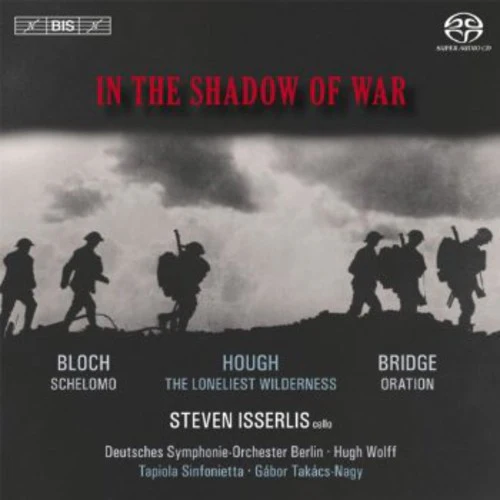
In the Shadow of War / Isserlis
BLOCH Schelomo 1. BRIDGE Oration, Concerto elegiaco 1. HOUGH The Loneliest Wilderness 2 • Steven Isserlis (vc); 1 Hugo Wolff, cond; 1 German SO Berlin; 2 Gábor Takács, cond; 2 Tapiola Sinfonietta • BIS 1992 (SACD: 67:40)
Steven Isserlis joined Richard Hickox and the London Symphony Orchestra in 1988 for a very fine and critically well-received recording of Bloch’s Schelomo for Virgin Classics. Also on that disc was a more than respectable account of Elgar’s Cello Concerto. Except for the benefit of surround-sound audio and improved sonics on this new BIS release, I’m not prepared to say that Isserlis betters his previous account. At 58, he’s still in his prime and at the height of his game technically, but the years seem not to have aged Isserlis’s ancient King of Israel. If anything, Isserlis and Hugo Wolff now put a bit more spring into Solomon’s step, though the difference of only 23 seconds—21:45 in 1988 vs. 21:22 in 2012 is simply too small to notice over the given timespan.
The album comes with a title, In the Shadow of War , and a theme. Bloch, as is well known, was deeply depressed over the grim events unfolding during World War I, and for solace and understanding, he turned to the words of despair and wisdom in the Book of Ecclesiastes, believed to have been authored by Solomon 2,000 years earlier. It was from this that in 1916 Bloch drew inspiration for his magnificent rhapsody-cum-tone poem, Schelomo , for cello and orchestra.
Frank Bridge’s Oration, Concerto elegiaco for Cello and Orchestra is far less well known than Bloch’s opus, but it, too, has received a previous recording by Isserlis and Hickox with the City of London Sinfonia on EMI. Unfortunately, I don’t have that disc, so I can’t compare the performance to this new one, but it doesn’t go back as far as Isserlis’s Virgin Classics Schelomo . The Isserlis/Hickox/EMI CD, coupled with Britten’s Cello Symphony , was released in 2007. We don’t have a description of Bridge’s Oration in the composer’s own words, as we do a description of Schelomo from Bloch himself, so we can only speculate on Bridge’s motives for writing the piece and its precise meaning. In 1930, the date of Oration ’s composition, World War I had long ago ended and World War II was yet to come. Yet everything about this work paints the most grisly, gruesome portrait imaginable of war’s death and destruction. Isserlis, who has written his own album note, describes the music minute by minute, evoking images of “men hurling themselves into enemy fire” and “the leaden march of doomed soldiers.” The solo cello is the fallen soldier who, in the end, is left to expire alone, “his final desolate thoughts fading into empty nothingness.”
Nearly 30 minutes in duration, Bridge’s Oration is not an easy work to listen to, or to play, I’m sure, so it’s not surprising that it hasn’t achieved anything close to the popularity of Bloch’s Schelomo . Besides Isserlis’s own previous recording of the piece, it hasn’t received much attention on disc, but the attention it has received has come from major-league cellists, namely, Rafael Wallfisch, Alban Gerhardt, and Julian Lloyd Webber.
I have to admit that before listening to it, Stephen Hough’s The Loneliest Wilderness shouted, “Raise shields! Raise shields!,” as would any piece for me dated 2005. Well, it only took a matter of seconds before the music cried out to me, “Lower shields! Lower shields!” I would buy this disc for The Loneliest Wilderness alone. The piece was originally composed for bassoon and orchestra, but Isserlis persuaded Hough, composer, pianist, and good friend, that the lyrical nature of the solo part was ideal for cello. Since the ranges of the two instruments are reasonably close to each other, I don’t know if it was necessary for Hough to make any adjustments in the solo line or not, but this is one gorgeous outpouring of poignant, moving, heartfelt music. Bless Stephen Hough for composing it, and bless Steven Isserlis for including it on this disc. The work, according to the note, was inspired by Herbert Read’s poem My Company , and I can’t think of any other way to describe it than to say it’s a rapturous rhapsody in full neoromantic bloom.
This may prove to be the best cello and orchestra recording of the year, and it’s urgently recommended.
FANFARE: Jerry Dubins
BLOCH Schelomo 1. BRIDGE Oration, Concerto elegiaco 1. HOUGH The Loneliest Wilderness 2 • Steven Isserlis (vc); 1 Hugo Wolff, cond; 1 German SO Berlin; 2 Gábor Takács, cond; 2 Tapiola Sinfonietta • BIS 1992 (SACD: 67:40)
Steven Isserlis joined Richard Hickox and the London Symphony Orchestra in 1988 for a very fine and critically well-received recording of Bloch’s Schelomo for Virgin Classics. Also on that disc was a more than respectable account of Elgar’s Cello Concerto. Except for the benefit of surround-sound audio and improved sonics on this new BIS release, I’m not prepared to say that Isserlis betters his previous account. At 58, he’s still in his prime and at the height of his game technically, but the years seem not to have aged Isserlis’s ancient King of Israel. If anything, Isserlis and Hugo Wolff now put a bit more spring into Solomon’s step, though the difference of only 23 seconds—21:45 in 1988 vs. 21:22 in 2012 is simply too small to notice over the given timespan.
The album comes with a title, In the Shadow of War , and a theme. Bloch, as is well known, was deeply depressed over the grim events unfolding during World War I, and for solace and understanding, he turned to the words of despair and wisdom in the Book of Ecclesiastes, believed to have been authored by Solomon 2,000 years earlier. It was from this that in 1916 Bloch drew inspiration for his magnificent rhapsody-cum-tone poem, Schelomo , for cello and orchestra.
Frank Bridge’s Oration, Concerto elegiaco for Cello and Orchestra is far less well known than Bloch’s opus, but it, too, has received a previous recording by Isserlis and Hickox with the City of London Sinfonia on EMI. Unfortunately, I don’t have that disc, so I can’t compare the performance to this new one, but it doesn’t go back as far as Isserlis’s Virgin Classics Schelomo . The Isserlis/Hickox/EMI CD, coupled with Britten’s Cello Symphony , was released in 2007. We don’t have a description of Bridge’s Oration in the composer’s own words, as we do a description of Schelomo from Bloch himself, so we can only speculate on Bridge’s motives for writing the piece and its precise meaning. In 1930, the date of Oration ’s composition, World War I had long ago ended and World War II was yet to come. Yet everything about this work paints the most grisly, gruesome portrait imaginable of war’s death and destruction. Isserlis, who has written his own album note, describes the music minute by minute, evoking images of “men hurling themselves into enemy fire” and “the leaden march of doomed soldiers.” The solo cello is the fallen soldier who, in the end, is left to expire alone, “his final desolate thoughts fading into empty nothingness.”
Nearly 30 minutes in duration, Bridge’s Oration is not an easy work to listen to, or to play, I’m sure, so it’s not surprising that it hasn’t achieved anything close to the popularity of Bloch’s Schelomo . Besides Isserlis’s own previous recording of the piece, it hasn’t received much attention on disc, but the attention it has received has come from major-league cellists, namely, Rafael Wallfisch, Alban Gerhardt, and Julian Lloyd Webber.
I have to admit that before listening to it, Stephen Hough’s The Loneliest Wilderness shouted, “Raise shields! Raise shields!,” as would any piece for me dated 2005. Well, it only took a matter of seconds before the music cried out to me, “Lower shields! Lower shields!” I would buy this disc for The Loneliest Wilderness alone. The piece was originally composed for bassoon and orchestra, but Isserlis persuaded Hough, composer, pianist, and good friend, that the lyrical nature of the solo part was ideal for cello. Since the ranges of the two instruments are reasonably close to each other, I don’t know if it was necessary for Hough to make any adjustments in the solo line or not, but this is one gorgeous outpouring of poignant, moving, heartfelt music. Bless Stephen Hough for composing it, and bless Steven Isserlis for including it on this disc. The work, according to the note, was inspired by Herbert Read’s poem My Company , and I can’t think of any other way to describe it than to say it’s a rapturous rhapsody in full neoromantic bloom.
This may prove to be the best cello and orchestra recording of the year, and it’s urgently recommended.
FANFARE: Jerry Dubins
$21.99
In the Shadow of War / Isserlis—
$21.99
Description
BLOCH Schelomo 1. BRIDGE Oration, Concerto elegiaco 1. HOUGH The Loneliest Wilderness 2 • Steven Isserlis (vc); 1 Hugo Wolff, cond; 1 German SO Berlin; 2 Gábor Takács, cond; 2 Tapiola Sinfonietta • BIS 1992 (SACD: 67:40)
Steven Isserlis joined Richard Hickox and the London Symphony Orchestra in 1988 for a very fine and critically well-received recording of Bloch’s Schelomo for Virgin Classics. Also on that disc was a more than respectable account of Elgar’s Cello Concerto. Except for the benefit of surround-sound audio and improved sonics on this new BIS release, I’m not prepared to say that Isserlis betters his previous account. At 58, he’s still in his prime and at the height of his game technically, but the years seem not to have aged Isserlis’s ancient King of Israel. If anything, Isserlis and Hugo Wolff now put a bit more spring into Solomon’s step, though the difference of only 23 seconds—21:45 in 1988 vs. 21:22 in 2012 is simply too small to notice over the given timespan.
The album comes with a title, In the Shadow of War , and a theme. Bloch, as is well known, was deeply depressed over the grim events unfolding during World War I, and for solace and understanding, he turned to the words of despair and wisdom in the Book of Ecclesiastes, believed to have been authored by Solomon 2,000 years earlier. It was from this that in 1916 Bloch drew inspiration for his magnificent rhapsody-cum-tone poem, Schelomo , for cello and orchestra.
Frank Bridge’s Oration, Concerto elegiaco for Cello and Orchestra is far less well known than Bloch’s opus, but it, too, has received a previous recording by Isserlis and Hickox with the City of London Sinfonia on EMI. Unfortunately, I don’t have that disc, so I can’t compare the performance to this new one, but it doesn’t go back as far as Isserlis’s Virgin Classics Schelomo . The Isserlis/Hickox/EMI CD, coupled with Britten’s Cello Symphony , was released in 2007. We don’t have a description of Bridge’s Oration in the composer’s own words, as we do a description of Schelomo from Bloch himself, so we can only speculate on Bridge’s motives for writing the piece and its precise meaning. In 1930, the date of Oration ’s composition, World War I had long ago ended and World War II was yet to come. Yet everything about this work paints the most grisly, gruesome portrait imaginable of war’s death and destruction. Isserlis, who has written his own album note, describes the music minute by minute, evoking images of “men hurling themselves into enemy fire” and “the leaden march of doomed soldiers.” The solo cello is the fallen soldier who, in the end, is left to expire alone, “his final desolate thoughts fading into empty nothingness.”
Nearly 30 minutes in duration, Bridge’s Oration is not an easy work to listen to, or to play, I’m sure, so it’s not surprising that it hasn’t achieved anything close to the popularity of Bloch’s Schelomo . Besides Isserlis’s own previous recording of the piece, it hasn’t received much attention on disc, but the attention it has received has come from major-league cellists, namely, Rafael Wallfisch, Alban Gerhardt, and Julian Lloyd Webber.
I have to admit that before listening to it, Stephen Hough’s The Loneliest Wilderness shouted, “Raise shields! Raise shields!,” as would any piece for me dated 2005. Well, it only took a matter of seconds before the music cried out to me, “Lower shields! Lower shields!” I would buy this disc for The Loneliest Wilderness alone. The piece was originally composed for bassoon and orchestra, but Isserlis persuaded Hough, composer, pianist, and good friend, that the lyrical nature of the solo part was ideal for cello. Since the ranges of the two instruments are reasonably close to each other, I don’t know if it was necessary for Hough to make any adjustments in the solo line or not, but this is one gorgeous outpouring of poignant, moving, heartfelt music. Bless Stephen Hough for composing it, and bless Steven Isserlis for including it on this disc. The work, according to the note, was inspired by Herbert Read’s poem My Company , and I can’t think of any other way to describe it than to say it’s a rapturous rhapsody in full neoromantic bloom.
This may prove to be the best cello and orchestra recording of the year, and it’s urgently recommended.
FANFARE: Jerry Dubins