🎉 Up to 70% Off Selected ItemsShop Sale

Italian Virtuosi Of The Chitarrone / Lindberg
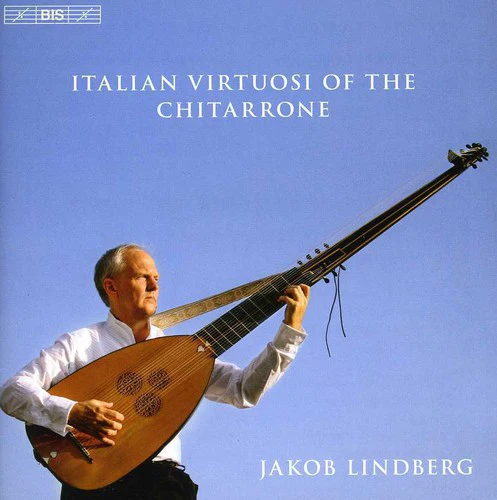
My attention was won by the cover. There’s Jakob Lindberg holding the most enormous stringed instrument I’ve ever seen. The long neck of the instrument extends off into the distance and Lindberg himself looks completely unintimidated. There’s no way to resist that. Then I put on the first track, Giovanni Girolamo Kapsperger’s “Arpeggiata,” and was enthralled. It’s an extraordinary little piece, building with the minimalistic drama of a Philip Glass piece across chords and seemingly across the centuries.
There are more gems to be had here. Kapsperger’s “Passacaglia” is a masterwork, the compact frame and starkly simple bass line concealing a work of enormous emotional fervor. I was going to call it “haunting” until I saw that the booklet - written by the artist - already does, and yet there really is not a better word. As always in the baroque byways, there are composers exploring harmony in interesting ways; most intriguingly, Alessandro Piccinini contributes a “Toccata cromatica” and Bellerofonte Castaldi a “Cromatica corrente”. Castaldi’s “Cecchina corrente” is more of a scene-stealer, bounding in with a burly, jovial dance but then, halfway through, breaking down into a more intricate rhythmic pattern. That said, it’s really Kapsperger who dominates this recital, since there is next to no music here better than the arpeggiata, passacaglia, or rowdily witty “Colascione”.
The main competition is from Paul O’Dette on HM Gold, a mid-price recital of nothing but Kapsperger. O’Dette uses a chitarrone for some works and a lute for most. He somehow misses out on the passacaglia, but his Kapsperger is well worth having too. In fact I purchased it after hearing the CD being reviewed here. A disc on Hänssler I haven’t heard, featuring Joachim Held on a lute, combines these three composers with the amusingly named Michelangelo Galilei. Castaldi’s songs with voice can be heard on Toccata Classics, and on a CD which was one of MusicWeb’s 2012 Recordings of the Year. For the neophyte this excellent BIS CD is a good sampler; depending on what you like you can move on to the composer-specific albums elsewhere, although I warn that you really will want to collect Kapsperger if you don’t already. If you do, I hear nothing which will let you down here.
A minor irritation: if you’re intending to add this to your computerized collection, you have your work cut out. The Gracenote (iTunes) database doesn’t have information on this CD, which means you’ll be typing in all 27 track names yourself.
-- Brian Reinhart, MusicWeb International
There are more gems to be had here. Kapsperger’s “Passacaglia” is a masterwork, the compact frame and starkly simple bass line concealing a work of enormous emotional fervor. I was going to call it “haunting” until I saw that the booklet - written by the artist - already does, and yet there really is not a better word. As always in the baroque byways, there are composers exploring harmony in interesting ways; most intriguingly, Alessandro Piccinini contributes a “Toccata cromatica” and Bellerofonte Castaldi a “Cromatica corrente”. Castaldi’s “Cecchina corrente” is more of a scene-stealer, bounding in with a burly, jovial dance but then, halfway through, breaking down into a more intricate rhythmic pattern. That said, it’s really Kapsperger who dominates this recital, since there is next to no music here better than the arpeggiata, passacaglia, or rowdily witty “Colascione”.
The main competition is from Paul O’Dette on HM Gold, a mid-price recital of nothing but Kapsperger. O’Dette uses a chitarrone for some works and a lute for most. He somehow misses out on the passacaglia, but his Kapsperger is well worth having too. In fact I purchased it after hearing the CD being reviewed here. A disc on Hänssler I haven’t heard, featuring Joachim Held on a lute, combines these three composers with the amusingly named Michelangelo Galilei. Castaldi’s songs with voice can be heard on Toccata Classics, and on a CD which was one of MusicWeb’s 2012 Recordings of the Year. For the neophyte this excellent BIS CD is a good sampler; depending on what you like you can move on to the composer-specific albums elsewhere, although I warn that you really will want to collect Kapsperger if you don’t already. If you do, I hear nothing which will let you down here.
A minor irritation: if you’re intending to add this to your computerized collection, you have your work cut out. The Gracenote (iTunes) database doesn’t have information on this CD, which means you’ll be typing in all 27 track names yourself.
-- Brian Reinhart, MusicWeb International
My attention was won by the cover. There’s Jakob Lindberg holding the most enormous stringed instrument I’ve ever seen. The long neck of the instrument extends off into the distance and Lindberg himself looks completely unintimidated. There’s no way to resist that. Then I put on the first track, Giovanni Girolamo Kapsperger’s “Arpeggiata,” and was enthralled. It’s an extraordinary little piece, building with the minimalistic drama of a Philip Glass piece across chords and seemingly across the centuries.
There are more gems to be had here. Kapsperger’s “Passacaglia” is a masterwork, the compact frame and starkly simple bass line concealing a work of enormous emotional fervor. I was going to call it “haunting” until I saw that the booklet - written by the artist - already does, and yet there really is not a better word. As always in the baroque byways, there are composers exploring harmony in interesting ways; most intriguingly, Alessandro Piccinini contributes a “Toccata cromatica” and Bellerofonte Castaldi a “Cromatica corrente”. Castaldi’s “Cecchina corrente” is more of a scene-stealer, bounding in with a burly, jovial dance but then, halfway through, breaking down into a more intricate rhythmic pattern. That said, it’s really Kapsperger who dominates this recital, since there is next to no music here better than the arpeggiata, passacaglia, or rowdily witty “Colascione”.
The main competition is from Paul O’Dette on HM Gold, a mid-price recital of nothing but Kapsperger. O’Dette uses a chitarrone for some works and a lute for most. He somehow misses out on the passacaglia, but his Kapsperger is well worth having too. In fact I purchased it after hearing the CD being reviewed here. A disc on Hänssler I haven’t heard, featuring Joachim Held on a lute, combines these three composers with the amusingly named Michelangelo Galilei. Castaldi’s songs with voice can be heard on Toccata Classics, and on a CD which was one of MusicWeb’s 2012 Recordings of the Year. For the neophyte this excellent BIS CD is a good sampler; depending on what you like you can move on to the composer-specific albums elsewhere, although I warn that you really will want to collect Kapsperger if you don’t already. If you do, I hear nothing which will let you down here.
A minor irritation: if you’re intending to add this to your computerized collection, you have your work cut out. The Gracenote (iTunes) database doesn’t have information on this CD, which means you’ll be typing in all 27 track names yourself.
-- Brian Reinhart, MusicWeb International
There are more gems to be had here. Kapsperger’s “Passacaglia” is a masterwork, the compact frame and starkly simple bass line concealing a work of enormous emotional fervor. I was going to call it “haunting” until I saw that the booklet - written by the artist - already does, and yet there really is not a better word. As always in the baroque byways, there are composers exploring harmony in interesting ways; most intriguingly, Alessandro Piccinini contributes a “Toccata cromatica” and Bellerofonte Castaldi a “Cromatica corrente”. Castaldi’s “Cecchina corrente” is more of a scene-stealer, bounding in with a burly, jovial dance but then, halfway through, breaking down into a more intricate rhythmic pattern. That said, it’s really Kapsperger who dominates this recital, since there is next to no music here better than the arpeggiata, passacaglia, or rowdily witty “Colascione”.
The main competition is from Paul O’Dette on HM Gold, a mid-price recital of nothing but Kapsperger. O’Dette uses a chitarrone for some works and a lute for most. He somehow misses out on the passacaglia, but his Kapsperger is well worth having too. In fact I purchased it after hearing the CD being reviewed here. A disc on Hänssler I haven’t heard, featuring Joachim Held on a lute, combines these three composers with the amusingly named Michelangelo Galilei. Castaldi’s songs with voice can be heard on Toccata Classics, and on a CD which was one of MusicWeb’s 2012 Recordings of the Year. For the neophyte this excellent BIS CD is a good sampler; depending on what you like you can move on to the composer-specific albums elsewhere, although I warn that you really will want to collect Kapsperger if you don’t already. If you do, I hear nothing which will let you down here.
A minor irritation: if you’re intending to add this to your computerized collection, you have your work cut out. The Gracenote (iTunes) database doesn’t have information on this CD, which means you’ll be typing in all 27 track names yourself.
-- Brian Reinhart, MusicWeb International
$21.99
Italian Virtuosi Of The Chitarrone / Lindberg—
$21.99
Description
My attention was won by the cover. There’s Jakob Lindberg holding the most enormous stringed instrument I’ve ever seen. The long neck of the instrument extends off into the distance and Lindberg himself looks completely unintimidated. There’s no way to resist that. Then I put on the first track, Giovanni Girolamo Kapsperger’s “Arpeggiata,” and was enthralled. It’s an extraordinary little piece, building with the minimalistic drama of a Philip Glass piece across chords and seemingly across the centuries.
There are more gems to be had here. Kapsperger’s “Passacaglia” is a masterwork, the compact frame and starkly simple bass line concealing a work of enormous emotional fervor. I was going to call it “haunting” until I saw that the booklet - written by the artist - already does, and yet there really is not a better word. As always in the baroque byways, there are composers exploring harmony in interesting ways; most intriguingly, Alessandro Piccinini contributes a “Toccata cromatica” and Bellerofonte Castaldi a “Cromatica corrente”. Castaldi’s “Cecchina corrente” is more of a scene-stealer, bounding in with a burly, jovial dance but then, halfway through, breaking down into a more intricate rhythmic pattern. That said, it’s really Kapsperger who dominates this recital, since there is next to no music here better than the arpeggiata, passacaglia, or rowdily witty “Colascione”.
The main competition is from Paul O’Dette on HM Gold, a mid-price recital of nothing but Kapsperger. O’Dette uses a chitarrone for some works and a lute for most. He somehow misses out on the passacaglia, but his Kapsperger is well worth having too. In fact I purchased it after hearing the CD being reviewed here. A disc on Hänssler I haven’t heard, featuring Joachim Held on a lute, combines these three composers with the amusingly named Michelangelo Galilei. Castaldi’s songs with voice can be heard on Toccata Classics, and on a CD which was one of MusicWeb’s 2012 Recordings of the Year. For the neophyte this excellent BIS CD is a good sampler; depending on what you like you can move on to the composer-specific albums elsewhere, although I warn that you really will want to collect Kapsperger if you don’t already. If you do, I hear nothing which will let you down here.
A minor irritation: if you’re intending to add this to your computerized collection, you have your work cut out. The Gracenote (iTunes) database doesn’t have information on this CD, which means you’ll be typing in all 27 track names yourself.
-- Brian Reinhart, MusicWeb International
There are more gems to be had here. Kapsperger’s “Passacaglia” is a masterwork, the compact frame and starkly simple bass line concealing a work of enormous emotional fervor. I was going to call it “haunting” until I saw that the booklet - written by the artist - already does, and yet there really is not a better word. As always in the baroque byways, there are composers exploring harmony in interesting ways; most intriguingly, Alessandro Piccinini contributes a “Toccata cromatica” and Bellerofonte Castaldi a “Cromatica corrente”. Castaldi’s “Cecchina corrente” is more of a scene-stealer, bounding in with a burly, jovial dance but then, halfway through, breaking down into a more intricate rhythmic pattern. That said, it’s really Kapsperger who dominates this recital, since there is next to no music here better than the arpeggiata, passacaglia, or rowdily witty “Colascione”.
The main competition is from Paul O’Dette on HM Gold, a mid-price recital of nothing but Kapsperger. O’Dette uses a chitarrone for some works and a lute for most. He somehow misses out on the passacaglia, but his Kapsperger is well worth having too. In fact I purchased it after hearing the CD being reviewed here. A disc on Hänssler I haven’t heard, featuring Joachim Held on a lute, combines these three composers with the amusingly named Michelangelo Galilei. Castaldi’s songs with voice can be heard on Toccata Classics, and on a CD which was one of MusicWeb’s 2012 Recordings of the Year. For the neophyte this excellent BIS CD is a good sampler; depending on what you like you can move on to the composer-specific albums elsewhere, although I warn that you really will want to collect Kapsperger if you don’t already. If you do, I hear nothing which will let you down here.
A minor irritation: if you’re intending to add this to your computerized collection, you have your work cut out. The Gracenote (iTunes) database doesn’t have information on this CD, which means you’ll be typing in all 27 track names yourself.
-- Brian Reinhart, MusicWeb International