🎉 Up to 70% Off Selected ItemsShop Sale

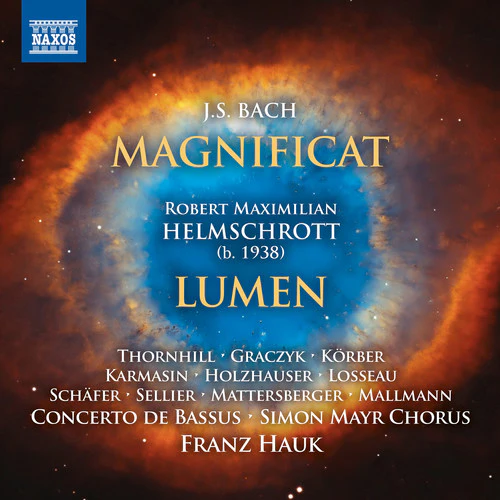
J.S. Bach: Magnificat, BWV 243 - Helmschrott: Lumen
Shortly after taking up the position of Thomaskantor in Leipzig in 1723, Bach wrote a Magnificat in E flat major for performance at Christmas. Around a decade later he revised the work, transposing it down to D major and making it more concise. Utilizing a Biblical text, the piece is suffused with a series of memorable arias and choruses and orchestrated with spectacular grandeur. Lumen is a contemporary musical dialogue that urges empathy between the three Abrahamic religions. Translating the oratorio form into a 'unity of diversity,' Robert M. Helmschrott has converted the poetry of the Old and New Testaments, the Torah and Qur'an into an interfaith 'language of sounds and singing.'
Shortly after taking up the position of Thomaskantor in Leipzig in 1723, Bach wrote a Magnificat in E flat major for performance at Christmas. Around a decade later he revised the work, transposing it down to D major and making it more concise. Utilizing a Biblical text, the piece is suffused with a series of memorable arias and choruses and orchestrated with spectacular grandeur. Lumen is a contemporary musical dialogue that urges empathy between the three Abrahamic religions. Translating the oratorio form into a 'unity of diversity,' Robert M. Helmschrott has converted the poetry of the Old and New Testaments, the Torah and Qur'an into an interfaith 'language of sounds and singing.'
$9.99
J.S. Bach: Magnificat, BWV 243 - Helmschrott: Lumen—
$9.99
Description
Shortly after taking up the position of Thomaskantor in Leipzig in 1723, Bach wrote a Magnificat in E flat major for performance at Christmas. Around a decade later he revised the work, transposing it down to D major and making it more concise. Utilizing a Biblical text, the piece is suffused with a series of memorable arias and choruses and orchestrated with spectacular grandeur. Lumen is a contemporary musical dialogue that urges empathy between the three Abrahamic religions. Translating the oratorio form into a 'unity of diversity,' Robert M. Helmschrott has converted the poetry of the Old and New Testaments, the Torah and Qur'an into an interfaith 'language of sounds and singing.'