🎉 Up to 70% Off Selected ItemsShop Sale

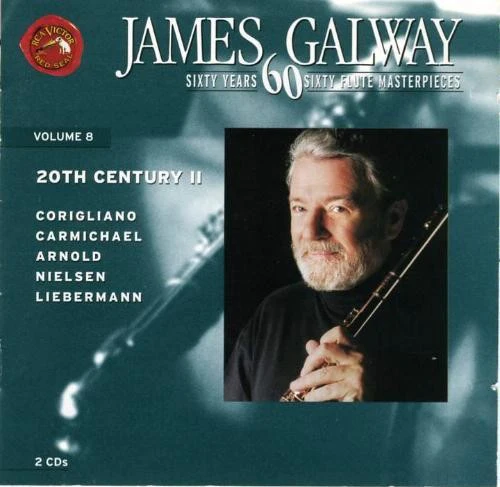
James Galway - 60 Flute Masterpieces Vol 8 - 20th Century II
The substantial opening Moderato of the Flute Concerto (commissioned and premiered by Galway in 1992 with Slatkin and the Saint Louis Symphony Orchestra) starts and finishes like some lost instalment from Prokofiev's Romeo and Juliet, but the bulk of the movement is given over to a wistful chaconne which Liebermann then proceeds to work out with a graceful fluency and imaginative resource that will surprise no one already familiar with the thirdmovement passacaglia of Liebermann's impressive Second Piano Concerto. If the two remaining movements aren't perhaps on quite the same level of inspiration, the solo writing is grateful, the scoring stylish and the whole work makes a most appealing addition to the genre.
In many ways, the Piccolo Concerto (1996) shares the same ground-plan as that of the Flute Concerto, its first two movements again displaying a mastery of variation technique, followed by a wittily ebullient finale (which quotes from Mozart's Symphony No. 40, Beethoven's Eroica and Sousa's The Stars and Stripes Forever). The central Adagio is especially reminiscent of Shostakovich in its icily atmospheric chill, but there are strong echoes of the Russian master throughout (whom Liebermann openly acknowledges as 'one of my biggest musical influences').
Galway is his usual immaculate self, as effortlessly assured an exponent of the piccolo as he is a flautist. Moreover, the London Mozart Players respond with enthusiasm under the composer's shapely lead.
-- Gramophone [2/1999, reviewing the Liebermann works]
---------------------------------------
In this expert, sweet-toned and affectionate music-making, these fine artists audibly enjoy themselves hugely, responding to Arnold's idiomatic and resourceful writing as to the manner born. I especially enjoyed Galway and friends in the sparkling early Three Shanties for wind quintet (written in 1943 for the composer's LPO colleagues) and the delicious Divertimento for flute, oboe and clarinet (1953). Cast in six pithy movements (and masterfully played here), the latter piece contains invention of great freshness and charm, with definite echoes of the English Dances from the same period.
In the wistful central Andante of the First Flute Concerto (1954), Sir Neville Marriner and his beautifully prepared Academy strings provide a poignant backdrop to Galway's ravishing playing, and this music's kinship with the great slow movement of Arnold's Second Symphony (completed the previous year) is most perceptively brought out.
-- Gramophone [4/1998, reviewing the Arnold works]
---------------------------------------
...it goes without saying that Galway's personality and virtuosity are commanding... He gives a brilliant and confident account of the 1926 Concerto, and here also serves as conductor...
-- Gramophone [2/1988, reviewing the Nielsen concerto]
In many ways, the Piccolo Concerto (1996) shares the same ground-plan as that of the Flute Concerto, its first two movements again displaying a mastery of variation technique, followed by a wittily ebullient finale (which quotes from Mozart's Symphony No. 40, Beethoven's Eroica and Sousa's The Stars and Stripes Forever). The central Adagio is especially reminiscent of Shostakovich in its icily atmospheric chill, but there are strong echoes of the Russian master throughout (whom Liebermann openly acknowledges as 'one of my biggest musical influences').
Galway is his usual immaculate self, as effortlessly assured an exponent of the piccolo as he is a flautist. Moreover, the London Mozart Players respond with enthusiasm under the composer's shapely lead.
-- Gramophone [2/1999, reviewing the Liebermann works]
---------------------------------------
In this expert, sweet-toned and affectionate music-making, these fine artists audibly enjoy themselves hugely, responding to Arnold's idiomatic and resourceful writing as to the manner born. I especially enjoyed Galway and friends in the sparkling early Three Shanties for wind quintet (written in 1943 for the composer's LPO colleagues) and the delicious Divertimento for flute, oboe and clarinet (1953). Cast in six pithy movements (and masterfully played here), the latter piece contains invention of great freshness and charm, with definite echoes of the English Dances from the same period.
In the wistful central Andante of the First Flute Concerto (1954), Sir Neville Marriner and his beautifully prepared Academy strings provide a poignant backdrop to Galway's ravishing playing, and this music's kinship with the great slow movement of Arnold's Second Symphony (completed the previous year) is most perceptively brought out.
-- Gramophone [4/1998, reviewing the Arnold works]
---------------------------------------
...it goes without saying that Galway's personality and virtuosity are commanding... He gives a brilliant and confident account of the 1926 Concerto, and here also serves as conductor...
-- Gramophone [2/1988, reviewing the Nielsen concerto]
The substantial opening Moderato of the Flute Concerto (commissioned and premiered by Galway in 1992 with Slatkin and the Saint Louis Symphony Orchestra) starts and finishes like some lost instalment from Prokofiev's Romeo and Juliet, but the bulk of the movement is given over to a wistful chaconne which Liebermann then proceeds to work out with a graceful fluency and imaginative resource that will surprise no one already familiar with the thirdmovement passacaglia of Liebermann's impressive Second Piano Concerto. If the two remaining movements aren't perhaps on quite the same level of inspiration, the solo writing is grateful, the scoring stylish and the whole work makes a most appealing addition to the genre.
In many ways, the Piccolo Concerto (1996) shares the same ground-plan as that of the Flute Concerto, its first two movements again displaying a mastery of variation technique, followed by a wittily ebullient finale (which quotes from Mozart's Symphony No. 40, Beethoven's Eroica and Sousa's The Stars and Stripes Forever). The central Adagio is especially reminiscent of Shostakovich in its icily atmospheric chill, but there are strong echoes of the Russian master throughout (whom Liebermann openly acknowledges as 'one of my biggest musical influences').
Galway is his usual immaculate self, as effortlessly assured an exponent of the piccolo as he is a flautist. Moreover, the London Mozart Players respond with enthusiasm under the composer's shapely lead.
-- Gramophone [2/1999, reviewing the Liebermann works]
---------------------------------------
In this expert, sweet-toned and affectionate music-making, these fine artists audibly enjoy themselves hugely, responding to Arnold's idiomatic and resourceful writing as to the manner born. I especially enjoyed Galway and friends in the sparkling early Three Shanties for wind quintet (written in 1943 for the composer's LPO colleagues) and the delicious Divertimento for flute, oboe and clarinet (1953). Cast in six pithy movements (and masterfully played here), the latter piece contains invention of great freshness and charm, with definite echoes of the English Dances from the same period.
In the wistful central Andante of the First Flute Concerto (1954), Sir Neville Marriner and his beautifully prepared Academy strings provide a poignant backdrop to Galway's ravishing playing, and this music's kinship with the great slow movement of Arnold's Second Symphony (completed the previous year) is most perceptively brought out.
-- Gramophone [4/1998, reviewing the Arnold works]
---------------------------------------
...it goes without saying that Galway's personality and virtuosity are commanding... He gives a brilliant and confident account of the 1926 Concerto, and here also serves as conductor...
-- Gramophone [2/1988, reviewing the Nielsen concerto]
In many ways, the Piccolo Concerto (1996) shares the same ground-plan as that of the Flute Concerto, its first two movements again displaying a mastery of variation technique, followed by a wittily ebullient finale (which quotes from Mozart's Symphony No. 40, Beethoven's Eroica and Sousa's The Stars and Stripes Forever). The central Adagio is especially reminiscent of Shostakovich in its icily atmospheric chill, but there are strong echoes of the Russian master throughout (whom Liebermann openly acknowledges as 'one of my biggest musical influences').
Galway is his usual immaculate self, as effortlessly assured an exponent of the piccolo as he is a flautist. Moreover, the London Mozart Players respond with enthusiasm under the composer's shapely lead.
-- Gramophone [2/1999, reviewing the Liebermann works]
---------------------------------------
In this expert, sweet-toned and affectionate music-making, these fine artists audibly enjoy themselves hugely, responding to Arnold's idiomatic and resourceful writing as to the manner born. I especially enjoyed Galway and friends in the sparkling early Three Shanties for wind quintet (written in 1943 for the composer's LPO colleagues) and the delicious Divertimento for flute, oboe and clarinet (1953). Cast in six pithy movements (and masterfully played here), the latter piece contains invention of great freshness and charm, with definite echoes of the English Dances from the same period.
In the wistful central Andante of the First Flute Concerto (1954), Sir Neville Marriner and his beautifully prepared Academy strings provide a poignant backdrop to Galway's ravishing playing, and this music's kinship with the great slow movement of Arnold's Second Symphony (completed the previous year) is most perceptively brought out.
-- Gramophone [4/1998, reviewing the Arnold works]
---------------------------------------
...it goes without saying that Galway's personality and virtuosity are commanding... He gives a brilliant and confident account of the 1926 Concerto, and here also serves as conductor...
-- Gramophone [2/1988, reviewing the Nielsen concerto]
$8.75
Original: $24.99
-65%James Galway - 60 Flute Masterpieces Vol 8 - 20th Century II—
$24.99
$8.75Description
The substantial opening Moderato of the Flute Concerto (commissioned and premiered by Galway in 1992 with Slatkin and the Saint Louis Symphony Orchestra) starts and finishes like some lost instalment from Prokofiev's Romeo and Juliet, but the bulk of the movement is given over to a wistful chaconne which Liebermann then proceeds to work out with a graceful fluency and imaginative resource that will surprise no one already familiar with the thirdmovement passacaglia of Liebermann's impressive Second Piano Concerto. If the two remaining movements aren't perhaps on quite the same level of inspiration, the solo writing is grateful, the scoring stylish and the whole work makes a most appealing addition to the genre.
In many ways, the Piccolo Concerto (1996) shares the same ground-plan as that of the Flute Concerto, its first two movements again displaying a mastery of variation technique, followed by a wittily ebullient finale (which quotes from Mozart's Symphony No. 40, Beethoven's Eroica and Sousa's The Stars and Stripes Forever). The central Adagio is especially reminiscent of Shostakovich in its icily atmospheric chill, but there are strong echoes of the Russian master throughout (whom Liebermann openly acknowledges as 'one of my biggest musical influences').
Galway is his usual immaculate self, as effortlessly assured an exponent of the piccolo as he is a flautist. Moreover, the London Mozart Players respond with enthusiasm under the composer's shapely lead.
-- Gramophone [2/1999, reviewing the Liebermann works]
---------------------------------------
In this expert, sweet-toned and affectionate music-making, these fine artists audibly enjoy themselves hugely, responding to Arnold's idiomatic and resourceful writing as to the manner born. I especially enjoyed Galway and friends in the sparkling early Three Shanties for wind quintet (written in 1943 for the composer's LPO colleagues) and the delicious Divertimento for flute, oboe and clarinet (1953). Cast in six pithy movements (and masterfully played here), the latter piece contains invention of great freshness and charm, with definite echoes of the English Dances from the same period.
In the wistful central Andante of the First Flute Concerto (1954), Sir Neville Marriner and his beautifully prepared Academy strings provide a poignant backdrop to Galway's ravishing playing, and this music's kinship with the great slow movement of Arnold's Second Symphony (completed the previous year) is most perceptively brought out.
-- Gramophone [4/1998, reviewing the Arnold works]
---------------------------------------
...it goes without saying that Galway's personality and virtuosity are commanding... He gives a brilliant and confident account of the 1926 Concerto, and here also serves as conductor...
-- Gramophone [2/1988, reviewing the Nielsen concerto]
In many ways, the Piccolo Concerto (1996) shares the same ground-plan as that of the Flute Concerto, its first two movements again displaying a mastery of variation technique, followed by a wittily ebullient finale (which quotes from Mozart's Symphony No. 40, Beethoven's Eroica and Sousa's The Stars and Stripes Forever). The central Adagio is especially reminiscent of Shostakovich in its icily atmospheric chill, but there are strong echoes of the Russian master throughout (whom Liebermann openly acknowledges as 'one of my biggest musical influences').
Galway is his usual immaculate self, as effortlessly assured an exponent of the piccolo as he is a flautist. Moreover, the London Mozart Players respond with enthusiasm under the composer's shapely lead.
-- Gramophone [2/1999, reviewing the Liebermann works]
---------------------------------------
In this expert, sweet-toned and affectionate music-making, these fine artists audibly enjoy themselves hugely, responding to Arnold's idiomatic and resourceful writing as to the manner born. I especially enjoyed Galway and friends in the sparkling early Three Shanties for wind quintet (written in 1943 for the composer's LPO colleagues) and the delicious Divertimento for flute, oboe and clarinet (1953). Cast in six pithy movements (and masterfully played here), the latter piece contains invention of great freshness and charm, with definite echoes of the English Dances from the same period.
In the wistful central Andante of the First Flute Concerto (1954), Sir Neville Marriner and his beautifully prepared Academy strings provide a poignant backdrop to Galway's ravishing playing, and this music's kinship with the great slow movement of Arnold's Second Symphony (completed the previous year) is most perceptively brought out.
-- Gramophone [4/1998, reviewing the Arnold works]
---------------------------------------
...it goes without saying that Galway's personality and virtuosity are commanding... He gives a brilliant and confident account of the 1926 Concerto, and here also serves as conductor...
-- Gramophone [2/1988, reviewing the Nielsen concerto]