Labor: Clarinet Quintet; Clarinet Trios; Quintet for Winds and Piano
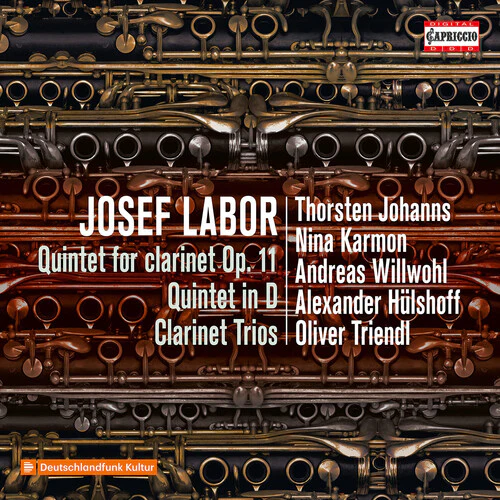
The loss of one sense, it is said, makes the other keener. What the concert pianist, organist, and composer Josef Labor lost in eyesight when smallpox left him blind at age three, must have been added to his ears. Although roughly a Brahmsian (and a friend of the composer), Labor wrote in an original style, informed by his knowledge of and love for early music. As a piano teacher, he taught Arnold Schoenberg, Alma Schindler, and Paul Wittgenstein. The connection to the Wittgenstein family explains his many works for piano left hand, including the two Clarinet Trios on this set (the clarinet was Ludwig Wittgenstein’s instrument) which are coupled with his Clarinet- and his Wind Quintets.
REVIEW:
From the evidence here, there is no question that Labor had studied Brahms well and produced startlingly effective facsimiles. Sample the finale of the Trio in G minor for clarinet, viola, and piano left hand; it could easily be taken for a forgotten Brahms work. Labor did not manage Brahms' exquisite combination of limpid tunes with dizzying structural complexity, but at times, he came very close. All but one of the pieces here receive their world premieres. A few other pieces by Labor have surfaced, but these are fortunate to receive the fluent performances with which they're favored here. This release is certainly of interest to lovers of pre-WWI Vienna and those interested in the Wittgenstein family, but also to those beyond.
-- AllMusic.com (James Manheim)
The loss of one sense, it is said, makes the other keener. What the concert pianist, organist, and composer Josef Labor lost in eyesight when smallpox left him blind at age three, must have been added to his ears. Although roughly a Brahmsian (and a friend of the composer), Labor wrote in an original style, informed by his knowledge of and love for early music. As a piano teacher, he taught Arnold Schoenberg, Alma Schindler, and Paul Wittgenstein. The connection to the Wittgenstein family explains his many works for piano left hand, including the two Clarinet Trios on this set (the clarinet was Ludwig Wittgenstein’s instrument) which are coupled with his Clarinet- and his Wind Quintets.
REVIEW:
From the evidence here, there is no question that Labor had studied Brahms well and produced startlingly effective facsimiles. Sample the finale of the Trio in G minor for clarinet, viola, and piano left hand; it could easily be taken for a forgotten Brahms work. Labor did not manage Brahms' exquisite combination of limpid tunes with dizzying structural complexity, but at times, he came very close. All but one of the pieces here receive their world premieres. A few other pieces by Labor have surfaced, but these are fortunate to receive the fluent performances with which they're favored here. This release is certainly of interest to lovers of pre-WWI Vienna and those interested in the Wittgenstein family, but also to those beyond.
-- AllMusic.com (James Manheim)
Original: $14.99
-65%$14.99
$5.25Description
The loss of one sense, it is said, makes the other keener. What the concert pianist, organist, and composer Josef Labor lost in eyesight when smallpox left him blind at age three, must have been added to his ears. Although roughly a Brahmsian (and a friend of the composer), Labor wrote in an original style, informed by his knowledge of and love for early music. As a piano teacher, he taught Arnold Schoenberg, Alma Schindler, and Paul Wittgenstein. The connection to the Wittgenstein family explains his many works for piano left hand, including the two Clarinet Trios on this set (the clarinet was Ludwig Wittgenstein’s instrument) which are coupled with his Clarinet- and his Wind Quintets.
REVIEW:
From the evidence here, there is no question that Labor had studied Brahms well and produced startlingly effective facsimiles. Sample the finale of the Trio in G minor for clarinet, viola, and piano left hand; it could easily be taken for a forgotten Brahms work. Labor did not manage Brahms' exquisite combination of limpid tunes with dizzying structural complexity, but at times, he came very close. All but one of the pieces here receive their world premieres. A few other pieces by Labor have surfaced, but these are fortunate to receive the fluent performances with which they're favored here. This release is certainly of interest to lovers of pre-WWI Vienna and those interested in the Wittgenstein family, but also to those beyond.
-- AllMusic.com (James Manheim)