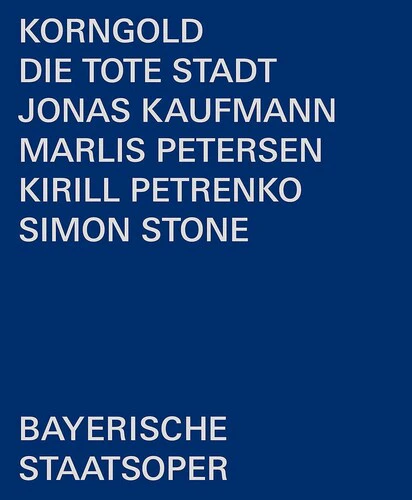
Korngold: Die tote Stadt / Kaufmann, Petersen, Petrenko, Bayerisches Staatsorchester [Blu-ray]
Also available on standard DVD
The premiere of Korngold's Die tote Stadt at the Bayerische Staatsoper in 2019 was praised both by press and audiences. Marlis Petersen (Marie/Marietta) and Jonas Kaufmann (Paul) sang the main roles, with the Bayerisches Staatsorchester under Kirill Petrenko's baton, in the intense staging by Simon Stone. After opening night, Joshua Barone wrote in the NY Times: “[The] work's comeback may have reached its peak at the Bavarian State Opera. It’s difficult to imagine a better case for Die tote Stadt than was made in Munich.” The boundary between dream and reality dissolves as Paul, mourning his dead wife Marie, meets the dancer Marietta. With her looks so similar to Marie’s, Marietta becomes the object of the projection of Paul’s erotic desires. Following a nerve-racking “vision”, Paul is finally reeled back to reality and he can leave Bruges as the place of his death cult. The original title of the piece, “Triumph des Lebens”, is symbolic of the main character’s personal development. Just a few weeks before the successful world premiere of Die tote Stadt, none other than Puccini himself described Korngold as the “greatest hope of new German music”. Because of their melodic urgency, arias such as “Glück, das mir verblieb (Marietta's Lute Song)” and “Mein Sehnen, mein Wähnen (Pierrot's Song)” have found a home among the concert repertoires of many opera singers and radiate far beyond the fame of Die tote Stadt. This production is the first AV release on our newly launched label.
Also available on standard DVD
The premiere of Korngold's Die tote Stadt at the Bayerische Staatsoper in 2019 was praised both by press and audiences. Marlis Petersen (Marie/Marietta) and Jonas Kaufmann (Paul) sang the main roles, with the Bayerisches Staatsorchester under Kirill Petrenko's baton, in the intense staging by Simon Stone. After opening night, Joshua Barone wrote in the NY Times: “[The] work's comeback may have reached its peak at the Bavarian State Opera. It’s difficult to imagine a better case for Die tote Stadt than was made in Munich.” The boundary between dream and reality dissolves as Paul, mourning his dead wife Marie, meets the dancer Marietta. With her looks so similar to Marie’s, Marietta becomes the object of the projection of Paul’s erotic desires. Following a nerve-racking “vision”, Paul is finally reeled back to reality and he can leave Bruges as the place of his death cult. The original title of the piece, “Triumph des Lebens”, is symbolic of the main character’s personal development. Just a few weeks before the successful world premiere of Die tote Stadt, none other than Puccini himself described Korngold as the “greatest hope of new German music”. Because of their melodic urgency, arias such as “Glück, das mir verblieb (Marietta's Lute Song)” and “Mein Sehnen, mein Wähnen (Pierrot's Song)” have found a home among the concert repertoires of many opera singers and radiate far beyond the fame of Die tote Stadt. This production is the first AV release on our newly launched label.
Description
Also available on standard DVD
The premiere of Korngold's Die tote Stadt at the Bayerische Staatsoper in 2019 was praised both by press and audiences. Marlis Petersen (Marie/Marietta) and Jonas Kaufmann (Paul) sang the main roles, with the Bayerisches Staatsorchester under Kirill Petrenko's baton, in the intense staging by Simon Stone. After opening night, Joshua Barone wrote in the NY Times: “[The] work's comeback may have reached its peak at the Bavarian State Opera. It’s difficult to imagine a better case for Die tote Stadt than was made in Munich.” The boundary between dream and reality dissolves as Paul, mourning his dead wife Marie, meets the dancer Marietta. With her looks so similar to Marie’s, Marietta becomes the object of the projection of Paul’s erotic desires. Following a nerve-racking “vision”, Paul is finally reeled back to reality and he can leave Bruges as the place of his death cult. The original title of the piece, “Triumph des Lebens”, is symbolic of the main character’s personal development. Just a few weeks before the successful world premiere of Die tote Stadt, none other than Puccini himself described Korngold as the “greatest hope of new German music”. Because of their melodic urgency, arias such as “Glück, das mir verblieb (Marietta's Lute Song)” and “Mein Sehnen, mein Wähnen (Pierrot's Song)” have found a home among the concert repertoires of many opera singers and radiate far beyond the fame of Die tote Stadt. This production is the first AV release on our newly launched label.