🎉 Up to 70% Off Selected ItemsShop Sale

1 / 2
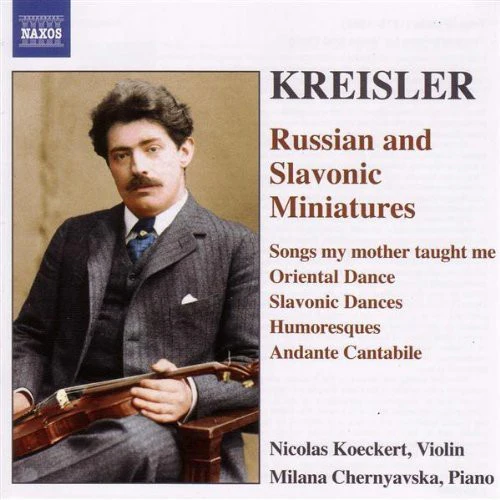
Kreisler: Russian & Slavonic Miniatures / Koeckert, Et Al
Fritz Kreisler poured forth a steady stream of transcriptions of popular songs, like The World Is Waiting for the Sunrise, of those that would sometime become popular songs, like Dawes’s Melody, as well as of tunes that entered the public consciousness without ever quite achieving popular status. All these are in addition to his soon-to-become beloved original compositions, like the “Lanner waltzes” Liebesleid, Liebesfreud, and Schön Rosmarin. Nicolas Koeckert and Milana Chernyavska have collected Transcriptions of the Third Kind with Slavic flavoring in an anthology of almost popular (at least, recognizable) favorites by Rimsky-Korsakov, Tchaikovsky, and Dvo?ák. These he plays with a combination of tonal warmth and technical alertness that wins him a place among violinists who play Kreisler’s works, if not quite as Kreisler himself did, at least as convincing in their own way. The number of violinists in this category will, of course, vary from listener to listener. Surely, Elman must belong there, although he sounds nothing like Kreisler, and so does Francescatti, whose dashing style and biting clarity hardly recall Kreisler’s Gemütlichkeit. Yet, since even so aristocratic and individual a violinist as Milstein can fail to make his point in some of these works, it’s clear that a strong personality and redoubtable technique don’t suffice. While Koeckert glories in the rich tonal possibilities of such pieces as Rimsky-Korsakov’s Hymn to the Sun, he never becomes smarmy, taking, for example, a brisk tempo where he might bog down in Dvo?ák’s Humoresque. Hearing Kreisler’s recordings for the first time may offer a jolting surprise to those who had experienced his pieces only in performances by other violinists. (The number of such listeners may be greater than anyone might estimate: I once encountered a recent master’s degree recipient from a well-known music school—in violin performance, no less—who mused about how wonderful it would be if we could actually hear the way Kreisler played his own pieces. O tempora, O mores!) Kreisler’s playing sounds vibrant yet expressive, and, of course, authoritative and convincing. But it’s not sentimental in the popular sense. Even in Ethelbert Nevin’s songs, The Rosary and Mighty lak’ a Rose (both of which he recorded twice, the latter for its first time with Geraldine Farrar in 1915), he never wallowed. He may have addressed his audiences in the vernacular, but he refused to condescend. Koeckert also walks this fine line, although his chosen material doesn’t bring him so close to the abyss. And he sparkles with the required brilliance in pieces like Tchaikovsky’s Humoresque. Whatever composer Kreisler transcribed always emerged from the process sounding a bit like Kreisler, or at least, Viennese, like Kreisler himself (think of his reworking of Paganini’s First Violin Concerto). He infused some of this personal element into his piano parts, which, like Heifetz’s, give the distinct, if not distracting, impression of being well crafted. And Milana Chernyavska plays them that way. These pieces would be hard to come by, at least in one place, outside RCA’s 10-CD Kreisler collection, 19:4. All the more, then, do they deserve an enthusiastic welcome in Koeckert’s idiomatic and ingratiating collection, in reverberant yet revealing recorded sound that Kreisler himself could only have envied. Recommended.
FANFARE: Robert Maxham
FANFARE: Robert Maxham
Fritz Kreisler poured forth a steady stream of transcriptions of popular songs, like The World Is Waiting for the Sunrise, of those that would sometime become popular songs, like Dawes’s Melody, as well as of tunes that entered the public consciousness without ever quite achieving popular status. All these are in addition to his soon-to-become beloved original compositions, like the “Lanner waltzes” Liebesleid, Liebesfreud, and Schön Rosmarin. Nicolas Koeckert and Milana Chernyavska have collected Transcriptions of the Third Kind with Slavic flavoring in an anthology of almost popular (at least, recognizable) favorites by Rimsky-Korsakov, Tchaikovsky, and Dvo?ák. These he plays with a combination of tonal warmth and technical alertness that wins him a place among violinists who play Kreisler’s works, if not quite as Kreisler himself did, at least as convincing in their own way. The number of violinists in this category will, of course, vary from listener to listener. Surely, Elman must belong there, although he sounds nothing like Kreisler, and so does Francescatti, whose dashing style and biting clarity hardly recall Kreisler’s Gemütlichkeit. Yet, since even so aristocratic and individual a violinist as Milstein can fail to make his point in some of these works, it’s clear that a strong personality and redoubtable technique don’t suffice. While Koeckert glories in the rich tonal possibilities of such pieces as Rimsky-Korsakov’s Hymn to the Sun, he never becomes smarmy, taking, for example, a brisk tempo where he might bog down in Dvo?ák’s Humoresque. Hearing Kreisler’s recordings for the first time may offer a jolting surprise to those who had experienced his pieces only in performances by other violinists. (The number of such listeners may be greater than anyone might estimate: I once encountered a recent master’s degree recipient from a well-known music school—in violin performance, no less—who mused about how wonderful it would be if we could actually hear the way Kreisler played his own pieces. O tempora, O mores!) Kreisler’s playing sounds vibrant yet expressive, and, of course, authoritative and convincing. But it’s not sentimental in the popular sense. Even in Ethelbert Nevin’s songs, The Rosary and Mighty lak’ a Rose (both of which he recorded twice, the latter for its first time with Geraldine Farrar in 1915), he never wallowed. He may have addressed his audiences in the vernacular, but he refused to condescend. Koeckert also walks this fine line, although his chosen material doesn’t bring him so close to the abyss. And he sparkles with the required brilliance in pieces like Tchaikovsky’s Humoresque. Whatever composer Kreisler transcribed always emerged from the process sounding a bit like Kreisler, or at least, Viennese, like Kreisler himself (think of his reworking of Paganini’s First Violin Concerto). He infused some of this personal element into his piano parts, which, like Heifetz’s, give the distinct, if not distracting, impression of being well crafted. And Milana Chernyavska plays them that way. These pieces would be hard to come by, at least in one place, outside RCA’s 10-CD Kreisler collection, 19:4. All the more, then, do they deserve an enthusiastic welcome in Koeckert’s idiomatic and ingratiating collection, in reverberant yet revealing recorded sound that Kreisler himself could only have envied. Recommended.
FANFARE: Robert Maxham
FANFARE: Robert Maxham
$19.99
Kreisler: Russian & Slavonic Miniatures / Koeckert, Et Al—
$19.99
Description
Fritz Kreisler poured forth a steady stream of transcriptions of popular songs, like The World Is Waiting for the Sunrise, of those that would sometime become popular songs, like Dawes’s Melody, as well as of tunes that entered the public consciousness without ever quite achieving popular status. All these are in addition to his soon-to-become beloved original compositions, like the “Lanner waltzes” Liebesleid, Liebesfreud, and Schön Rosmarin. Nicolas Koeckert and Milana Chernyavska have collected Transcriptions of the Third Kind with Slavic flavoring in an anthology of almost popular (at least, recognizable) favorites by Rimsky-Korsakov, Tchaikovsky, and Dvo?ák. These he plays with a combination of tonal warmth and technical alertness that wins him a place among violinists who play Kreisler’s works, if not quite as Kreisler himself did, at least as convincing in their own way. The number of violinists in this category will, of course, vary from listener to listener. Surely, Elman must belong there, although he sounds nothing like Kreisler, and so does Francescatti, whose dashing style and biting clarity hardly recall Kreisler’s Gemütlichkeit. Yet, since even so aristocratic and individual a violinist as Milstein can fail to make his point in some of these works, it’s clear that a strong personality and redoubtable technique don’t suffice. While Koeckert glories in the rich tonal possibilities of such pieces as Rimsky-Korsakov’s Hymn to the Sun, he never becomes smarmy, taking, for example, a brisk tempo where he might bog down in Dvo?ák’s Humoresque. Hearing Kreisler’s recordings for the first time may offer a jolting surprise to those who had experienced his pieces only in performances by other violinists. (The number of such listeners may be greater than anyone might estimate: I once encountered a recent master’s degree recipient from a well-known music school—in violin performance, no less—who mused about how wonderful it would be if we could actually hear the way Kreisler played his own pieces. O tempora, O mores!) Kreisler’s playing sounds vibrant yet expressive, and, of course, authoritative and convincing. But it’s not sentimental in the popular sense. Even in Ethelbert Nevin’s songs, The Rosary and Mighty lak’ a Rose (both of which he recorded twice, the latter for its first time with Geraldine Farrar in 1915), he never wallowed. He may have addressed his audiences in the vernacular, but he refused to condescend. Koeckert also walks this fine line, although his chosen material doesn’t bring him so close to the abyss. And he sparkles with the required brilliance in pieces like Tchaikovsky’s Humoresque. Whatever composer Kreisler transcribed always emerged from the process sounding a bit like Kreisler, or at least, Viennese, like Kreisler himself (think of his reworking of Paganini’s First Violin Concerto). He infused some of this personal element into his piano parts, which, like Heifetz’s, give the distinct, if not distracting, impression of being well crafted. And Milana Chernyavska plays them that way. These pieces would be hard to come by, at least in one place, outside RCA’s 10-CD Kreisler collection, 19:4. All the more, then, do they deserve an enthusiastic welcome in Koeckert’s idiomatic and ingratiating collection, in reverberant yet revealing recorded sound that Kreisler himself could only have envied. Recommended.
FANFARE: Robert Maxham
FANFARE: Robert Maxham