🎉 Up to 70% Off Selected ItemsShop Sale

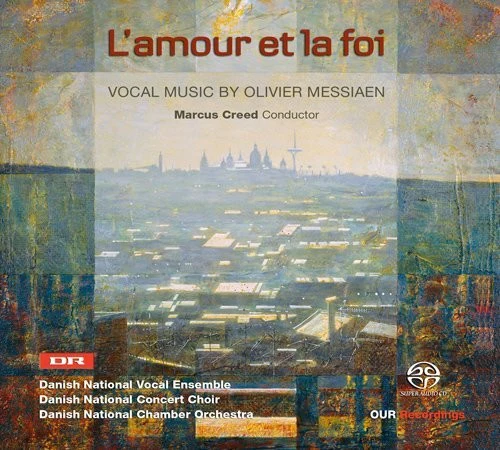
L'amour et la Foi - Vocal Music by Olivier Messiaen / Creed

“You’re traveling through another dimension, a dimension not only of sight and sound, but of mind–a journey into a wondrous land bounded only by imagination…” Although that was an introduction to the strange new world of the classic 1960s television series The Twilight Zone, it came to mind as an equally apt intro to the music of Olivier Messiaen. Although his world isn’t exactly the Twilight Zone’s unfathomable, unpredictable “middle ground between science and superstition”, in his choral music the composer definitely did create his own special, unique, alternately mystifying and frightening, ultimately exhilarating “zone” of sound, a realm of ensemble vocalism that challenges all who will hear.
The Three Liturgies–for female voices, piano, ondes Martenot, celeste, vibraphone, percussion, and string orchestra–is as radical in every aspect as anything today’s composers offer, but at its core there is a passionate heart and a musical purpose beyond merely making noise. You keep listening, not because you’re charmed and comforted–but rather because your senses are so deeply stirred, the familiar conventions of choral sound and rhythmic form and expression so profoundly and movingly redefined.
Long before composers such as Arvo Pärt or György Ligeti became known for works whose rhythmic and harmonic effects sparked descriptions such as “soundscape” and “suspension of time”, there was Messiaen’s motet O sacrum convivium! (1937), which not only embodies those concepts but remains an unforgettably moving, perfect realization of this oft-set sacred text.
Once again we approach the very edge of the boundaries of musical time and space–not to mention the edge of what’s humanly possible, vocally speaking–with the Cinq Rechants (Five Refrains), written for 12 solo voices. The subject is a part of “the myth of Tristan and Isolde”; the music deals in extremes, in all aspects, from dynamics and rhythmic forms to virtuosic vocal technique. You don’t forget this music once you’ve heard it. And fortunately Marcus Creed and his Danish singers and players–along with pianist Marianna Shirinyan and ondes Martenot soloist Thomas Bloch (in the Three Liturgies)–are more than just able advocates for Messiaen’s music: they are musicians of exceptional ability and admirable commitment, who leave no doubt that we are hearing performances that will stand alongside or above any in the catalog.
Whether turned up or at a lower level, the sound is full and vibrant and well-balanced in both the combined choir/instrumental and a cappella pieces. While this program and repertoire may not be for everyone, if you’re a serious choral music fan and you don’t already have these works in your collection, you need to hear this, and this recording most invitingly opens the door.
-- David Vernier, ClassicsToday.com
“You’re traveling through another dimension, a dimension not only of sight and sound, but of mind–a journey into a wondrous land bounded only by imagination…” Although that was an introduction to the strange new world of the classic 1960s television series The Twilight Zone, it came to mind as an equally apt intro to the music of Olivier Messiaen. Although his world isn’t exactly the Twilight Zone’s unfathomable, unpredictable “middle ground between science and superstition”, in his choral music the composer definitely did create his own special, unique, alternately mystifying and frightening, ultimately exhilarating “zone” of sound, a realm of ensemble vocalism that challenges all who will hear.
The Three Liturgies–for female voices, piano, ondes Martenot, celeste, vibraphone, percussion, and string orchestra–is as radical in every aspect as anything today’s composers offer, but at its core there is a passionate heart and a musical purpose beyond merely making noise. You keep listening, not because you’re charmed and comforted–but rather because your senses are so deeply stirred, the familiar conventions of choral sound and rhythmic form and expression so profoundly and movingly redefined.
Long before composers such as Arvo Pärt or György Ligeti became known for works whose rhythmic and harmonic effects sparked descriptions such as “soundscape” and “suspension of time”, there was Messiaen’s motet O sacrum convivium! (1937), which not only embodies those concepts but remains an unforgettably moving, perfect realization of this oft-set sacred text.
Once again we approach the very edge of the boundaries of musical time and space–not to mention the edge of what’s humanly possible, vocally speaking–with the Cinq Rechants (Five Refrains), written for 12 solo voices. The subject is a part of “the myth of Tristan and Isolde”; the music deals in extremes, in all aspects, from dynamics and rhythmic forms to virtuosic vocal technique. You don’t forget this music once you’ve heard it. And fortunately Marcus Creed and his Danish singers and players–along with pianist Marianna Shirinyan and ondes Martenot soloist Thomas Bloch (in the Three Liturgies)–are more than just able advocates for Messiaen’s music: they are musicians of exceptional ability and admirable commitment, who leave no doubt that we are hearing performances that will stand alongside or above any in the catalog.
Whether turned up or at a lower level, the sound is full and vibrant and well-balanced in both the combined choir/instrumental and a cappella pieces. While this program and repertoire may not be for everyone, if you’re a serious choral music fan and you don’t already have these works in your collection, you need to hear this, and this recording most invitingly opens the door.
-- David Vernier, ClassicsToday.com
$6.65
Original: $18.99
-65%L'amour et la Foi - Vocal Music by Olivier Messiaen / Creed—
$18.99
$6.65Description
“You’re traveling through another dimension, a dimension not only of sight and sound, but of mind–a journey into a wondrous land bounded only by imagination…” Although that was an introduction to the strange new world of the classic 1960s television series The Twilight Zone, it came to mind as an equally apt intro to the music of Olivier Messiaen. Although his world isn’t exactly the Twilight Zone’s unfathomable, unpredictable “middle ground between science and superstition”, in his choral music the composer definitely did create his own special, unique, alternately mystifying and frightening, ultimately exhilarating “zone” of sound, a realm of ensemble vocalism that challenges all who will hear.
The Three Liturgies–for female voices, piano, ondes Martenot, celeste, vibraphone, percussion, and string orchestra–is as radical in every aspect as anything today’s composers offer, but at its core there is a passionate heart and a musical purpose beyond merely making noise. You keep listening, not because you’re charmed and comforted–but rather because your senses are so deeply stirred, the familiar conventions of choral sound and rhythmic form and expression so profoundly and movingly redefined.
Long before composers such as Arvo Pärt or György Ligeti became known for works whose rhythmic and harmonic effects sparked descriptions such as “soundscape” and “suspension of time”, there was Messiaen’s motet O sacrum convivium! (1937), which not only embodies those concepts but remains an unforgettably moving, perfect realization of this oft-set sacred text.
Once again we approach the very edge of the boundaries of musical time and space–not to mention the edge of what’s humanly possible, vocally speaking–with the Cinq Rechants (Five Refrains), written for 12 solo voices. The subject is a part of “the myth of Tristan and Isolde”; the music deals in extremes, in all aspects, from dynamics and rhythmic forms to virtuosic vocal technique. You don’t forget this music once you’ve heard it. And fortunately Marcus Creed and his Danish singers and players–along with pianist Marianna Shirinyan and ondes Martenot soloist Thomas Bloch (in the Three Liturgies)–are more than just able advocates for Messiaen’s music: they are musicians of exceptional ability and admirable commitment, who leave no doubt that we are hearing performances that will stand alongside or above any in the catalog.
Whether turned up or at a lower level, the sound is full and vibrant and well-balanced in both the combined choir/instrumental and a cappella pieces. While this program and repertoire may not be for everyone, if you’re a serious choral music fan and you don’t already have these works in your collection, you need to hear this, and this recording most invitingly opens the door.
-- David Vernier, ClassicsToday.com