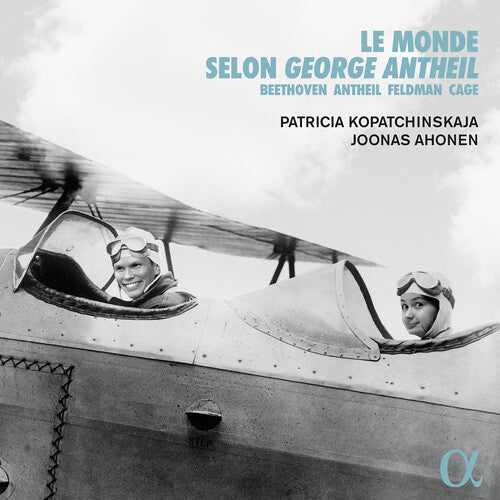
The World According to George Antheil / Kopatchinskaja, Ahonen
George Antheil called himself a ‘Pianist-Futurist’. A lover of speed, cars and airplanes, the American composer settled in the Paris of the Années Folles, where he frequented Picasso shows and Stravinsky concerts, and composed works such as the Sonate sauvage and Jazz Sonata, which caused a scandal: during a concert in Budapest, he even brandished a pistol to restore silence in the hall . . . He hero-worshipped Beethoven, whose pieces he played in the first part of his recitals before moving onto his own music. In 1933, he returned to the United States, where he met John Cage and Morton Feldman. Patricia Kopatschinskaja and the young Finnish pianist Joonas Ahonen – whom The Times, following what the journalist described as ‘one of those concerts you remember for ever’, presented as the violinist’s ‘doppelgänger’! – pay tribute to the self-proclaimed ‘Bad Boy of Music’.
Critical acclaim from the New York Times:
"George Antheil (1900-59) was a technophilic, self-declared bad boy of music; regardless of whether that’s true, he didn’t please his way into the canon. Here, however, this American composer gets a tribute that places him in a lineage of innovators from Beethoven to the mid-20th century — traced by the daredevil violinist Patricia Kopatchinskaja and an enthusiastic partner in the pianist Joonas Ahonen.
"...Antheil would perform his works alongside, say, something from a century earlier, and Kopatchinskaja and Ahonen do the same by programming Beethoven’s Violin Sonata No. 7 in C minor. It is a fiery and freely interpreted account reminiscent of Gidon Kremer and Martha Argerich’s fearless, unpredictable, at times unwieldy recordings from the 1990s.
"Like the Beethoven, the Antheil is in four movements, but it blends traditional form with a thoroughly modern sound that, in this reading, bustles at a breakneck pace with percussive and metallic timbres. Looking beyond Antheil’s generation, the album also includes pieces by Morton Feldman and a nocturne by John Cage, works that subtly recall the sonatas but also stand alone as studies in sound-making and extremity — of strength and softness, of overtone-rich expanses. Executed with discipline that borders on mechanical, they couldn’t be better suited to a world according to George." --The New York Times (Joshua Barone)
George Antheil called himself a ‘Pianist-Futurist’. A lover of speed, cars and airplanes, the American composer settled in the Paris of the Années Folles, where he frequented Picasso shows and Stravinsky concerts, and composed works such as the Sonate sauvage and Jazz Sonata, which caused a scandal: during a concert in Budapest, he even brandished a pistol to restore silence in the hall . . . He hero-worshipped Beethoven, whose pieces he played in the first part of his recitals before moving onto his own music. In 1933, he returned to the United States, where he met John Cage and Morton Feldman. Patricia Kopatschinskaja and the young Finnish pianist Joonas Ahonen – whom The Times, following what the journalist described as ‘one of those concerts you remember for ever’, presented as the violinist’s ‘doppelgänger’! – pay tribute to the self-proclaimed ‘Bad Boy of Music’.
Critical acclaim from the New York Times:
"George Antheil (1900-59) was a technophilic, self-declared bad boy of music; regardless of whether that’s true, he didn’t please his way into the canon. Here, however, this American composer gets a tribute that places him in a lineage of innovators from Beethoven to the mid-20th century — traced by the daredevil violinist Patricia Kopatchinskaja and an enthusiastic partner in the pianist Joonas Ahonen.
"...Antheil would perform his works alongside, say, something from a century earlier, and Kopatchinskaja and Ahonen do the same by programming Beethoven’s Violin Sonata No. 7 in C minor. It is a fiery and freely interpreted account reminiscent of Gidon Kremer and Martha Argerich’s fearless, unpredictable, at times unwieldy recordings from the 1990s.
"Like the Beethoven, the Antheil is in four movements, but it blends traditional form with a thoroughly modern sound that, in this reading, bustles at a breakneck pace with percussive and metallic timbres. Looking beyond Antheil’s generation, the album also includes pieces by Morton Feldman and a nocturne by John Cage, works that subtly recall the sonatas but also stand alone as studies in sound-making and extremity — of strength and softness, of overtone-rich expanses. Executed with discipline that borders on mechanical, they couldn’t be better suited to a world according to George." --The New York Times (Joshua Barone)
Original: $10.50
-65%$10.50
$3.67Description
George Antheil called himself a ‘Pianist-Futurist’. A lover of speed, cars and airplanes, the American composer settled in the Paris of the Années Folles, where he frequented Picasso shows and Stravinsky concerts, and composed works such as the Sonate sauvage and Jazz Sonata, which caused a scandal: during a concert in Budapest, he even brandished a pistol to restore silence in the hall . . . He hero-worshipped Beethoven, whose pieces he played in the first part of his recitals before moving onto his own music. In 1933, he returned to the United States, where he met John Cage and Morton Feldman. Patricia Kopatschinskaja and the young Finnish pianist Joonas Ahonen – whom The Times, following what the journalist described as ‘one of those concerts you remember for ever’, presented as the violinist’s ‘doppelgänger’! – pay tribute to the self-proclaimed ‘Bad Boy of Music’.
Critical acclaim from the New York Times:
"George Antheil (1900-59) was a technophilic, self-declared bad boy of music; regardless of whether that’s true, he didn’t please his way into the canon. Here, however, this American composer gets a tribute that places him in a lineage of innovators from Beethoven to the mid-20th century — traced by the daredevil violinist Patricia Kopatchinskaja and an enthusiastic partner in the pianist Joonas Ahonen.
"...Antheil would perform his works alongside, say, something from a century earlier, and Kopatchinskaja and Ahonen do the same by programming Beethoven’s Violin Sonata No. 7 in C minor. It is a fiery and freely interpreted account reminiscent of Gidon Kremer and Martha Argerich’s fearless, unpredictable, at times unwieldy recordings from the 1990s.
"Like the Beethoven, the Antheil is in four movements, but it blends traditional form with a thoroughly modern sound that, in this reading, bustles at a breakneck pace with percussive and metallic timbres. Looking beyond Antheil’s generation, the album also includes pieces by Morton Feldman and a nocturne by John Cage, works that subtly recall the sonatas but also stand alone as studies in sound-making and extremity — of strength and softness, of overtone-rich expanses. Executed with discipline that borders on mechanical, they couldn’t be better suited to a world according to George." --The New York Times (Joshua Barone)