
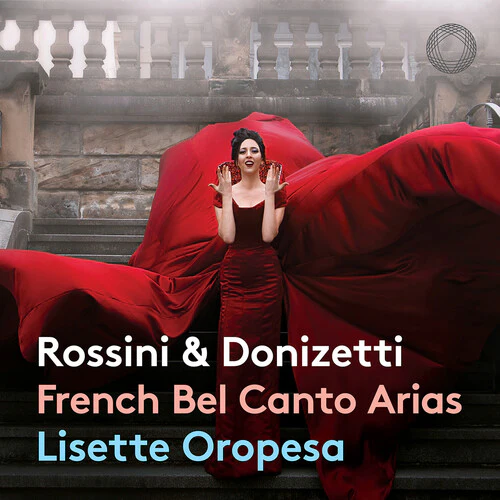
French Bel Canto Arias - Rossini & Donizetti / Lisette Oropesa
A New Yorker Notable Recording of 2022!
On her second solo album Lisette Oropesa has combined two of her greatest loves, the French language and Italian bel canto. This recording with the Dresdner Philharmonie under the baton of Corrado Rovaris showcases the variety of lesser-known and more popular works by Rossini and Donizetti, featuring arias that contain coloratura, lyricism, drama, heightened emotion, and even comedy. Star soprano Lisette Oropesa made her Pentatone debut with Ombra Compagna, Mozart Concert Arias in 2021, and sung the title heroine in a complete recording of Verdi’s La Traviata, also released on the label in 2022. The Dresdner Philharmonie was involved in that same recording, and has also participated in several other recordings released by Pentatone, such as Weber’s Der Freischütz (2019), Mascagni’s Cavalleria Rusticana, Puccini’s Il Tabarro (both 2020) and Beethoven’s Fidelio (2021). Conductor Corrado Rovaris particularly excels in bel canto and verismo repertoire, and makes his Pentatone debut.
REVIEW:
Oropesa's very first notes here, from Le Siège de Corinthe, are warm and pleading, the tone round and full–and utterly beautiful. As the voice rises, it doesn’t lose texture. The coloratura is close to flawless, as is her pitch. The roulades and runs are so fierce in the Rossini selections that, let’s face it, a touch of hesitation is to be expected and it is just that–a touch.
This is very difficult music–just think of how few recital CDs have included these two scenes. The necessary legato, the sadness, the darkening of the tone, and the purposeful use of vibrato are rare indeed; there is a true musician in the house.
Mathilde’s aria from Guillaume Tell is sure-fire. She manages it beautifully, the start of each phrase knowing full well the direction in which it’s going, the breath control natural. “Salut à la France” is divine: carefree, joyous, full of perfect downward scales and staccatos, and capped with a fine E-flat.
More than anything else, you come away from this recital with the realization that Oropesa and, indeed, the Dresden Philharmonic and conductor Corrado Rovaris, have fashioned a warmhearted, stylistically impeccable look at French bel canto, frequently overlooked. There’s nothing hackneyed here, and no ear fatigue listening to a high solo voice for 65 minutes...what a fine disc!
-- ClassicsToday (Robert Levine)
A New Yorker Notable Recording of 2022!
On her second solo album Lisette Oropesa has combined two of her greatest loves, the French language and Italian bel canto. This recording with the Dresdner Philharmonie under the baton of Corrado Rovaris showcases the variety of lesser-known and more popular works by Rossini and Donizetti, featuring arias that contain coloratura, lyricism, drama, heightened emotion, and even comedy. Star soprano Lisette Oropesa made her Pentatone debut with Ombra Compagna, Mozart Concert Arias in 2021, and sung the title heroine in a complete recording of Verdi’s La Traviata, also released on the label in 2022. The Dresdner Philharmonie was involved in that same recording, and has also participated in several other recordings released by Pentatone, such as Weber’s Der Freischütz (2019), Mascagni’s Cavalleria Rusticana, Puccini’s Il Tabarro (both 2020) and Beethoven’s Fidelio (2021). Conductor Corrado Rovaris particularly excels in bel canto and verismo repertoire, and makes his Pentatone debut.
REVIEW:
Oropesa's very first notes here, from Le Siège de Corinthe, are warm and pleading, the tone round and full–and utterly beautiful. As the voice rises, it doesn’t lose texture. The coloratura is close to flawless, as is her pitch. The roulades and runs are so fierce in the Rossini selections that, let’s face it, a touch of hesitation is to be expected and it is just that–a touch.
This is very difficult music–just think of how few recital CDs have included these two scenes. The necessary legato, the sadness, the darkening of the tone, and the purposeful use of vibrato are rare indeed; there is a true musician in the house.
Mathilde’s aria from Guillaume Tell is sure-fire. She manages it beautifully, the start of each phrase knowing full well the direction in which it’s going, the breath control natural. “Salut à la France” is divine: carefree, joyous, full of perfect downward scales and staccatos, and capped with a fine E-flat.
More than anything else, you come away from this recital with the realization that Oropesa and, indeed, the Dresden Philharmonic and conductor Corrado Rovaris, have fashioned a warmhearted, stylistically impeccable look at French bel canto, frequently overlooked. There’s nothing hackneyed here, and no ear fatigue listening to a high solo voice for 65 minutes...what a fine disc!
-- ClassicsToday (Robert Levine)
Original: $21.99
-65%$21.99
$7.70Description
A New Yorker Notable Recording of 2022!
On her second solo album Lisette Oropesa has combined two of her greatest loves, the French language and Italian bel canto. This recording with the Dresdner Philharmonie under the baton of Corrado Rovaris showcases the variety of lesser-known and more popular works by Rossini and Donizetti, featuring arias that contain coloratura, lyricism, drama, heightened emotion, and even comedy. Star soprano Lisette Oropesa made her Pentatone debut with Ombra Compagna, Mozart Concert Arias in 2021, and sung the title heroine in a complete recording of Verdi’s La Traviata, also released on the label in 2022. The Dresdner Philharmonie was involved in that same recording, and has also participated in several other recordings released by Pentatone, such as Weber’s Der Freischütz (2019), Mascagni’s Cavalleria Rusticana, Puccini’s Il Tabarro (both 2020) and Beethoven’s Fidelio (2021). Conductor Corrado Rovaris particularly excels in bel canto and verismo repertoire, and makes his Pentatone debut.
REVIEW:
Oropesa's very first notes here, from Le Siège de Corinthe, are warm and pleading, the tone round and full–and utterly beautiful. As the voice rises, it doesn’t lose texture. The coloratura is close to flawless, as is her pitch. The roulades and runs are so fierce in the Rossini selections that, let’s face it, a touch of hesitation is to be expected and it is just that–a touch.
This is very difficult music–just think of how few recital CDs have included these two scenes. The necessary legato, the sadness, the darkening of the tone, and the purposeful use of vibrato are rare indeed; there is a true musician in the house.
Mathilde’s aria from Guillaume Tell is sure-fire. She manages it beautifully, the start of each phrase knowing full well the direction in which it’s going, the breath control natural. “Salut à la France” is divine: carefree, joyous, full of perfect downward scales and staccatos, and capped with a fine E-flat.
More than anything else, you come away from this recital with the realization that Oropesa and, indeed, the Dresden Philharmonic and conductor Corrado Rovaris, have fashioned a warmhearted, stylistically impeccable look at French bel canto, frequently overlooked. There’s nothing hackneyed here, and no ear fatigue listening to a high solo voice for 65 minutes...what a fine disc!
-- ClassicsToday (Robert Levine)






















