🎉 Up to 70% Off Selected ItemsShop Sale

1 / 2
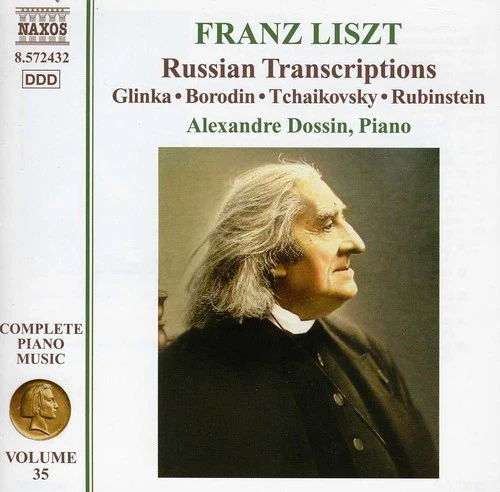
Liszt: Russian Transcriptions, Vol. 35 / Alexandre Dossin
LISZT Polonaise from Yevgeney Onegin. Le Rossignol. Chanson bohémienne. Abschied. Mazurka. March from Russlan and Ludmilla. Prelude to the Borodin Polka. Russian Galop. Tarantella by César Cui. Slavic Tarentella by Dargomyzhsky. 2 Anton Rubinstein songs. Autrefois • Alexandre Dossin (pn) • NAXOS 572432 (66: 25)
The Naxos traversal of Liszt’s complete piano music, which began in 1997, has now reached its 35th volume with Alexandre Dossin playing a fascinating program of transcriptions of Russian composers. Dossin’s bona fides as a Liszt player of distinction were established with his 2007 contribution to the series, a disc devoted to the Verdi transcriptions and paraphrases. This new release shows him in wide-ranging repertoire, from salon trifles such as the Chanson bohémienne of Bulakhov, through the resplendent setting of the Polonaise from Tchaikovsky’s Yevgeny Onegin , to the heartrending Abschied (Farewell), a simple song setting for Liszt’s beloved pupil Siloti.
The chief interest of this repertoire, however, is not its variety, but its chronology. Five of the transcriptions—those based on music of Alyabyev, Bulakhov, Glinka, and Vielgorsky—are souvenirs of Liszt’s Russian tours of the 1840s. The isolated Mazurka “composed by a St. Petersburg amateur,” possibly Vielgorsky, dates from 1856, during Liszt’s Weimar years. The remainder—including the Tchaikovsky Polonaise and the Borodin, Dargomyzhsky, and Cui transcriptions as well as the two Rubinstein songs—were all set by Liszt in 1880 or later. In other words, these final seven transcriptions are products of the last six years of Liszt’s life and thus contemporaneous with such late-style works as Czárdás macabre , the Hungarian Historical Portraits, Bagatelle without Tonality, Unstern!, and the several pieces memorializing Wagner.
The Polonaise from Onegin , easily the most familiar work on the disc, is given an extrovert reading that highlights its profusion of opulent pianistic detail without obscuring the overall structure and momentum of the dance. Dossin’s interpretation readily holds its own beside those older, famous ones of Cziffra and Ponti, and perhaps surpasses them in its unforced poise and characteristic voice. Dossin approaches Alyabyev’s The Nightingale , set by Liszt as a veritable mini-Russian rhapsody, with intelligence and finesse. Meanwhile, the quirky Circassian March from Glinka’s Russlan and Ludmilla, a virtuoso tour de force , fairly explodes with rhythmic acrobatics and kaleidoscopic colors.
The two tarantellas by Dargomyzhsky and Cui are particularly intriguing, reminding us that, during the 1860s, Liszt and Dargomyzhsky were among the first composers to experiment (independently) with use of the whole-tone scale—Dargomyzhsky in his opera The Stone Guest and Liszt in his melodrama Der traurige Mönch. Both tarantellas exemplify Liszt’s tendency in old age to transform the materials he transcribed, imbuing them with the radical harmonic and rhythmic characteristics of his own late style. In many cases, and certainly in these tarantellas, the originals are endowed with a “new formal and authorial weight,” as Jonathan Kregor has suggested in his pathbreaking study, Liszt as Transcriber (2010). Dargomyzhsky had been dead 10 years when his unprepossessing piano duet Slavic Tarantella was taken up by Liszt and expanded into a haunting and concert-worthy piano solo. The longest piece on the program is the Tarantella by César Cui , possibly Liszt’s very last transcription of another composer’s work. Kregor points out that Cui’s orchestral original had been in circulation for more than 25years when Liszt decided to transcribe it. Liszt expands, emends, and amplifies the material in a way that elevates this folk dance to a veritable metaphysical realm. If proof were needed that the acuity of Liszt’s perceptions and the richness of his imagination remained undiminished to the end, the Tarantella by César Cui provides ample testimony.
It is hard to imagine a more eloquent spokesman for this repertoire than Dossin. Though he is by birth and upbringing Brazilian, the nine years he spent studying in Moscow lend an unmistakable authenticity to his voice in Russian music. Moreover, Dossin’s refined and multifaceted pianism, combined with his formidable intellectual and musical grasp, make him one of the more remarkable Liszt interpreters before the public today.
FANFARE: Patrick Rucker
LISZT Polonaise from Yevgeney Onegin. Le Rossignol. Chanson bohémienne. Abschied. Mazurka. March from Russlan and Ludmilla. Prelude to the Borodin Polka. Russian Galop. Tarantella by César Cui. Slavic Tarentella by Dargomyzhsky. 2 Anton Rubinstein songs. Autrefois • Alexandre Dossin (pn) • NAXOS 572432 (66: 25)
The Naxos traversal of Liszt’s complete piano music, which began in 1997, has now reached its 35th volume with Alexandre Dossin playing a fascinating program of transcriptions of Russian composers. Dossin’s bona fides as a Liszt player of distinction were established with his 2007 contribution to the series, a disc devoted to the Verdi transcriptions and paraphrases. This new release shows him in wide-ranging repertoire, from salon trifles such as the Chanson bohémienne of Bulakhov, through the resplendent setting of the Polonaise from Tchaikovsky’s Yevgeny Onegin , to the heartrending Abschied (Farewell), a simple song setting for Liszt’s beloved pupil Siloti.
The chief interest of this repertoire, however, is not its variety, but its chronology. Five of the transcriptions—those based on music of Alyabyev, Bulakhov, Glinka, and Vielgorsky—are souvenirs of Liszt’s Russian tours of the 1840s. The isolated Mazurka “composed by a St. Petersburg amateur,” possibly Vielgorsky, dates from 1856, during Liszt’s Weimar years. The remainder—including the Tchaikovsky Polonaise and the Borodin, Dargomyzhsky, and Cui transcriptions as well as the two Rubinstein songs—were all set by Liszt in 1880 or later. In other words, these final seven transcriptions are products of the last six years of Liszt’s life and thus contemporaneous with such late-style works as Czárdás macabre , the Hungarian Historical Portraits, Bagatelle without Tonality, Unstern!, and the several pieces memorializing Wagner.
The Polonaise from Onegin , easily the most familiar work on the disc, is given an extrovert reading that highlights its profusion of opulent pianistic detail without obscuring the overall structure and momentum of the dance. Dossin’s interpretation readily holds its own beside those older, famous ones of Cziffra and Ponti, and perhaps surpasses them in its unforced poise and characteristic voice. Dossin approaches Alyabyev’s The Nightingale , set by Liszt as a veritable mini-Russian rhapsody, with intelligence and finesse. Meanwhile, the quirky Circassian March from Glinka’s Russlan and Ludmilla, a virtuoso tour de force , fairly explodes with rhythmic acrobatics and kaleidoscopic colors.
The two tarantellas by Dargomyzhsky and Cui are particularly intriguing, reminding us that, during the 1860s, Liszt and Dargomyzhsky were among the first composers to experiment (independently) with use of the whole-tone scale—Dargomyzhsky in his opera The Stone Guest and Liszt in his melodrama Der traurige Mönch. Both tarantellas exemplify Liszt’s tendency in old age to transform the materials he transcribed, imbuing them with the radical harmonic and rhythmic characteristics of his own late style. In many cases, and certainly in these tarantellas, the originals are endowed with a “new formal and authorial weight,” as Jonathan Kregor has suggested in his pathbreaking study, Liszt as Transcriber (2010). Dargomyzhsky had been dead 10 years when his unprepossessing piano duet Slavic Tarantella was taken up by Liszt and expanded into a haunting and concert-worthy piano solo. The longest piece on the program is the Tarantella by César Cui , possibly Liszt’s very last transcription of another composer’s work. Kregor points out that Cui’s orchestral original had been in circulation for more than 25years when Liszt decided to transcribe it. Liszt expands, emends, and amplifies the material in a way that elevates this folk dance to a veritable metaphysical realm. If proof were needed that the acuity of Liszt’s perceptions and the richness of his imagination remained undiminished to the end, the Tarantella by César Cui provides ample testimony.
It is hard to imagine a more eloquent spokesman for this repertoire than Dossin. Though he is by birth and upbringing Brazilian, the nine years he spent studying in Moscow lend an unmistakable authenticity to his voice in Russian music. Moreover, Dossin’s refined and multifaceted pianism, combined with his formidable intellectual and musical grasp, make him one of the more remarkable Liszt interpreters before the public today.
FANFARE: Patrick Rucker
$13.99
Liszt: Russian Transcriptions, Vol. 35 / Alexandre Dossin—
$13.99
Description
LISZT Polonaise from Yevgeney Onegin. Le Rossignol. Chanson bohémienne. Abschied. Mazurka. March from Russlan and Ludmilla. Prelude to the Borodin Polka. Russian Galop. Tarantella by César Cui. Slavic Tarentella by Dargomyzhsky. 2 Anton Rubinstein songs. Autrefois • Alexandre Dossin (pn) • NAXOS 572432 (66: 25)
The Naxos traversal of Liszt’s complete piano music, which began in 1997, has now reached its 35th volume with Alexandre Dossin playing a fascinating program of transcriptions of Russian composers. Dossin’s bona fides as a Liszt player of distinction were established with his 2007 contribution to the series, a disc devoted to the Verdi transcriptions and paraphrases. This new release shows him in wide-ranging repertoire, from salon trifles such as the Chanson bohémienne of Bulakhov, through the resplendent setting of the Polonaise from Tchaikovsky’s Yevgeny Onegin , to the heartrending Abschied (Farewell), a simple song setting for Liszt’s beloved pupil Siloti.
The chief interest of this repertoire, however, is not its variety, but its chronology. Five of the transcriptions—those based on music of Alyabyev, Bulakhov, Glinka, and Vielgorsky—are souvenirs of Liszt’s Russian tours of the 1840s. The isolated Mazurka “composed by a St. Petersburg amateur,” possibly Vielgorsky, dates from 1856, during Liszt’s Weimar years. The remainder—including the Tchaikovsky Polonaise and the Borodin, Dargomyzhsky, and Cui transcriptions as well as the two Rubinstein songs—were all set by Liszt in 1880 or later. In other words, these final seven transcriptions are products of the last six years of Liszt’s life and thus contemporaneous with such late-style works as Czárdás macabre , the Hungarian Historical Portraits, Bagatelle without Tonality, Unstern!, and the several pieces memorializing Wagner.
The Polonaise from Onegin , easily the most familiar work on the disc, is given an extrovert reading that highlights its profusion of opulent pianistic detail without obscuring the overall structure and momentum of the dance. Dossin’s interpretation readily holds its own beside those older, famous ones of Cziffra and Ponti, and perhaps surpasses them in its unforced poise and characteristic voice. Dossin approaches Alyabyev’s The Nightingale , set by Liszt as a veritable mini-Russian rhapsody, with intelligence and finesse. Meanwhile, the quirky Circassian March from Glinka’s Russlan and Ludmilla, a virtuoso tour de force , fairly explodes with rhythmic acrobatics and kaleidoscopic colors.
The two tarantellas by Dargomyzhsky and Cui are particularly intriguing, reminding us that, during the 1860s, Liszt and Dargomyzhsky were among the first composers to experiment (independently) with use of the whole-tone scale—Dargomyzhsky in his opera The Stone Guest and Liszt in his melodrama Der traurige Mönch. Both tarantellas exemplify Liszt’s tendency in old age to transform the materials he transcribed, imbuing them with the radical harmonic and rhythmic characteristics of his own late style. In many cases, and certainly in these tarantellas, the originals are endowed with a “new formal and authorial weight,” as Jonathan Kregor has suggested in his pathbreaking study, Liszt as Transcriber (2010). Dargomyzhsky had been dead 10 years when his unprepossessing piano duet Slavic Tarantella was taken up by Liszt and expanded into a haunting and concert-worthy piano solo. The longest piece on the program is the Tarantella by César Cui , possibly Liszt’s very last transcription of another composer’s work. Kregor points out that Cui’s orchestral original had been in circulation for more than 25years when Liszt decided to transcribe it. Liszt expands, emends, and amplifies the material in a way that elevates this folk dance to a veritable metaphysical realm. If proof were needed that the acuity of Liszt’s perceptions and the richness of his imagination remained undiminished to the end, the Tarantella by César Cui provides ample testimony.
It is hard to imagine a more eloquent spokesman for this repertoire than Dossin. Though he is by birth and upbringing Brazilian, the nine years he spent studying in Moscow lend an unmistakable authenticity to his voice in Russian music. Moreover, Dossin’s refined and multifaceted pianism, combined with his formidable intellectual and musical grasp, make him one of the more remarkable Liszt interpreters before the public today.
FANFARE: Patrick Rucker