Łukaszewski: Sacred Choral Works / Sirmais, Latvia State Choir
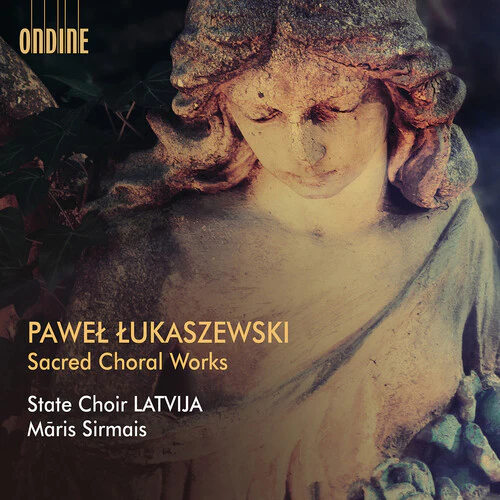
Pawel Łukaszewski (b. 1968) is possibly the most-performed contemporary composer from Poland. His spiritual choral works are performed by both professional and amateur choirs around the world. Łukaszewski’s output has a significant position in Great Britain where his works are performed and premiered by renowned London and Cambridge choral ensembles. This new album by the award-winning State Choir LATVIJA under Maris Sirmais includes several world première recordings from the Polish master.
REVIEW:
The performances presented here by the State Choir of Latvia under its conductor, Māris Sirmais, are simply outstanding. At what seems to be about 50 voices, the choir is larger than a chamber choir but smaller than a symphonic choir, and it manages to combine the virtues of both in this tremendously impressive recital. The choir has no faults to my ear. Intonation and ensemble are excellent, all parts exhibit outstanding internal blend with no individual voices sticking out, and excessive vibrato – the bane of choral excellence – is non-existent. The choir exhibits an extreme dynamic range, and yet at both ends of that spectrum its technical control never wavers, whether at fff – where it can produce an immense sound with no sign of hardness – or when reduced to more soloistic proportions. The recording is well up to the challenge that such an ensemble presents, and the sound is rich, deep, resonant, and detailed all at once.
-- Fanfare
Pawel Łukaszewski (b. 1968) is possibly the most-performed contemporary composer from Poland. His spiritual choral works are performed by both professional and amateur choirs around the world. Łukaszewski’s output has a significant position in Great Britain where his works are performed and premiered by renowned London and Cambridge choral ensembles. This new album by the award-winning State Choir LATVIJA under Maris Sirmais includes several world première recordings from the Polish master.
REVIEW:
The performances presented here by the State Choir of Latvia under its conductor, Māris Sirmais, are simply outstanding. At what seems to be about 50 voices, the choir is larger than a chamber choir but smaller than a symphonic choir, and it manages to combine the virtues of both in this tremendously impressive recital. The choir has no faults to my ear. Intonation and ensemble are excellent, all parts exhibit outstanding internal blend with no individual voices sticking out, and excessive vibrato – the bane of choral excellence – is non-existent. The choir exhibits an extreme dynamic range, and yet at both ends of that spectrum its technical control never wavers, whether at fff – where it can produce an immense sound with no sign of hardness – or when reduced to more soloistic proportions. The recording is well up to the challenge that such an ensemble presents, and the sound is rich, deep, resonant, and detailed all at once.
-- Fanfare
Original: $14.99
-65%$14.99
$5.25Description
Pawel Łukaszewski (b. 1968) is possibly the most-performed contemporary composer from Poland. His spiritual choral works are performed by both professional and amateur choirs around the world. Łukaszewski’s output has a significant position in Great Britain where his works are performed and premiered by renowned London and Cambridge choral ensembles. This new album by the award-winning State Choir LATVIJA under Maris Sirmais includes several world première recordings from the Polish master.
REVIEW:
The performances presented here by the State Choir of Latvia under its conductor, Māris Sirmais, are simply outstanding. At what seems to be about 50 voices, the choir is larger than a chamber choir but smaller than a symphonic choir, and it manages to combine the virtues of both in this tremendously impressive recital. The choir has no faults to my ear. Intonation and ensemble are excellent, all parts exhibit outstanding internal blend with no individual voices sticking out, and excessive vibrato – the bane of choral excellence – is non-existent. The choir exhibits an extreme dynamic range, and yet at both ends of that spectrum its technical control never wavers, whether at fff – where it can produce an immense sound with no sign of hardness – or when reduced to more soloistic proportions. The recording is well up to the challenge that such an ensemble presents, and the sound is rich, deep, resonant, and detailed all at once.
-- Fanfare