🎉 Up to 70% Off Selected ItemsShop Sale

1 / 2
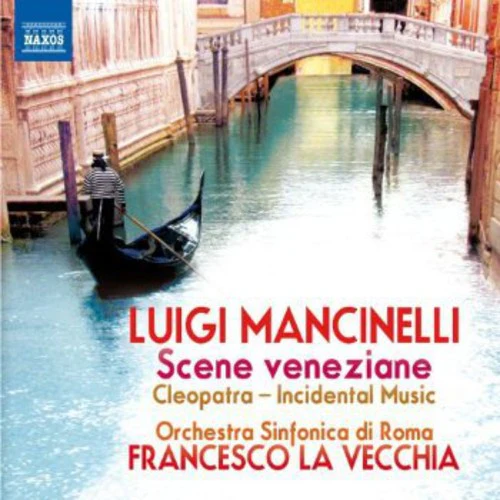
Mancinelli: Scene Veneziane / La Vecchia, Rome Symphony Orchestra
Luigi Mancinelli was a noted conductor, composer, and cellist. Over the course of his productive life (1848-1921) he became an important exponent of Verdi, Puccini, and Wagner, while living long enough to dip his toes into some of the earliest examples of film music. The two movements (out of six) from his incidental music to Cleopatra date from 1877 and show great promise. The Overture is dramatic, with memorable thematic material, while the Battaglia di Azio is simple in form and concept, but effective enough. It must have worked well in the theater.
Scene veneziane supposedly also dates from 1877, but wasn’t performed until 1889. I have my doubts about the alleged date of composition, for even if correct the work reveals an amazingly advanced orchestral technique as compared to Cleopatra. The very opening strikingly anticipates the start of Respighi’s Three Botticelli Pictures of some 50 years later (1927), and timbral nuances such as using the harp as a melody instrument, doubling the winds, reveal Mancinelli as a highly sophisticated composer. The work tells a love story, beginning with a brilliant carnival and continuing with such moments as a declaration of love, a gondola ride, and concluding ceremonial music (amazingly like a Bruckner adagio) leading to a joyful dance. It’s great fun, and a real find.
Francesco La Vecchia, as usual in this series, leads a vivacious performance, perhaps a bit roughly played in spots by the Rome Symphony’s brass, but exciting and enjoyable nonetheless. The sonics are brightly lit and have a bit too much of the “empty hall” effect, but are in all other respects perfectly adequate. A very enjoyable disc from a composer who achieved quite a bit, and deserves a hearing.
-- David Hurwitz, ClassicsToday.com
--------
Even the most casual of Fanfare readers cannot fail to note the regularity with which even its most experienced contributors encounter composers they’ve never heard of before, many of them worthy of far more respect and recognition than they commonly get. Such a case faces this writer once again—an Italian by the name of Luigi Mancinelli. Discounting a couple of songs buried in large anthologies, the only previous Mancinelli music to be found in the Fanfare Archive was published 22 years ago, when David Johnson reviewed the complete incidental music to Cleopatra and the Romantic Overture (14:6).
Mancinelli is better known to posterity as a conductor than as a composer, including many years at Covent Garden and the Met, but he did leave a fairly substantial catalog of works that includes several operas. Johnson was not much taken with Mancinelli’s music, fairly damning it with faint praise, but I beg to differ. The opening bars of the Scene veneziane suggest nothing less than the Respighi of The Birds or The Pines of Rome —bright, sparkling sounds of a master orchestrator. Elsewhere we hear a grand, stately, and well-developed theme that could well have been a passage from an Elgar score marked with his trademark Nobilmente . Other moments have the touch of Glazunov. I have avoided mentioning Mancinelli’s dates (1845-1921) until now because the irony is that he preceded all the composers whose names I’ve just dropped. Also, as Johnson noted, Mancinelli, like Toscanini (also Italian), “began his musical life as a cellist and got his first big break by substituting at the podium for an indisposed conductor at a performance of Aida. ” Again, Mancinelli did not follow in Toscanini’s footsteps, but rather preceded the more famous maestro.
The present CD is billed as the world premiere recording of the complete Scene veneziane (Venetian Scenes, 1877). The five scenes, totaling 36 minutes, include the opening portrayal of a carnival; a love scene characterized by delicately intertwining woodwinds and a glowing, lyrical theme; the merry scurrying as indicated by the title “Flight of the Lovers to Chioggia” (again we find an anticipation of a later composer, here the Prokofiev of Romeo and Juliet ); an evocative gondola ride; and the final 13-minute scene depicting the processional wedding music, a return to the love scene and a rousing conclusion.
The Overture and “Battle of Actium” are two of the six symphonic interludes Mancinelli composed for a production of Pietro Cossa’s Cleopatra (also in 1877). The program notes describe the 10-minute Overture as “a fitting prelude to a tale of love, orgiastic excesses and the violence of war,” an assessment with which I fully concur. It has its share of bombast but also some stirring tunes; Wagner’s Rienzi might have served as its model. At 12 minutes, the “Battle of Actium” stands as a tone poem in its own right, a vivid depiction of that famous navel encounter complete with evocations of the sea, approaching rival fleets, the confusion of battle, and the love music that accompanies the flight of Anthony and Cleopatra. Through its use of recurring motifs, structural integrity and inspired orchestration, it is at least as good as most of Liszt’s tone poems.
Marta Marullo provides a fairly extensive biography of the composer as well as good, detailed program notes about the music in the inlay booklet, which is unfortunately rendered almost unreadable by the dense, tiny print. The Orchestra Sinfonica di Roma is a fine ensemble, conducted with verve and sensitivity by Francesco la Vecchia. If you need an obscure new composer in your life, I can heartily recommend Luigi Mancinelli.
FANFARE: Robert Markow
Scene veneziane supposedly also dates from 1877, but wasn’t performed until 1889. I have my doubts about the alleged date of composition, for even if correct the work reveals an amazingly advanced orchestral technique as compared to Cleopatra. The very opening strikingly anticipates the start of Respighi’s Three Botticelli Pictures of some 50 years later (1927), and timbral nuances such as using the harp as a melody instrument, doubling the winds, reveal Mancinelli as a highly sophisticated composer. The work tells a love story, beginning with a brilliant carnival and continuing with such moments as a declaration of love, a gondola ride, and concluding ceremonial music (amazingly like a Bruckner adagio) leading to a joyful dance. It’s great fun, and a real find.
Francesco La Vecchia, as usual in this series, leads a vivacious performance, perhaps a bit roughly played in spots by the Rome Symphony’s brass, but exciting and enjoyable nonetheless. The sonics are brightly lit and have a bit too much of the “empty hall” effect, but are in all other respects perfectly adequate. A very enjoyable disc from a composer who achieved quite a bit, and deserves a hearing.
-- David Hurwitz, ClassicsToday.com
--------
Even the most casual of Fanfare readers cannot fail to note the regularity with which even its most experienced contributors encounter composers they’ve never heard of before, many of them worthy of far more respect and recognition than they commonly get. Such a case faces this writer once again—an Italian by the name of Luigi Mancinelli. Discounting a couple of songs buried in large anthologies, the only previous Mancinelli music to be found in the Fanfare Archive was published 22 years ago, when David Johnson reviewed the complete incidental music to Cleopatra and the Romantic Overture (14:6).
Mancinelli is better known to posterity as a conductor than as a composer, including many years at Covent Garden and the Met, but he did leave a fairly substantial catalog of works that includes several operas. Johnson was not much taken with Mancinelli’s music, fairly damning it with faint praise, but I beg to differ. The opening bars of the Scene veneziane suggest nothing less than the Respighi of The Birds or The Pines of Rome —bright, sparkling sounds of a master orchestrator. Elsewhere we hear a grand, stately, and well-developed theme that could well have been a passage from an Elgar score marked with his trademark Nobilmente . Other moments have the touch of Glazunov. I have avoided mentioning Mancinelli’s dates (1845-1921) until now because the irony is that he preceded all the composers whose names I’ve just dropped. Also, as Johnson noted, Mancinelli, like Toscanini (also Italian), “began his musical life as a cellist and got his first big break by substituting at the podium for an indisposed conductor at a performance of Aida. ” Again, Mancinelli did not follow in Toscanini’s footsteps, but rather preceded the more famous maestro.
The present CD is billed as the world premiere recording of the complete Scene veneziane (Venetian Scenes, 1877). The five scenes, totaling 36 minutes, include the opening portrayal of a carnival; a love scene characterized by delicately intertwining woodwinds and a glowing, lyrical theme; the merry scurrying as indicated by the title “Flight of the Lovers to Chioggia” (again we find an anticipation of a later composer, here the Prokofiev of Romeo and Juliet ); an evocative gondola ride; and the final 13-minute scene depicting the processional wedding music, a return to the love scene and a rousing conclusion.
The Overture and “Battle of Actium” are two of the six symphonic interludes Mancinelli composed for a production of Pietro Cossa’s Cleopatra (also in 1877). The program notes describe the 10-minute Overture as “a fitting prelude to a tale of love, orgiastic excesses and the violence of war,” an assessment with which I fully concur. It has its share of bombast but also some stirring tunes; Wagner’s Rienzi might have served as its model. At 12 minutes, the “Battle of Actium” stands as a tone poem in its own right, a vivid depiction of that famous navel encounter complete with evocations of the sea, approaching rival fleets, the confusion of battle, and the love music that accompanies the flight of Anthony and Cleopatra. Through its use of recurring motifs, structural integrity and inspired orchestration, it is at least as good as most of Liszt’s tone poems.
Marta Marullo provides a fairly extensive biography of the composer as well as good, detailed program notes about the music in the inlay booklet, which is unfortunately rendered almost unreadable by the dense, tiny print. The Orchestra Sinfonica di Roma is a fine ensemble, conducted with verve and sensitivity by Francesco la Vecchia. If you need an obscure new composer in your life, I can heartily recommend Luigi Mancinelli.
FANFARE: Robert Markow
Luigi Mancinelli was a noted conductor, composer, and cellist. Over the course of his productive life (1848-1921) he became an important exponent of Verdi, Puccini, and Wagner, while living long enough to dip his toes into some of the earliest examples of film music. The two movements (out of six) from his incidental music to Cleopatra date from 1877 and show great promise. The Overture is dramatic, with memorable thematic material, while the Battaglia di Azio is simple in form and concept, but effective enough. It must have worked well in the theater.
Scene veneziane supposedly also dates from 1877, but wasn’t performed until 1889. I have my doubts about the alleged date of composition, for even if correct the work reveals an amazingly advanced orchestral technique as compared to Cleopatra. The very opening strikingly anticipates the start of Respighi’s Three Botticelli Pictures of some 50 years later (1927), and timbral nuances such as using the harp as a melody instrument, doubling the winds, reveal Mancinelli as a highly sophisticated composer. The work tells a love story, beginning with a brilliant carnival and continuing with such moments as a declaration of love, a gondola ride, and concluding ceremonial music (amazingly like a Bruckner adagio) leading to a joyful dance. It’s great fun, and a real find.
Francesco La Vecchia, as usual in this series, leads a vivacious performance, perhaps a bit roughly played in spots by the Rome Symphony’s brass, but exciting and enjoyable nonetheless. The sonics are brightly lit and have a bit too much of the “empty hall” effect, but are in all other respects perfectly adequate. A very enjoyable disc from a composer who achieved quite a bit, and deserves a hearing.
-- David Hurwitz, ClassicsToday.com
--------
Even the most casual of Fanfare readers cannot fail to note the regularity with which even its most experienced contributors encounter composers they’ve never heard of before, many of them worthy of far more respect and recognition than they commonly get. Such a case faces this writer once again—an Italian by the name of Luigi Mancinelli. Discounting a couple of songs buried in large anthologies, the only previous Mancinelli music to be found in the Fanfare Archive was published 22 years ago, when David Johnson reviewed the complete incidental music to Cleopatra and the Romantic Overture (14:6).
Mancinelli is better known to posterity as a conductor than as a composer, including many years at Covent Garden and the Met, but he did leave a fairly substantial catalog of works that includes several operas. Johnson was not much taken with Mancinelli’s music, fairly damning it with faint praise, but I beg to differ. The opening bars of the Scene veneziane suggest nothing less than the Respighi of The Birds or The Pines of Rome —bright, sparkling sounds of a master orchestrator. Elsewhere we hear a grand, stately, and well-developed theme that could well have been a passage from an Elgar score marked with his trademark Nobilmente . Other moments have the touch of Glazunov. I have avoided mentioning Mancinelli’s dates (1845-1921) until now because the irony is that he preceded all the composers whose names I’ve just dropped. Also, as Johnson noted, Mancinelli, like Toscanini (also Italian), “began his musical life as a cellist and got his first big break by substituting at the podium for an indisposed conductor at a performance of Aida. ” Again, Mancinelli did not follow in Toscanini’s footsteps, but rather preceded the more famous maestro.
The present CD is billed as the world premiere recording of the complete Scene veneziane (Venetian Scenes, 1877). The five scenes, totaling 36 minutes, include the opening portrayal of a carnival; a love scene characterized by delicately intertwining woodwinds and a glowing, lyrical theme; the merry scurrying as indicated by the title “Flight of the Lovers to Chioggia” (again we find an anticipation of a later composer, here the Prokofiev of Romeo and Juliet ); an evocative gondola ride; and the final 13-minute scene depicting the processional wedding music, a return to the love scene and a rousing conclusion.
The Overture and “Battle of Actium” are two of the six symphonic interludes Mancinelli composed for a production of Pietro Cossa’s Cleopatra (also in 1877). The program notes describe the 10-minute Overture as “a fitting prelude to a tale of love, orgiastic excesses and the violence of war,” an assessment with which I fully concur. It has its share of bombast but also some stirring tunes; Wagner’s Rienzi might have served as its model. At 12 minutes, the “Battle of Actium” stands as a tone poem in its own right, a vivid depiction of that famous navel encounter complete with evocations of the sea, approaching rival fleets, the confusion of battle, and the love music that accompanies the flight of Anthony and Cleopatra. Through its use of recurring motifs, structural integrity and inspired orchestration, it is at least as good as most of Liszt’s tone poems.
Marta Marullo provides a fairly extensive biography of the composer as well as good, detailed program notes about the music in the inlay booklet, which is unfortunately rendered almost unreadable by the dense, tiny print. The Orchestra Sinfonica di Roma is a fine ensemble, conducted with verve and sensitivity by Francesco la Vecchia. If you need an obscure new composer in your life, I can heartily recommend Luigi Mancinelli.
FANFARE: Robert Markow
Scene veneziane supposedly also dates from 1877, but wasn’t performed until 1889. I have my doubts about the alleged date of composition, for even if correct the work reveals an amazingly advanced orchestral technique as compared to Cleopatra. The very opening strikingly anticipates the start of Respighi’s Three Botticelli Pictures of some 50 years later (1927), and timbral nuances such as using the harp as a melody instrument, doubling the winds, reveal Mancinelli as a highly sophisticated composer. The work tells a love story, beginning with a brilliant carnival and continuing with such moments as a declaration of love, a gondola ride, and concluding ceremonial music (amazingly like a Bruckner adagio) leading to a joyful dance. It’s great fun, and a real find.
Francesco La Vecchia, as usual in this series, leads a vivacious performance, perhaps a bit roughly played in spots by the Rome Symphony’s brass, but exciting and enjoyable nonetheless. The sonics are brightly lit and have a bit too much of the “empty hall” effect, but are in all other respects perfectly adequate. A very enjoyable disc from a composer who achieved quite a bit, and deserves a hearing.
-- David Hurwitz, ClassicsToday.com
--------
Even the most casual of Fanfare readers cannot fail to note the regularity with which even its most experienced contributors encounter composers they’ve never heard of before, many of them worthy of far more respect and recognition than they commonly get. Such a case faces this writer once again—an Italian by the name of Luigi Mancinelli. Discounting a couple of songs buried in large anthologies, the only previous Mancinelli music to be found in the Fanfare Archive was published 22 years ago, when David Johnson reviewed the complete incidental music to Cleopatra and the Romantic Overture (14:6).
Mancinelli is better known to posterity as a conductor than as a composer, including many years at Covent Garden and the Met, but he did leave a fairly substantial catalog of works that includes several operas. Johnson was not much taken with Mancinelli’s music, fairly damning it with faint praise, but I beg to differ. The opening bars of the Scene veneziane suggest nothing less than the Respighi of The Birds or The Pines of Rome —bright, sparkling sounds of a master orchestrator. Elsewhere we hear a grand, stately, and well-developed theme that could well have been a passage from an Elgar score marked with his trademark Nobilmente . Other moments have the touch of Glazunov. I have avoided mentioning Mancinelli’s dates (1845-1921) until now because the irony is that he preceded all the composers whose names I’ve just dropped. Also, as Johnson noted, Mancinelli, like Toscanini (also Italian), “began his musical life as a cellist and got his first big break by substituting at the podium for an indisposed conductor at a performance of Aida. ” Again, Mancinelli did not follow in Toscanini’s footsteps, but rather preceded the more famous maestro.
The present CD is billed as the world premiere recording of the complete Scene veneziane (Venetian Scenes, 1877). The five scenes, totaling 36 minutes, include the opening portrayal of a carnival; a love scene characterized by delicately intertwining woodwinds and a glowing, lyrical theme; the merry scurrying as indicated by the title “Flight of the Lovers to Chioggia” (again we find an anticipation of a later composer, here the Prokofiev of Romeo and Juliet ); an evocative gondola ride; and the final 13-minute scene depicting the processional wedding music, a return to the love scene and a rousing conclusion.
The Overture and “Battle of Actium” are two of the six symphonic interludes Mancinelli composed for a production of Pietro Cossa’s Cleopatra (also in 1877). The program notes describe the 10-minute Overture as “a fitting prelude to a tale of love, orgiastic excesses and the violence of war,” an assessment with which I fully concur. It has its share of bombast but also some stirring tunes; Wagner’s Rienzi might have served as its model. At 12 minutes, the “Battle of Actium” stands as a tone poem in its own right, a vivid depiction of that famous navel encounter complete with evocations of the sea, approaching rival fleets, the confusion of battle, and the love music that accompanies the flight of Anthony and Cleopatra. Through its use of recurring motifs, structural integrity and inspired orchestration, it is at least as good as most of Liszt’s tone poems.
Marta Marullo provides a fairly extensive biography of the composer as well as good, detailed program notes about the music in the inlay booklet, which is unfortunately rendered almost unreadable by the dense, tiny print. The Orchestra Sinfonica di Roma is a fine ensemble, conducted with verve and sensitivity by Francesco la Vecchia. If you need an obscure new composer in your life, I can heartily recommend Luigi Mancinelli.
FANFARE: Robert Markow
$13.99
Mancinelli: Scene Veneziane / La Vecchia, Rome Symphony Orchestra—
$13.99
Description
Luigi Mancinelli was a noted conductor, composer, and cellist. Over the course of his productive life (1848-1921) he became an important exponent of Verdi, Puccini, and Wagner, while living long enough to dip his toes into some of the earliest examples of film music. The two movements (out of six) from his incidental music to Cleopatra date from 1877 and show great promise. The Overture is dramatic, with memorable thematic material, while the Battaglia di Azio is simple in form and concept, but effective enough. It must have worked well in the theater.
Scene veneziane supposedly also dates from 1877, but wasn’t performed until 1889. I have my doubts about the alleged date of composition, for even if correct the work reveals an amazingly advanced orchestral technique as compared to Cleopatra. The very opening strikingly anticipates the start of Respighi’s Three Botticelli Pictures of some 50 years later (1927), and timbral nuances such as using the harp as a melody instrument, doubling the winds, reveal Mancinelli as a highly sophisticated composer. The work tells a love story, beginning with a brilliant carnival and continuing with such moments as a declaration of love, a gondola ride, and concluding ceremonial music (amazingly like a Bruckner adagio) leading to a joyful dance. It’s great fun, and a real find.
Francesco La Vecchia, as usual in this series, leads a vivacious performance, perhaps a bit roughly played in spots by the Rome Symphony’s brass, but exciting and enjoyable nonetheless. The sonics are brightly lit and have a bit too much of the “empty hall” effect, but are in all other respects perfectly adequate. A very enjoyable disc from a composer who achieved quite a bit, and deserves a hearing.
-- David Hurwitz, ClassicsToday.com
--------
Even the most casual of Fanfare readers cannot fail to note the regularity with which even its most experienced contributors encounter composers they’ve never heard of before, many of them worthy of far more respect and recognition than they commonly get. Such a case faces this writer once again—an Italian by the name of Luigi Mancinelli. Discounting a couple of songs buried in large anthologies, the only previous Mancinelli music to be found in the Fanfare Archive was published 22 years ago, when David Johnson reviewed the complete incidental music to Cleopatra and the Romantic Overture (14:6).
Mancinelli is better known to posterity as a conductor than as a composer, including many years at Covent Garden and the Met, but he did leave a fairly substantial catalog of works that includes several operas. Johnson was not much taken with Mancinelli’s music, fairly damning it with faint praise, but I beg to differ. The opening bars of the Scene veneziane suggest nothing less than the Respighi of The Birds or The Pines of Rome —bright, sparkling sounds of a master orchestrator. Elsewhere we hear a grand, stately, and well-developed theme that could well have been a passage from an Elgar score marked with his trademark Nobilmente . Other moments have the touch of Glazunov. I have avoided mentioning Mancinelli’s dates (1845-1921) until now because the irony is that he preceded all the composers whose names I’ve just dropped. Also, as Johnson noted, Mancinelli, like Toscanini (also Italian), “began his musical life as a cellist and got his first big break by substituting at the podium for an indisposed conductor at a performance of Aida. ” Again, Mancinelli did not follow in Toscanini’s footsteps, but rather preceded the more famous maestro.
The present CD is billed as the world premiere recording of the complete Scene veneziane (Venetian Scenes, 1877). The five scenes, totaling 36 minutes, include the opening portrayal of a carnival; a love scene characterized by delicately intertwining woodwinds and a glowing, lyrical theme; the merry scurrying as indicated by the title “Flight of the Lovers to Chioggia” (again we find an anticipation of a later composer, here the Prokofiev of Romeo and Juliet ); an evocative gondola ride; and the final 13-minute scene depicting the processional wedding music, a return to the love scene and a rousing conclusion.
The Overture and “Battle of Actium” are two of the six symphonic interludes Mancinelli composed for a production of Pietro Cossa’s Cleopatra (also in 1877). The program notes describe the 10-minute Overture as “a fitting prelude to a tale of love, orgiastic excesses and the violence of war,” an assessment with which I fully concur. It has its share of bombast but also some stirring tunes; Wagner’s Rienzi might have served as its model. At 12 minutes, the “Battle of Actium” stands as a tone poem in its own right, a vivid depiction of that famous navel encounter complete with evocations of the sea, approaching rival fleets, the confusion of battle, and the love music that accompanies the flight of Anthony and Cleopatra. Through its use of recurring motifs, structural integrity and inspired orchestration, it is at least as good as most of Liszt’s tone poems.
Marta Marullo provides a fairly extensive biography of the composer as well as good, detailed program notes about the music in the inlay booklet, which is unfortunately rendered almost unreadable by the dense, tiny print. The Orchestra Sinfonica di Roma is a fine ensemble, conducted with verve and sensitivity by Francesco la Vecchia. If you need an obscure new composer in your life, I can heartily recommend Luigi Mancinelli.
FANFARE: Robert Markow
Scene veneziane supposedly also dates from 1877, but wasn’t performed until 1889. I have my doubts about the alleged date of composition, for even if correct the work reveals an amazingly advanced orchestral technique as compared to Cleopatra. The very opening strikingly anticipates the start of Respighi’s Three Botticelli Pictures of some 50 years later (1927), and timbral nuances such as using the harp as a melody instrument, doubling the winds, reveal Mancinelli as a highly sophisticated composer. The work tells a love story, beginning with a brilliant carnival and continuing with such moments as a declaration of love, a gondola ride, and concluding ceremonial music (amazingly like a Bruckner adagio) leading to a joyful dance. It’s great fun, and a real find.
Francesco La Vecchia, as usual in this series, leads a vivacious performance, perhaps a bit roughly played in spots by the Rome Symphony’s brass, but exciting and enjoyable nonetheless. The sonics are brightly lit and have a bit too much of the “empty hall” effect, but are in all other respects perfectly adequate. A very enjoyable disc from a composer who achieved quite a bit, and deserves a hearing.
-- David Hurwitz, ClassicsToday.com
--------
Even the most casual of Fanfare readers cannot fail to note the regularity with which even its most experienced contributors encounter composers they’ve never heard of before, many of them worthy of far more respect and recognition than they commonly get. Such a case faces this writer once again—an Italian by the name of Luigi Mancinelli. Discounting a couple of songs buried in large anthologies, the only previous Mancinelli music to be found in the Fanfare Archive was published 22 years ago, when David Johnson reviewed the complete incidental music to Cleopatra and the Romantic Overture (14:6).
Mancinelli is better known to posterity as a conductor than as a composer, including many years at Covent Garden and the Met, but he did leave a fairly substantial catalog of works that includes several operas. Johnson was not much taken with Mancinelli’s music, fairly damning it with faint praise, but I beg to differ. The opening bars of the Scene veneziane suggest nothing less than the Respighi of The Birds or The Pines of Rome —bright, sparkling sounds of a master orchestrator. Elsewhere we hear a grand, stately, and well-developed theme that could well have been a passage from an Elgar score marked with his trademark Nobilmente . Other moments have the touch of Glazunov. I have avoided mentioning Mancinelli’s dates (1845-1921) until now because the irony is that he preceded all the composers whose names I’ve just dropped. Also, as Johnson noted, Mancinelli, like Toscanini (also Italian), “began his musical life as a cellist and got his first big break by substituting at the podium for an indisposed conductor at a performance of Aida. ” Again, Mancinelli did not follow in Toscanini’s footsteps, but rather preceded the more famous maestro.
The present CD is billed as the world premiere recording of the complete Scene veneziane (Venetian Scenes, 1877). The five scenes, totaling 36 minutes, include the opening portrayal of a carnival; a love scene characterized by delicately intertwining woodwinds and a glowing, lyrical theme; the merry scurrying as indicated by the title “Flight of the Lovers to Chioggia” (again we find an anticipation of a later composer, here the Prokofiev of Romeo and Juliet ); an evocative gondola ride; and the final 13-minute scene depicting the processional wedding music, a return to the love scene and a rousing conclusion.
The Overture and “Battle of Actium” are two of the six symphonic interludes Mancinelli composed for a production of Pietro Cossa’s Cleopatra (also in 1877). The program notes describe the 10-minute Overture as “a fitting prelude to a tale of love, orgiastic excesses and the violence of war,” an assessment with which I fully concur. It has its share of bombast but also some stirring tunes; Wagner’s Rienzi might have served as its model. At 12 minutes, the “Battle of Actium” stands as a tone poem in its own right, a vivid depiction of that famous navel encounter complete with evocations of the sea, approaching rival fleets, the confusion of battle, and the love music that accompanies the flight of Anthony and Cleopatra. Through its use of recurring motifs, structural integrity and inspired orchestration, it is at least as good as most of Liszt’s tone poems.
Marta Marullo provides a fairly extensive biography of the composer as well as good, detailed program notes about the music in the inlay booklet, which is unfortunately rendered almost unreadable by the dense, tiny print. The Orchestra Sinfonica di Roma is a fine ensemble, conducted with verve and sensitivity by Francesco la Vecchia. If you need an obscure new composer in your life, I can heartily recommend Luigi Mancinelli.
FANFARE: Robert Markow