🎉 Up to 70% Off Selected ItemsShop Sale

1 / 2
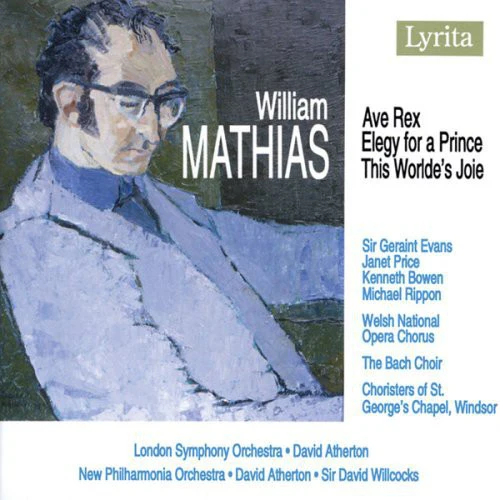
Mathias: Ave Rex, Elegy, This Worlde's Joie / Atherton Et Al
A good specimen of lateral thinking here: at least in as far as it crosses catalogues, years and performers, and comes up with a new combination. Here are three works for voice and orchestra, two choral, one for soloist, written between 1969 and 1974 (though I believe This Worlde's Joie also incorporates two settings from a Cantata in Praise of Love written in 1959). They have a good deal in common yet enough separate identity for them to comprise an acceptably varied programme, the Elegy for a Prince forming a relatively tough and tangy item to be sandwiched in between the choral collections. Of these, Ave Rex is a set of carols, ''Sir Christmas'' being now by far the best known, and This Worlde's Joie a cantata in four movements, nearly 50 minutes long, employing a boys' choir as well as the usual forces of soloists, mixed choir and orchestra.
This, of course, makes us think of Britten, and indeed it is difficult not to think of him, and to a lesser extent Tippett, throughout the disc. In his useful booklet-note, Geraint Lewis acknowledges this but expresses it in terms of ''occasional points of contact and homage'', which is probably excessively diplomatic. We are still, I think, too close to these composers of our time to avoid the word 'derivative': in a few more years it will probably not matter or affect enjoyment, which, irrespective of such questions, is still quite considerable. This Worlde's Joie moves delightfully from one good setting to another, always contriving to unify the structure and work effectively towards climax and contrast. The Prince of the Elegy is Llywelyn ap Gruffudd, killed by English soldiers in 1282: a stern mood prevails, the orchestral writing harder and more austere than the composer's usual style though it yields to some tender expression in the last section.
Sir Geraint Evans, who gave the Elegy's first performance at Llandaff in 1972, sings with authority and dark coloration (for the most part the tessitura is low, rising towards the end and finishing with a sustained soft high E). The soloists in the cantata are excellent and I couldn't help wondering why more was not heard on record of Janet Price. Willcocks and Atherton conduct with vigour and care for detail, and the recordings are admirably clean. In the original review of This Worlde's Joie Trevor Harvey found the words ''not all that clear'', but this seems largely to have been remedied, and indeed one of the best features of Mathias's writing for voices is that he is habitually careful to make the music serve the words and not obscure them.
-- Gramophone [2/1995]
This, of course, makes us think of Britten, and indeed it is difficult not to think of him, and to a lesser extent Tippett, throughout the disc. In his useful booklet-note, Geraint Lewis acknowledges this but expresses it in terms of ''occasional points of contact and homage'', which is probably excessively diplomatic. We are still, I think, too close to these composers of our time to avoid the word 'derivative': in a few more years it will probably not matter or affect enjoyment, which, irrespective of such questions, is still quite considerable. This Worlde's Joie moves delightfully from one good setting to another, always contriving to unify the structure and work effectively towards climax and contrast. The Prince of the Elegy is Llywelyn ap Gruffudd, killed by English soldiers in 1282: a stern mood prevails, the orchestral writing harder and more austere than the composer's usual style though it yields to some tender expression in the last section.
Sir Geraint Evans, who gave the Elegy's first performance at Llandaff in 1972, sings with authority and dark coloration (for the most part the tessitura is low, rising towards the end and finishing with a sustained soft high E). The soloists in the cantata are excellent and I couldn't help wondering why more was not heard on record of Janet Price. Willcocks and Atherton conduct with vigour and care for detail, and the recordings are admirably clean. In the original review of This Worlde's Joie Trevor Harvey found the words ''not all that clear'', but this seems largely to have been remedied, and indeed one of the best features of Mathias's writing for voices is that he is habitually careful to make the music serve the words and not obscure them.
-- Gramophone [2/1995]
A good specimen of lateral thinking here: at least in as far as it crosses catalogues, years and performers, and comes up with a new combination. Here are three works for voice and orchestra, two choral, one for soloist, written between 1969 and 1974 (though I believe This Worlde's Joie also incorporates two settings from a Cantata in Praise of Love written in 1959). They have a good deal in common yet enough separate identity for them to comprise an acceptably varied programme, the Elegy for a Prince forming a relatively tough and tangy item to be sandwiched in between the choral collections. Of these, Ave Rex is a set of carols, ''Sir Christmas'' being now by far the best known, and This Worlde's Joie a cantata in four movements, nearly 50 minutes long, employing a boys' choir as well as the usual forces of soloists, mixed choir and orchestra.
This, of course, makes us think of Britten, and indeed it is difficult not to think of him, and to a lesser extent Tippett, throughout the disc. In his useful booklet-note, Geraint Lewis acknowledges this but expresses it in terms of ''occasional points of contact and homage'', which is probably excessively diplomatic. We are still, I think, too close to these composers of our time to avoid the word 'derivative': in a few more years it will probably not matter or affect enjoyment, which, irrespective of such questions, is still quite considerable. This Worlde's Joie moves delightfully from one good setting to another, always contriving to unify the structure and work effectively towards climax and contrast. The Prince of the Elegy is Llywelyn ap Gruffudd, killed by English soldiers in 1282: a stern mood prevails, the orchestral writing harder and more austere than the composer's usual style though it yields to some tender expression in the last section.
Sir Geraint Evans, who gave the Elegy's first performance at Llandaff in 1972, sings with authority and dark coloration (for the most part the tessitura is low, rising towards the end and finishing with a sustained soft high E). The soloists in the cantata are excellent and I couldn't help wondering why more was not heard on record of Janet Price. Willcocks and Atherton conduct with vigour and care for detail, and the recordings are admirably clean. In the original review of This Worlde's Joie Trevor Harvey found the words ''not all that clear'', but this seems largely to have been remedied, and indeed one of the best features of Mathias's writing for voices is that he is habitually careful to make the music serve the words and not obscure them.
-- Gramophone [2/1995]
This, of course, makes us think of Britten, and indeed it is difficult not to think of him, and to a lesser extent Tippett, throughout the disc. In his useful booklet-note, Geraint Lewis acknowledges this but expresses it in terms of ''occasional points of contact and homage'', which is probably excessively diplomatic. We are still, I think, too close to these composers of our time to avoid the word 'derivative': in a few more years it will probably not matter or affect enjoyment, which, irrespective of such questions, is still quite considerable. This Worlde's Joie moves delightfully from one good setting to another, always contriving to unify the structure and work effectively towards climax and contrast. The Prince of the Elegy is Llywelyn ap Gruffudd, killed by English soldiers in 1282: a stern mood prevails, the orchestral writing harder and more austere than the composer's usual style though it yields to some tender expression in the last section.
Sir Geraint Evans, who gave the Elegy's first performance at Llandaff in 1972, sings with authority and dark coloration (for the most part the tessitura is low, rising towards the end and finishing with a sustained soft high E). The soloists in the cantata are excellent and I couldn't help wondering why more was not heard on record of Janet Price. Willcocks and Atherton conduct with vigour and care for detail, and the recordings are admirably clean. In the original review of This Worlde's Joie Trevor Harvey found the words ''not all that clear'', but this seems largely to have been remedied, and indeed one of the best features of Mathias's writing for voices is that he is habitually careful to make the music serve the words and not obscure them.
-- Gramophone [2/1995]
$20.99
Mathias: Ave Rex, Elegy, This Worlde's Joie / Atherton Et Al—
$20.99
Description
A good specimen of lateral thinking here: at least in as far as it crosses catalogues, years and performers, and comes up with a new combination. Here are three works for voice and orchestra, two choral, one for soloist, written between 1969 and 1974 (though I believe This Worlde's Joie also incorporates two settings from a Cantata in Praise of Love written in 1959). They have a good deal in common yet enough separate identity for them to comprise an acceptably varied programme, the Elegy for a Prince forming a relatively tough and tangy item to be sandwiched in between the choral collections. Of these, Ave Rex is a set of carols, ''Sir Christmas'' being now by far the best known, and This Worlde's Joie a cantata in four movements, nearly 50 minutes long, employing a boys' choir as well as the usual forces of soloists, mixed choir and orchestra.
This, of course, makes us think of Britten, and indeed it is difficult not to think of him, and to a lesser extent Tippett, throughout the disc. In his useful booklet-note, Geraint Lewis acknowledges this but expresses it in terms of ''occasional points of contact and homage'', which is probably excessively diplomatic. We are still, I think, too close to these composers of our time to avoid the word 'derivative': in a few more years it will probably not matter or affect enjoyment, which, irrespective of such questions, is still quite considerable. This Worlde's Joie moves delightfully from one good setting to another, always contriving to unify the structure and work effectively towards climax and contrast. The Prince of the Elegy is Llywelyn ap Gruffudd, killed by English soldiers in 1282: a stern mood prevails, the orchestral writing harder and more austere than the composer's usual style though it yields to some tender expression in the last section.
Sir Geraint Evans, who gave the Elegy's first performance at Llandaff in 1972, sings with authority and dark coloration (for the most part the tessitura is low, rising towards the end and finishing with a sustained soft high E). The soloists in the cantata are excellent and I couldn't help wondering why more was not heard on record of Janet Price. Willcocks and Atherton conduct with vigour and care for detail, and the recordings are admirably clean. In the original review of This Worlde's Joie Trevor Harvey found the words ''not all that clear'', but this seems largely to have been remedied, and indeed one of the best features of Mathias's writing for voices is that he is habitually careful to make the music serve the words and not obscure them.
-- Gramophone [2/1995]
This, of course, makes us think of Britten, and indeed it is difficult not to think of him, and to a lesser extent Tippett, throughout the disc. In his useful booklet-note, Geraint Lewis acknowledges this but expresses it in terms of ''occasional points of contact and homage'', which is probably excessively diplomatic. We are still, I think, too close to these composers of our time to avoid the word 'derivative': in a few more years it will probably not matter or affect enjoyment, which, irrespective of such questions, is still quite considerable. This Worlde's Joie moves delightfully from one good setting to another, always contriving to unify the structure and work effectively towards climax and contrast. The Prince of the Elegy is Llywelyn ap Gruffudd, killed by English soldiers in 1282: a stern mood prevails, the orchestral writing harder and more austere than the composer's usual style though it yields to some tender expression in the last section.
Sir Geraint Evans, who gave the Elegy's first performance at Llandaff in 1972, sings with authority and dark coloration (for the most part the tessitura is low, rising towards the end and finishing with a sustained soft high E). The soloists in the cantata are excellent and I couldn't help wondering why more was not heard on record of Janet Price. Willcocks and Atherton conduct with vigour and care for detail, and the recordings are admirably clean. In the original review of This Worlde's Joie Trevor Harvey found the words ''not all that clear'', but this seems largely to have been remedied, and indeed one of the best features of Mathias's writing for voices is that he is habitually careful to make the music serve the words and not obscure them.
-- Gramophone [2/1995]