🎉 Up to 70% Off Selected ItemsShop Sale

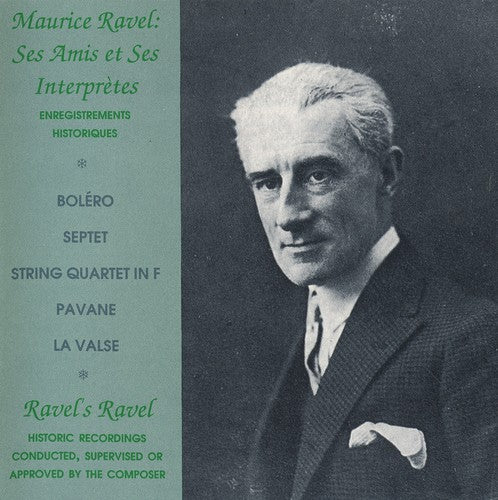
Maurice Ravel - Ses amis et ses interprets
Ravel's recording in 1930 of his Boléro is one of the great treasures of recorded music with its consistent tempo of quarter note = 63 instead of quarter note = 76 as marked and which the composer did not accelerate. This is not its first appearance on compact disc. It was released briefly with wobbly sound and deadened by the No Noise process (Philips 420 778-2) where it was misdated 1932 on the packaging. Now at last we have it in an astonishingly well-engineered transfer. (The Philips release also had Ravel's Chansons madécasses sung by the incomparable Madeline Grey with Ravel as her accompanist. This, too, was not without sonic blemishes and can still be heard to better advantage on the real-time cassette (In Sync C4143).) Ravel's recording of the Introduction and Allegro dates from 1923. There is more than a little surface noise on the discs used to make this transfer, but it becomes secondary to the hypnotic exoticism of this performance.
The three finest recordings of Ravel's string quartet I have heard are the one the Galimir String Quartet recorded in 1934, the one Galimir recorded in 1983 for Vanguard, and this performance from 1927 by the International String Quartet approved in all its particulars by Ravel and, chronologically, the first to be committed to discs. There are some intonation problems from cellist Herbert Withers in the third movement and the surfaces are not silent, but the fervor and the depth of emotional involvement are such as to override such reservations.
Ravel himself preferred the Pavane to be taken very slowly—as Koussevitzky recorded it in 1947—but Pierné's performance from 1929 was the slowest to appear during the composer's lifetime. Albert Wolff's recording of La Valse, while not the equal of later performances by Monteux and Ansermet, certainly can hold its own among them and its sheer elegance and poetry manifest the gentle approach the composer preferred. There is sufficient Ravel material to fill yet another compact disc and we can hope it will appear in time. William Malloch who did the transfers for this release also wrote the exemplary notes.
-- Jon Tuska, FANFARE [3/1993]
The three finest recordings of Ravel's string quartet I have heard are the one the Galimir String Quartet recorded in 1934, the one Galimir recorded in 1983 for Vanguard, and this performance from 1927 by the International String Quartet approved in all its particulars by Ravel and, chronologically, the first to be committed to discs. There are some intonation problems from cellist Herbert Withers in the third movement and the surfaces are not silent, but the fervor and the depth of emotional involvement are such as to override such reservations.
Ravel himself preferred the Pavane to be taken very slowly—as Koussevitzky recorded it in 1947—but Pierné's performance from 1929 was the slowest to appear during the composer's lifetime. Albert Wolff's recording of La Valse, while not the equal of later performances by Monteux and Ansermet, certainly can hold its own among them and its sheer elegance and poetry manifest the gentle approach the composer preferred. There is sufficient Ravel material to fill yet another compact disc and we can hope it will appear in time. William Malloch who did the transfers for this release also wrote the exemplary notes.
-- Jon Tuska, FANFARE [3/1993]
Ravel's recording in 1930 of his Boléro is one of the great treasures of recorded music with its consistent tempo of quarter note = 63 instead of quarter note = 76 as marked and which the composer did not accelerate. This is not its first appearance on compact disc. It was released briefly with wobbly sound and deadened by the No Noise process (Philips 420 778-2) where it was misdated 1932 on the packaging. Now at last we have it in an astonishingly well-engineered transfer. (The Philips release also had Ravel's Chansons madécasses sung by the incomparable Madeline Grey with Ravel as her accompanist. This, too, was not without sonic blemishes and can still be heard to better advantage on the real-time cassette (In Sync C4143).) Ravel's recording of the Introduction and Allegro dates from 1923. There is more than a little surface noise on the discs used to make this transfer, but it becomes secondary to the hypnotic exoticism of this performance.
The three finest recordings of Ravel's string quartet I have heard are the one the Galimir String Quartet recorded in 1934, the one Galimir recorded in 1983 for Vanguard, and this performance from 1927 by the International String Quartet approved in all its particulars by Ravel and, chronologically, the first to be committed to discs. There are some intonation problems from cellist Herbert Withers in the third movement and the surfaces are not silent, but the fervor and the depth of emotional involvement are such as to override such reservations.
Ravel himself preferred the Pavane to be taken very slowly—as Koussevitzky recorded it in 1947—but Pierné's performance from 1929 was the slowest to appear during the composer's lifetime. Albert Wolff's recording of La Valse, while not the equal of later performances by Monteux and Ansermet, certainly can hold its own among them and its sheer elegance and poetry manifest the gentle approach the composer preferred. There is sufficient Ravel material to fill yet another compact disc and we can hope it will appear in time. William Malloch who did the transfers for this release also wrote the exemplary notes.
-- Jon Tuska, FANFARE [3/1993]
The three finest recordings of Ravel's string quartet I have heard are the one the Galimir String Quartet recorded in 1934, the one Galimir recorded in 1983 for Vanguard, and this performance from 1927 by the International String Quartet approved in all its particulars by Ravel and, chronologically, the first to be committed to discs. There are some intonation problems from cellist Herbert Withers in the third movement and the surfaces are not silent, but the fervor and the depth of emotional involvement are such as to override such reservations.
Ravel himself preferred the Pavane to be taken very slowly—as Koussevitzky recorded it in 1947—but Pierné's performance from 1929 was the slowest to appear during the composer's lifetime. Albert Wolff's recording of La Valse, while not the equal of later performances by Monteux and Ansermet, certainly can hold its own among them and its sheer elegance and poetry manifest the gentle approach the composer preferred. There is sufficient Ravel material to fill yet another compact disc and we can hope it will appear in time. William Malloch who did the transfers for this release also wrote the exemplary notes.
-- Jon Tuska, FANFARE [3/1993]
$19.99
Maurice Ravel - Ses amis et ses interprets—
$19.99
Description
Ravel's recording in 1930 of his Boléro is one of the great treasures of recorded music with its consistent tempo of quarter note = 63 instead of quarter note = 76 as marked and which the composer did not accelerate. This is not its first appearance on compact disc. It was released briefly with wobbly sound and deadened by the No Noise process (Philips 420 778-2) where it was misdated 1932 on the packaging. Now at last we have it in an astonishingly well-engineered transfer. (The Philips release also had Ravel's Chansons madécasses sung by the incomparable Madeline Grey with Ravel as her accompanist. This, too, was not without sonic blemishes and can still be heard to better advantage on the real-time cassette (In Sync C4143).) Ravel's recording of the Introduction and Allegro dates from 1923. There is more than a little surface noise on the discs used to make this transfer, but it becomes secondary to the hypnotic exoticism of this performance.
The three finest recordings of Ravel's string quartet I have heard are the one the Galimir String Quartet recorded in 1934, the one Galimir recorded in 1983 for Vanguard, and this performance from 1927 by the International String Quartet approved in all its particulars by Ravel and, chronologically, the first to be committed to discs. There are some intonation problems from cellist Herbert Withers in the third movement and the surfaces are not silent, but the fervor and the depth of emotional involvement are such as to override such reservations.
Ravel himself preferred the Pavane to be taken very slowly—as Koussevitzky recorded it in 1947—but Pierné's performance from 1929 was the slowest to appear during the composer's lifetime. Albert Wolff's recording of La Valse, while not the equal of later performances by Monteux and Ansermet, certainly can hold its own among them and its sheer elegance and poetry manifest the gentle approach the composer preferred. There is sufficient Ravel material to fill yet another compact disc and we can hope it will appear in time. William Malloch who did the transfers for this release also wrote the exemplary notes.
-- Jon Tuska, FANFARE [3/1993]
The three finest recordings of Ravel's string quartet I have heard are the one the Galimir String Quartet recorded in 1934, the one Galimir recorded in 1983 for Vanguard, and this performance from 1927 by the International String Quartet approved in all its particulars by Ravel and, chronologically, the first to be committed to discs. There are some intonation problems from cellist Herbert Withers in the third movement and the surfaces are not silent, but the fervor and the depth of emotional involvement are such as to override such reservations.
Ravel himself preferred the Pavane to be taken very slowly—as Koussevitzky recorded it in 1947—but Pierné's performance from 1929 was the slowest to appear during the composer's lifetime. Albert Wolff's recording of La Valse, while not the equal of later performances by Monteux and Ansermet, certainly can hold its own among them and its sheer elegance and poetry manifest the gentle approach the composer preferred. There is sufficient Ravel material to fill yet another compact disc and we can hope it will appear in time. William Malloch who did the transfers for this release also wrote the exemplary notes.
-- Jon Tuska, FANFARE [3/1993]






















