🎉 Up to 70% Off Selected ItemsShop Sale

1 / 2
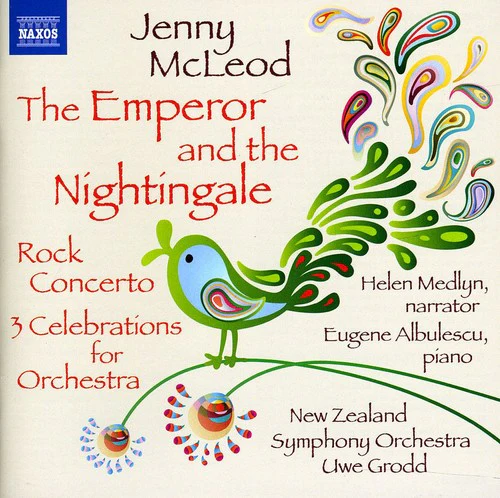
Mcleod: The Emperor And The Nightingale / Medlyn, Albulescu, Grodd, New Zealand Symphony
McLEOD The Emperor and the Nightingale 1. 3 Celebrations. Rock Concerto 2 • Uwe Grodd, cond; 1 Helen Medlyn (narr); 2 Eugene Albulescu (pn); New Zealand SO • NAXOS 8572671 (67:35)
The version of The Emperor and the Nightingale we hear here is a 2010 revision of a piece commissioned in 1985. It is an expertly composed tale for children, well narrated by the close-miked Helen Medlyn. Jenny McLeod’s lightness of touch and wit goes hand in hand with Medlyn’s approach, which includes some delightful impressions. The story is, of course, taken from Hans Christian Andersen’s The Nightingale . McLeod’s deft hand and her charming responses to the text bring much enjoyment.
McLeod was born in 1941 in Wellington, New Zealand. Her varied education is certainly not immediately obvious from the sound world of her narrated piece here. After a period with Douglas Lilburn at Victoria University of Wellington, McLeod traveled to Europe for study with Messiaen (Paris) and Stockhausen (Cologne). You will be hard-pressed to find any trace of either Messiaen or Stockhausen on the present disc. As far as I can see, the only other available piece by this composer is For Seven , an early work from 1965–66, on a disc of music by New Zealand women composers (Lorelt 116). For Seven is referred to in the booklet notes of the present release as “an early avant-garde chamber work” that had some success over the years. The works on this disc come from the ’80s, after she apparently rebelled against her earlier music (including a tour of New Zealand with her own pop band).
The Three Celebrations for orchestra continue in the highly appealing mode of The Emperor and the Nightingale. They were commissioned in 1986 by the New Zealand Symphony Orchestra for its 40th birthday celebrations, and there is more than a hint of the jubilant about them. Each movement has a title. “Journey Through Mountain Parklands” is highly evocative of the vistas of the southern snowy mountains, while “At the Bay” is a gentle pastorale. The finale is titled “A & P Show” and evokes a typical agricultural and pastoral fair (which sounds like a carnival crossed with a English country fair from the description). Hints of Coplandesque near-hoe-downs add to the fun. The performance is spot-on. Uwe Grodd has clearly spent much time rehearsing this; rhythms are beautifully tight.
Finally, a piano concerto (1986) based on her Rock Sonata for solo piano written for Eugene Albulescu; the pianist requested a version for piano and orchestra, and this is the result. The cadenza, interestingly, is meant to be improvised on the spot (an idea inserted at Albulescu’s request). Here, the program notes describe it as “held in check,” which implies a measure, at least, of premeditation. It is not difficult to hear the shadow of Gershwin here. The first movement is titled “To Distant Friends,” one of whom is referred to in the second movement (“Elegy for Charlie French”; French was an Aboriginal activist and friend of the composer’s). This is a poignant movement, quite extended at nine minutes. Albuslescu plays most beautifully here, spinning McLeod’s simple but effective lines with great tenderness. There is a real swing to the finale (“Rondo Latino”). Albulescu clearly has a great technique, as well as the capacity to enjoy himself, even under studio conditions.
The recording (produced and engineered by Tim Handley) is exemplary. Recommended.
FANFARE: Colin Clarke
McLEOD The Emperor and the Nightingale 1. 3 Celebrations. Rock Concerto 2 • Uwe Grodd, cond; 1 Helen Medlyn (narr); 2 Eugene Albulescu (pn); New Zealand SO • NAXOS 8572671 (67:35)
The version of The Emperor and the Nightingale we hear here is a 2010 revision of a piece commissioned in 1985. It is an expertly composed tale for children, well narrated by the close-miked Helen Medlyn. Jenny McLeod’s lightness of touch and wit goes hand in hand with Medlyn’s approach, which includes some delightful impressions. The story is, of course, taken from Hans Christian Andersen’s The Nightingale . McLeod’s deft hand and her charming responses to the text bring much enjoyment.
McLeod was born in 1941 in Wellington, New Zealand. Her varied education is certainly not immediately obvious from the sound world of her narrated piece here. After a period with Douglas Lilburn at Victoria University of Wellington, McLeod traveled to Europe for study with Messiaen (Paris) and Stockhausen (Cologne). You will be hard-pressed to find any trace of either Messiaen or Stockhausen on the present disc. As far as I can see, the only other available piece by this composer is For Seven , an early work from 1965–66, on a disc of music by New Zealand women composers (Lorelt 116). For Seven is referred to in the booklet notes of the present release as “an early avant-garde chamber work” that had some success over the years. The works on this disc come from the ’80s, after she apparently rebelled against her earlier music (including a tour of New Zealand with her own pop band).
The Three Celebrations for orchestra continue in the highly appealing mode of The Emperor and the Nightingale. They were commissioned in 1986 by the New Zealand Symphony Orchestra for its 40th birthday celebrations, and there is more than a hint of the jubilant about them. Each movement has a title. “Journey Through Mountain Parklands” is highly evocative of the vistas of the southern snowy mountains, while “At the Bay” is a gentle pastorale. The finale is titled “A & P Show” and evokes a typical agricultural and pastoral fair (which sounds like a carnival crossed with a English country fair from the description). Hints of Coplandesque near-hoe-downs add to the fun. The performance is spot-on. Uwe Grodd has clearly spent much time rehearsing this; rhythms are beautifully tight.
Finally, a piano concerto (1986) based on her Rock Sonata for solo piano written for Eugene Albulescu; the pianist requested a version for piano and orchestra, and this is the result. The cadenza, interestingly, is meant to be improvised on the spot (an idea inserted at Albulescu’s request). Here, the program notes describe it as “held in check,” which implies a measure, at least, of premeditation. It is not difficult to hear the shadow of Gershwin here. The first movement is titled “To Distant Friends,” one of whom is referred to in the second movement (“Elegy for Charlie French”; French was an Aboriginal activist and friend of the composer’s). This is a poignant movement, quite extended at nine minutes. Albuslescu plays most beautifully here, spinning McLeod’s simple but effective lines with great tenderness. There is a real swing to the finale (“Rondo Latino”). Albulescu clearly has a great technique, as well as the capacity to enjoy himself, even under studio conditions.
The recording (produced and engineered by Tim Handley) is exemplary. Recommended.
FANFARE: Colin Clarke
$13.99
Mcleod: The Emperor And The Nightingale / Medlyn, Albulescu, Grodd, New Zealand Symphony—
$13.99
Description
McLEOD The Emperor and the Nightingale 1. 3 Celebrations. Rock Concerto 2 • Uwe Grodd, cond; 1 Helen Medlyn (narr); 2 Eugene Albulescu (pn); New Zealand SO • NAXOS 8572671 (67:35)
The version of The Emperor and the Nightingale we hear here is a 2010 revision of a piece commissioned in 1985. It is an expertly composed tale for children, well narrated by the close-miked Helen Medlyn. Jenny McLeod’s lightness of touch and wit goes hand in hand with Medlyn’s approach, which includes some delightful impressions. The story is, of course, taken from Hans Christian Andersen’s The Nightingale . McLeod’s deft hand and her charming responses to the text bring much enjoyment.
McLeod was born in 1941 in Wellington, New Zealand. Her varied education is certainly not immediately obvious from the sound world of her narrated piece here. After a period with Douglas Lilburn at Victoria University of Wellington, McLeod traveled to Europe for study with Messiaen (Paris) and Stockhausen (Cologne). You will be hard-pressed to find any trace of either Messiaen or Stockhausen on the present disc. As far as I can see, the only other available piece by this composer is For Seven , an early work from 1965–66, on a disc of music by New Zealand women composers (Lorelt 116). For Seven is referred to in the booklet notes of the present release as “an early avant-garde chamber work” that had some success over the years. The works on this disc come from the ’80s, after she apparently rebelled against her earlier music (including a tour of New Zealand with her own pop band).
The Three Celebrations for orchestra continue in the highly appealing mode of The Emperor and the Nightingale. They were commissioned in 1986 by the New Zealand Symphony Orchestra for its 40th birthday celebrations, and there is more than a hint of the jubilant about them. Each movement has a title. “Journey Through Mountain Parklands” is highly evocative of the vistas of the southern snowy mountains, while “At the Bay” is a gentle pastorale. The finale is titled “A & P Show” and evokes a typical agricultural and pastoral fair (which sounds like a carnival crossed with a English country fair from the description). Hints of Coplandesque near-hoe-downs add to the fun. The performance is spot-on. Uwe Grodd has clearly spent much time rehearsing this; rhythms are beautifully tight.
Finally, a piano concerto (1986) based on her Rock Sonata for solo piano written for Eugene Albulescu; the pianist requested a version for piano and orchestra, and this is the result. The cadenza, interestingly, is meant to be improvised on the spot (an idea inserted at Albulescu’s request). Here, the program notes describe it as “held in check,” which implies a measure, at least, of premeditation. It is not difficult to hear the shadow of Gershwin here. The first movement is titled “To Distant Friends,” one of whom is referred to in the second movement (“Elegy for Charlie French”; French was an Aboriginal activist and friend of the composer’s). This is a poignant movement, quite extended at nine minutes. Albuslescu plays most beautifully here, spinning McLeod’s simple but effective lines with great tenderness. There is a real swing to the finale (“Rondo Latino”). Albulescu clearly has a great technique, as well as the capacity to enjoy himself, even under studio conditions.
The recording (produced and engineered by Tim Handley) is exemplary. Recommended.
FANFARE: Colin Clarke