🎉 Up to 70% Off Selected ItemsShop Sale

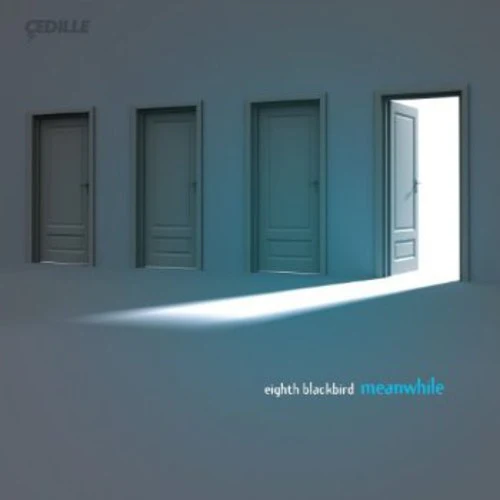
Meanwhile / Eighth Blackbird
MEANWHILE • eighth blackbird • CEDILLE 90000 (68:28)
MAZZOLI Still Life with Avalanche. HUREL _…à mesure. ETEZADY _from Damaged Goods. HARTKE Meanwhile: Incidental music to imaginary puppet plays. GLASS Music in Similar Motion. ADÈS Catch
Eighth blackbird has always impressed me with their unstoppable combination of fresh taste and virtuosic playing. They’ve gone from strength to strength in their series of albums, and this might well be my favorite. Whether I like all the pieces or not doesn’t really matter: If I did, it probably would mean they weren’t reaching out broadly enough, and what really matters is that the group plays as though it likes them.
Stephen Hartke (b. 1952) contributes the “title track” for the disc, Meanwhile (2007). It’s a micro-suite, referencing a personal re-imagining of Javanese puppet theater, yet I also hear echoes of Stravinsky from L’Histoire du Soldat . Perhaps the most consistently striking thing about the piece, though, is its sound world. It has dazzlingly imaginative percussion writing (the first movement has an insistently groovy hammering of three flexatones, for example). It’s a feast of little sonic plates, served with dizzying speed.
Missy Mazzoli (b.1980) opens the program with her Still Life With Avalanche (2008). She’s perhaps the most visibly successful composer of her generation, and fronts her own indie (all-female) rock band Victoire. The music is fluent and propulsive, but it moves me the least of the works here. The form for the majority of pieces I’ve heard by the composer is a chaconne (with repeating bass line), and even though she livens it here with polytonality, it still feels a little predictable to me. Others, I know, will disagree.
Philippe Hurel (b. 1955) is the most explicitly modernist composer on the program. His … à mesure (1996) feels like a very “post-Boulez” piece, in its evident rigor; its relentless motoric textures; and its sense of a complex undergirding system. But while formalistic, it’s not apparently serial. One hears constant repetition and sequencing of motives; indeed one could even reference minimalism in its obsessive cycling…except for the fact that there also seem to be processes at work that “eat away” at the material to distort it and trip it up (an approach owing something to Ligeti). His involvement with computer music is evident not only in the work’s structural logic but also in the slow drifting harmonies of its conclusion, which have a very “electronic” sound, even though they are all acoustic, emanating from the sextet.
Catch by Thomas Adès (b. 1971) is mercuriality incarnate. In just over nine minutes, the piece runs through a dazzling sequence of states and moods, at times somber, at others frenzied. Things can sound very raw, contrasts can be unnerving, and yet one never doubts the commitment of the composer to the resultant sounds and harmonies. It’s an almost sinister display of precociousness. Along with the Hurel, this is the most crazily virtuosic music on the program.
Philip Glass needs no introduction or explanation by this point. He’s not my favorite minimalist, but his presence on the program as a sort of elder statesman is strangely welcome, and I also salute the blackbirds for their selection of one of the composer’s early (1969), radical, and pathbreaking pieces, from the time when his “absolute” music was perhaps at its height of originality. And Roshanne Etezady (b.1973) is represented by two movements of her Damaged Goods. I’ve enjoyed almost every piece of the composer I’ve encountered, and these are a nice pairing; “About Time” is dark and mournful, while “Eleventh Hour” is a real rhythmic rush and the perfect closer to the program.
Eighth blackbird’s taste is stylistically omnivorous. They tend to avoid any school of composition in favor of real personality and high imagination. The result is a rare mix of substance and entertainment. I did mention that they’re able to negotiate all the subtleties of these different languages with equal virtuosity, didn’t I? Also, I salute them for sticking with the plucky Cedille label, which has been one of Chicago’s greatest cultural ambassadors for a couple of decades now. A wonderful disc.
FANFARE: Robert Carl
MEANWHILE • eighth blackbird • CEDILLE 90000 (68:28)
MAZZOLI Still Life with Avalanche. HUREL _…à mesure. ETEZADY _from Damaged Goods. HARTKE Meanwhile: Incidental music to imaginary puppet plays. GLASS Music in Similar Motion. ADÈS Catch
Eighth blackbird has always impressed me with their unstoppable combination of fresh taste and virtuosic playing. They’ve gone from strength to strength in their series of albums, and this might well be my favorite. Whether I like all the pieces or not doesn’t really matter: If I did, it probably would mean they weren’t reaching out broadly enough, and what really matters is that the group plays as though it likes them.
Stephen Hartke (b. 1952) contributes the “title track” for the disc, Meanwhile (2007). It’s a micro-suite, referencing a personal re-imagining of Javanese puppet theater, yet I also hear echoes of Stravinsky from L’Histoire du Soldat . Perhaps the most consistently striking thing about the piece, though, is its sound world. It has dazzlingly imaginative percussion writing (the first movement has an insistently groovy hammering of three flexatones, for example). It’s a feast of little sonic plates, served with dizzying speed.
Missy Mazzoli (b.1980) opens the program with her Still Life With Avalanche (2008). She’s perhaps the most visibly successful composer of her generation, and fronts her own indie (all-female) rock band Victoire. The music is fluent and propulsive, but it moves me the least of the works here. The form for the majority of pieces I’ve heard by the composer is a chaconne (with repeating bass line), and even though she livens it here with polytonality, it still feels a little predictable to me. Others, I know, will disagree.
Philippe Hurel (b. 1955) is the most explicitly modernist composer on the program. His … à mesure (1996) feels like a very “post-Boulez” piece, in its evident rigor; its relentless motoric textures; and its sense of a complex undergirding system. But while formalistic, it’s not apparently serial. One hears constant repetition and sequencing of motives; indeed one could even reference minimalism in its obsessive cycling…except for the fact that there also seem to be processes at work that “eat away” at the material to distort it and trip it up (an approach owing something to Ligeti). His involvement with computer music is evident not only in the work’s structural logic but also in the slow drifting harmonies of its conclusion, which have a very “electronic” sound, even though they are all acoustic, emanating from the sextet.
Catch by Thomas Adès (b. 1971) is mercuriality incarnate. In just over nine minutes, the piece runs through a dazzling sequence of states and moods, at times somber, at others frenzied. Things can sound very raw, contrasts can be unnerving, and yet one never doubts the commitment of the composer to the resultant sounds and harmonies. It’s an almost sinister display of precociousness. Along with the Hurel, this is the most crazily virtuosic music on the program.
Philip Glass needs no introduction or explanation by this point. He’s not my favorite minimalist, but his presence on the program as a sort of elder statesman is strangely welcome, and I also salute the blackbirds for their selection of one of the composer’s early (1969), radical, and pathbreaking pieces, from the time when his “absolute” music was perhaps at its height of originality. And Roshanne Etezady (b.1973) is represented by two movements of her Damaged Goods. I’ve enjoyed almost every piece of the composer I’ve encountered, and these are a nice pairing; “About Time” is dark and mournful, while “Eleventh Hour” is a real rhythmic rush and the perfect closer to the program.
Eighth blackbird’s taste is stylistically omnivorous. They tend to avoid any school of composition in favor of real personality and high imagination. The result is a rare mix of substance and entertainment. I did mention that they’re able to negotiate all the subtleties of these different languages with equal virtuosity, didn’t I? Also, I salute them for sticking with the plucky Cedille label, which has been one of Chicago’s greatest cultural ambassadors for a couple of decades now. A wonderful disc.
FANFARE: Robert Carl
$19.99
Meanwhile / Eighth Blackbird—
$19.99
Description
MEANWHILE • eighth blackbird • CEDILLE 90000 (68:28)
MAZZOLI Still Life with Avalanche. HUREL _…à mesure. ETEZADY _from Damaged Goods. HARTKE Meanwhile: Incidental music to imaginary puppet plays. GLASS Music in Similar Motion. ADÈS Catch
Eighth blackbird has always impressed me with their unstoppable combination of fresh taste and virtuosic playing. They’ve gone from strength to strength in their series of albums, and this might well be my favorite. Whether I like all the pieces or not doesn’t really matter: If I did, it probably would mean they weren’t reaching out broadly enough, and what really matters is that the group plays as though it likes them.
Stephen Hartke (b. 1952) contributes the “title track” for the disc, Meanwhile (2007). It’s a micro-suite, referencing a personal re-imagining of Javanese puppet theater, yet I also hear echoes of Stravinsky from L’Histoire du Soldat . Perhaps the most consistently striking thing about the piece, though, is its sound world. It has dazzlingly imaginative percussion writing (the first movement has an insistently groovy hammering of three flexatones, for example). It’s a feast of little sonic plates, served with dizzying speed.
Missy Mazzoli (b.1980) opens the program with her Still Life With Avalanche (2008). She’s perhaps the most visibly successful composer of her generation, and fronts her own indie (all-female) rock band Victoire. The music is fluent and propulsive, but it moves me the least of the works here. The form for the majority of pieces I’ve heard by the composer is a chaconne (with repeating bass line), and even though she livens it here with polytonality, it still feels a little predictable to me. Others, I know, will disagree.
Philippe Hurel (b. 1955) is the most explicitly modernist composer on the program. His … à mesure (1996) feels like a very “post-Boulez” piece, in its evident rigor; its relentless motoric textures; and its sense of a complex undergirding system. But while formalistic, it’s not apparently serial. One hears constant repetition and sequencing of motives; indeed one could even reference minimalism in its obsessive cycling…except for the fact that there also seem to be processes at work that “eat away” at the material to distort it and trip it up (an approach owing something to Ligeti). His involvement with computer music is evident not only in the work’s structural logic but also in the slow drifting harmonies of its conclusion, which have a very “electronic” sound, even though they are all acoustic, emanating from the sextet.
Catch by Thomas Adès (b. 1971) is mercuriality incarnate. In just over nine minutes, the piece runs through a dazzling sequence of states and moods, at times somber, at others frenzied. Things can sound very raw, contrasts can be unnerving, and yet one never doubts the commitment of the composer to the resultant sounds and harmonies. It’s an almost sinister display of precociousness. Along with the Hurel, this is the most crazily virtuosic music on the program.
Philip Glass needs no introduction or explanation by this point. He’s not my favorite minimalist, but his presence on the program as a sort of elder statesman is strangely welcome, and I also salute the blackbirds for their selection of one of the composer’s early (1969), radical, and pathbreaking pieces, from the time when his “absolute” music was perhaps at its height of originality. And Roshanne Etezady (b.1973) is represented by two movements of her Damaged Goods. I’ve enjoyed almost every piece of the composer I’ve encountered, and these are a nice pairing; “About Time” is dark and mournful, while “Eleventh Hour” is a real rhythmic rush and the perfect closer to the program.
Eighth blackbird’s taste is stylistically omnivorous. They tend to avoid any school of composition in favor of real personality and high imagination. The result is a rare mix of substance and entertainment. I did mention that they’re able to negotiate all the subtleties of these different languages with equal virtuosity, didn’t I? Also, I salute them for sticking with the plucky Cedille label, which has been one of Chicago’s greatest cultural ambassadors for a couple of decades now. A wonderful disc.
FANFARE: Robert Carl