🎉 Up to 70% Off Selected ItemsShop Sale

1 / 2
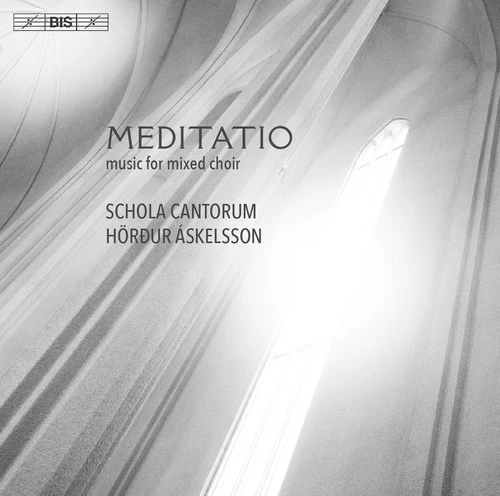
Meditatio: Music for Mixed Choir / Askelsson, Schola Cantorum
A MusicWeb International Recording of the Month
The Schola cantorum is a chamber choir – on this evidence an elite chamber choir - founded in 1996 by Hörður Áskelsson, who is a leading figure in Icelandic choral music. It numbers 19 singers (5/4/5/5). The program selected for this disc reflects the memorial music that is customarily sung in Iceland on the first Sunday in November; in Iceland the feasts of All Saints and All Souls have become merged and are celebrated jointly on that day.
As befits the nature of the program, there are no less than three settings, all in Latin, of the Nunc dimittis. The best-known is the setting by Arvo Pärt. His music always requires exemplary control on the part of the singers and that’s much in evidence here. There’s no hiding place in Pärt’s spare texture but the singers of Schola cantorum display great precision – a precision, I might add, that’s entirely at the service of the music and not just attained for its own sake. The other two settings of the canticle are fully worthy to stand besides Pärt’s celebrated version. Both are by members of the Schola – by coincidence both are members of its bass section. The music of Sigurður Sævarsson’s setting has a fragile beauty. The setting is very restrained, even eschewing the almost traditional climax at the words ‘lumen ad revelationem gentium’. The setting by Sævarsson’s colleague, Hreiðar Ingi is rather darker-hued, at least initially, though the music becomes louder and more radiant at ‘lumen ad revelationem gentium’. In the doxology the voices constantly overlap, creating an impression of urgency though it may be – I haven’t seen a score – that the pulse remains unchanged.
There are two settings of the poem Hvíld (Repose) by the Icelandic poet, Snorri Hjartarson (1906-86). One is by the Schola’s conductor, Hörður Áskelsson. His is an intriguing piece, containing probably the most harmonically adventurous music on the program. Earlier the choir sings another response to the same text, this time by Hugi Guðmundsson. This rapt composition is simple, sincere and disarmingly lovely.
Jón Leifs' Requiem is one of four works written in response to the tragically early death of his daughter in 1947 – she drowned at the age of just 17. Leifs’ Requiem is patently sincere – one would expect nothing less in the circumstances – and in this piece he bears his evident grief with dignity. On the surface the music seems simple but harmonically it’s sophisticated. I admired this piece very much.
There are two examples of the music of Þorkell Sigurbjörnsson. Nú hverfur sól í haf (The sun is sinking now) is a hymn – Sigurbjörnsson was closely involved in the music of the Church of Iceland. The tune is most attractive and it’s beautifully harmonised by Sigurbjörnsson. Heyr himna smiður (Hear, Heaven’s creator) is another hymn-like piece. In his invaluable notes Halldór Hauksson describes the piece as ‘exquisite and timeless’; I can understand why. I must not neglect to mention Anna Þorvaldsdóttir’s Heyr þú oss himnum á (Hear us in the heavens). The piece is based on an old Icelandic tune; it’s slow and prayerful.
The remainder of the program is devoted to composers and music that will be much more familiar to the general listener. I must confess that when I first played MacMillan’s A Child’s Prayer I thought the sound a bit too ‘present’, especially the quiet murmurs of the word “welcome” by the choir. However, I think that’s a function of the piece being placed first on the disc. When I went back to it my ears had adjusted and I was untroubled. In any event, it’s an extremely fine performance. Tavener’s The Lamb receives a marvellously accomplished performance, the chording precise and the dynamics expertly calibrated. Speaking of dynamics, the notes contain a quote from Eric Whitacre in which he says of his Lux aurumque ‘if the tight harmonies are carefully tuned and balanced they will shimmer and glow’. That’s just what happens here.
For me the standout performance on this superb disc is the Schola’s account of Eriks Ešenvalds’ wonderful, radiant composition O salutaris hostia. The present, luminous performance is as good as any I’ve heard, with two fabulous soprano soloists caroling above the rest of the choir.
This is truly an outstanding disc. The choir is superb. Their tuning, balance and blend is flawless and the sound that they make gives great pleasure. Yet while the singing may be expert there’s no sense of studied perfection; these expert singers and their conductor produce performances of genuine feeling that draw the listener in. In short, this is one of the most accomplished choral discs that I’ve heard in a long time. I loved their program in which familiar and unfamiliar music is blended in an ideal proportion.
The production values are up to the usual very high BIS standards. Halldór Hauksson’s notes are excellent, not least in introducing us to the Icelandic pieces, which will be unfamiliar to most people. I’ve drawn on his notes in writing of the Icelandic music. The recording itself is immaculate. The choir is presented in a clear, natural and present sound that shows off their singing to best advantage.
On all counts this disc is a winner.
– MusicWeb International (John Quinn)
The Schola cantorum is a chamber choir – on this evidence an elite chamber choir - founded in 1996 by Hörður Áskelsson, who is a leading figure in Icelandic choral music. It numbers 19 singers (5/4/5/5). The program selected for this disc reflects the memorial music that is customarily sung in Iceland on the first Sunday in November; in Iceland the feasts of All Saints and All Souls have become merged and are celebrated jointly on that day.
As befits the nature of the program, there are no less than three settings, all in Latin, of the Nunc dimittis. The best-known is the setting by Arvo Pärt. His music always requires exemplary control on the part of the singers and that’s much in evidence here. There’s no hiding place in Pärt’s spare texture but the singers of Schola cantorum display great precision – a precision, I might add, that’s entirely at the service of the music and not just attained for its own sake. The other two settings of the canticle are fully worthy to stand besides Pärt’s celebrated version. Both are by members of the Schola – by coincidence both are members of its bass section. The music of Sigurður Sævarsson’s setting has a fragile beauty. The setting is very restrained, even eschewing the almost traditional climax at the words ‘lumen ad revelationem gentium’. The setting by Sævarsson’s colleague, Hreiðar Ingi is rather darker-hued, at least initially, though the music becomes louder and more radiant at ‘lumen ad revelationem gentium’. In the doxology the voices constantly overlap, creating an impression of urgency though it may be – I haven’t seen a score – that the pulse remains unchanged.
There are two settings of the poem Hvíld (Repose) by the Icelandic poet, Snorri Hjartarson (1906-86). One is by the Schola’s conductor, Hörður Áskelsson. His is an intriguing piece, containing probably the most harmonically adventurous music on the program. Earlier the choir sings another response to the same text, this time by Hugi Guðmundsson. This rapt composition is simple, sincere and disarmingly lovely.
Jón Leifs' Requiem is one of four works written in response to the tragically early death of his daughter in 1947 – she drowned at the age of just 17. Leifs’ Requiem is patently sincere – one would expect nothing less in the circumstances – and in this piece he bears his evident grief with dignity. On the surface the music seems simple but harmonically it’s sophisticated. I admired this piece very much.
There are two examples of the music of Þorkell Sigurbjörnsson. Nú hverfur sól í haf (The sun is sinking now) is a hymn – Sigurbjörnsson was closely involved in the music of the Church of Iceland. The tune is most attractive and it’s beautifully harmonised by Sigurbjörnsson. Heyr himna smiður (Hear, Heaven’s creator) is another hymn-like piece. In his invaluable notes Halldór Hauksson describes the piece as ‘exquisite and timeless’; I can understand why. I must not neglect to mention Anna Þorvaldsdóttir’s Heyr þú oss himnum á (Hear us in the heavens). The piece is based on an old Icelandic tune; it’s slow and prayerful.
The remainder of the program is devoted to composers and music that will be much more familiar to the general listener. I must confess that when I first played MacMillan’s A Child’s Prayer I thought the sound a bit too ‘present’, especially the quiet murmurs of the word “welcome” by the choir. However, I think that’s a function of the piece being placed first on the disc. When I went back to it my ears had adjusted and I was untroubled. In any event, it’s an extremely fine performance. Tavener’s The Lamb receives a marvellously accomplished performance, the chording precise and the dynamics expertly calibrated. Speaking of dynamics, the notes contain a quote from Eric Whitacre in which he says of his Lux aurumque ‘if the tight harmonies are carefully tuned and balanced they will shimmer and glow’. That’s just what happens here.
For me the standout performance on this superb disc is the Schola’s account of Eriks Ešenvalds’ wonderful, radiant composition O salutaris hostia. The present, luminous performance is as good as any I’ve heard, with two fabulous soprano soloists caroling above the rest of the choir.
This is truly an outstanding disc. The choir is superb. Their tuning, balance and blend is flawless and the sound that they make gives great pleasure. Yet while the singing may be expert there’s no sense of studied perfection; these expert singers and their conductor produce performances of genuine feeling that draw the listener in. In short, this is one of the most accomplished choral discs that I’ve heard in a long time. I loved their program in which familiar and unfamiliar music is blended in an ideal proportion.
The production values are up to the usual very high BIS standards. Halldór Hauksson’s notes are excellent, not least in introducing us to the Icelandic pieces, which will be unfamiliar to most people. I’ve drawn on his notes in writing of the Icelandic music. The recording itself is immaculate. The choir is presented in a clear, natural and present sound that shows off their singing to best advantage.
On all counts this disc is a winner.
– MusicWeb International (John Quinn)
A MusicWeb International Recording of the Month
The Schola cantorum is a chamber choir – on this evidence an elite chamber choir - founded in 1996 by Hörður Áskelsson, who is a leading figure in Icelandic choral music. It numbers 19 singers (5/4/5/5). The program selected for this disc reflects the memorial music that is customarily sung in Iceland on the first Sunday in November; in Iceland the feasts of All Saints and All Souls have become merged and are celebrated jointly on that day.
As befits the nature of the program, there are no less than three settings, all in Latin, of the Nunc dimittis. The best-known is the setting by Arvo Pärt. His music always requires exemplary control on the part of the singers and that’s much in evidence here. There’s no hiding place in Pärt’s spare texture but the singers of Schola cantorum display great precision – a precision, I might add, that’s entirely at the service of the music and not just attained for its own sake. The other two settings of the canticle are fully worthy to stand besides Pärt’s celebrated version. Both are by members of the Schola – by coincidence both are members of its bass section. The music of Sigurður Sævarsson’s setting has a fragile beauty. The setting is very restrained, even eschewing the almost traditional climax at the words ‘lumen ad revelationem gentium’. The setting by Sævarsson’s colleague, Hreiðar Ingi is rather darker-hued, at least initially, though the music becomes louder and more radiant at ‘lumen ad revelationem gentium’. In the doxology the voices constantly overlap, creating an impression of urgency though it may be – I haven’t seen a score – that the pulse remains unchanged.
There are two settings of the poem Hvíld (Repose) by the Icelandic poet, Snorri Hjartarson (1906-86). One is by the Schola’s conductor, Hörður Áskelsson. His is an intriguing piece, containing probably the most harmonically adventurous music on the program. Earlier the choir sings another response to the same text, this time by Hugi Guðmundsson. This rapt composition is simple, sincere and disarmingly lovely.
Jón Leifs' Requiem is one of four works written in response to the tragically early death of his daughter in 1947 – she drowned at the age of just 17. Leifs’ Requiem is patently sincere – one would expect nothing less in the circumstances – and in this piece he bears his evident grief with dignity. On the surface the music seems simple but harmonically it’s sophisticated. I admired this piece very much.
There are two examples of the music of Þorkell Sigurbjörnsson. Nú hverfur sól í haf (The sun is sinking now) is a hymn – Sigurbjörnsson was closely involved in the music of the Church of Iceland. The tune is most attractive and it’s beautifully harmonised by Sigurbjörnsson. Heyr himna smiður (Hear, Heaven’s creator) is another hymn-like piece. In his invaluable notes Halldór Hauksson describes the piece as ‘exquisite and timeless’; I can understand why. I must not neglect to mention Anna Þorvaldsdóttir’s Heyr þú oss himnum á (Hear us in the heavens). The piece is based on an old Icelandic tune; it’s slow and prayerful.
The remainder of the program is devoted to composers and music that will be much more familiar to the general listener. I must confess that when I first played MacMillan’s A Child’s Prayer I thought the sound a bit too ‘present’, especially the quiet murmurs of the word “welcome” by the choir. However, I think that’s a function of the piece being placed first on the disc. When I went back to it my ears had adjusted and I was untroubled. In any event, it’s an extremely fine performance. Tavener’s The Lamb receives a marvellously accomplished performance, the chording precise and the dynamics expertly calibrated. Speaking of dynamics, the notes contain a quote from Eric Whitacre in which he says of his Lux aurumque ‘if the tight harmonies are carefully tuned and balanced they will shimmer and glow’. That’s just what happens here.
For me the standout performance on this superb disc is the Schola’s account of Eriks Ešenvalds’ wonderful, radiant composition O salutaris hostia. The present, luminous performance is as good as any I’ve heard, with two fabulous soprano soloists caroling above the rest of the choir.
This is truly an outstanding disc. The choir is superb. Their tuning, balance and blend is flawless and the sound that they make gives great pleasure. Yet while the singing may be expert there’s no sense of studied perfection; these expert singers and their conductor produce performances of genuine feeling that draw the listener in. In short, this is one of the most accomplished choral discs that I’ve heard in a long time. I loved their program in which familiar and unfamiliar music is blended in an ideal proportion.
The production values are up to the usual very high BIS standards. Halldór Hauksson’s notes are excellent, not least in introducing us to the Icelandic pieces, which will be unfamiliar to most people. I’ve drawn on his notes in writing of the Icelandic music. The recording itself is immaculate. The choir is presented in a clear, natural and present sound that shows off their singing to best advantage.
On all counts this disc is a winner.
– MusicWeb International (John Quinn)
The Schola cantorum is a chamber choir – on this evidence an elite chamber choir - founded in 1996 by Hörður Áskelsson, who is a leading figure in Icelandic choral music. It numbers 19 singers (5/4/5/5). The program selected for this disc reflects the memorial music that is customarily sung in Iceland on the first Sunday in November; in Iceland the feasts of All Saints and All Souls have become merged and are celebrated jointly on that day.
As befits the nature of the program, there are no less than three settings, all in Latin, of the Nunc dimittis. The best-known is the setting by Arvo Pärt. His music always requires exemplary control on the part of the singers and that’s much in evidence here. There’s no hiding place in Pärt’s spare texture but the singers of Schola cantorum display great precision – a precision, I might add, that’s entirely at the service of the music and not just attained for its own sake. The other two settings of the canticle are fully worthy to stand besides Pärt’s celebrated version. Both are by members of the Schola – by coincidence both are members of its bass section. The music of Sigurður Sævarsson’s setting has a fragile beauty. The setting is very restrained, even eschewing the almost traditional climax at the words ‘lumen ad revelationem gentium’. The setting by Sævarsson’s colleague, Hreiðar Ingi is rather darker-hued, at least initially, though the music becomes louder and more radiant at ‘lumen ad revelationem gentium’. In the doxology the voices constantly overlap, creating an impression of urgency though it may be – I haven’t seen a score – that the pulse remains unchanged.
There are two settings of the poem Hvíld (Repose) by the Icelandic poet, Snorri Hjartarson (1906-86). One is by the Schola’s conductor, Hörður Áskelsson. His is an intriguing piece, containing probably the most harmonically adventurous music on the program. Earlier the choir sings another response to the same text, this time by Hugi Guðmundsson. This rapt composition is simple, sincere and disarmingly lovely.
Jón Leifs' Requiem is one of four works written in response to the tragically early death of his daughter in 1947 – she drowned at the age of just 17. Leifs’ Requiem is patently sincere – one would expect nothing less in the circumstances – and in this piece he bears his evident grief with dignity. On the surface the music seems simple but harmonically it’s sophisticated. I admired this piece very much.
There are two examples of the music of Þorkell Sigurbjörnsson. Nú hverfur sól í haf (The sun is sinking now) is a hymn – Sigurbjörnsson was closely involved in the music of the Church of Iceland. The tune is most attractive and it’s beautifully harmonised by Sigurbjörnsson. Heyr himna smiður (Hear, Heaven’s creator) is another hymn-like piece. In his invaluable notes Halldór Hauksson describes the piece as ‘exquisite and timeless’; I can understand why. I must not neglect to mention Anna Þorvaldsdóttir’s Heyr þú oss himnum á (Hear us in the heavens). The piece is based on an old Icelandic tune; it’s slow and prayerful.
The remainder of the program is devoted to composers and music that will be much more familiar to the general listener. I must confess that when I first played MacMillan’s A Child’s Prayer I thought the sound a bit too ‘present’, especially the quiet murmurs of the word “welcome” by the choir. However, I think that’s a function of the piece being placed first on the disc. When I went back to it my ears had adjusted and I was untroubled. In any event, it’s an extremely fine performance. Tavener’s The Lamb receives a marvellously accomplished performance, the chording precise and the dynamics expertly calibrated. Speaking of dynamics, the notes contain a quote from Eric Whitacre in which he says of his Lux aurumque ‘if the tight harmonies are carefully tuned and balanced they will shimmer and glow’. That’s just what happens here.
For me the standout performance on this superb disc is the Schola’s account of Eriks Ešenvalds’ wonderful, radiant composition O salutaris hostia. The present, luminous performance is as good as any I’ve heard, with two fabulous soprano soloists caroling above the rest of the choir.
This is truly an outstanding disc. The choir is superb. Their tuning, balance and blend is flawless and the sound that they make gives great pleasure. Yet while the singing may be expert there’s no sense of studied perfection; these expert singers and their conductor produce performances of genuine feeling that draw the listener in. In short, this is one of the most accomplished choral discs that I’ve heard in a long time. I loved their program in which familiar and unfamiliar music is blended in an ideal proportion.
The production values are up to the usual very high BIS standards. Halldór Hauksson’s notes are excellent, not least in introducing us to the Icelandic pieces, which will be unfamiliar to most people. I’ve drawn on his notes in writing of the Icelandic music. The recording itself is immaculate. The choir is presented in a clear, natural and present sound that shows off their singing to best advantage.
On all counts this disc is a winner.
– MusicWeb International (John Quinn)
$15.99
Meditatio: Music for Mixed Choir / Askelsson, Schola Cantorum—
$15.99
Description
A MusicWeb International Recording of the Month
The Schola cantorum is a chamber choir – on this evidence an elite chamber choir - founded in 1996 by Hörður Áskelsson, who is a leading figure in Icelandic choral music. It numbers 19 singers (5/4/5/5). The program selected for this disc reflects the memorial music that is customarily sung in Iceland on the first Sunday in November; in Iceland the feasts of All Saints and All Souls have become merged and are celebrated jointly on that day.
As befits the nature of the program, there are no less than three settings, all in Latin, of the Nunc dimittis. The best-known is the setting by Arvo Pärt. His music always requires exemplary control on the part of the singers and that’s much in evidence here. There’s no hiding place in Pärt’s spare texture but the singers of Schola cantorum display great precision – a precision, I might add, that’s entirely at the service of the music and not just attained for its own sake. The other two settings of the canticle are fully worthy to stand besides Pärt’s celebrated version. Both are by members of the Schola – by coincidence both are members of its bass section. The music of Sigurður Sævarsson’s setting has a fragile beauty. The setting is very restrained, even eschewing the almost traditional climax at the words ‘lumen ad revelationem gentium’. The setting by Sævarsson’s colleague, Hreiðar Ingi is rather darker-hued, at least initially, though the music becomes louder and more radiant at ‘lumen ad revelationem gentium’. In the doxology the voices constantly overlap, creating an impression of urgency though it may be – I haven’t seen a score – that the pulse remains unchanged.
There are two settings of the poem Hvíld (Repose) by the Icelandic poet, Snorri Hjartarson (1906-86). One is by the Schola’s conductor, Hörður Áskelsson. His is an intriguing piece, containing probably the most harmonically adventurous music on the program. Earlier the choir sings another response to the same text, this time by Hugi Guðmundsson. This rapt composition is simple, sincere and disarmingly lovely.
Jón Leifs' Requiem is one of four works written in response to the tragically early death of his daughter in 1947 – she drowned at the age of just 17. Leifs’ Requiem is patently sincere – one would expect nothing less in the circumstances – and in this piece he bears his evident grief with dignity. On the surface the music seems simple but harmonically it’s sophisticated. I admired this piece very much.
There are two examples of the music of Þorkell Sigurbjörnsson. Nú hverfur sól í haf (The sun is sinking now) is a hymn – Sigurbjörnsson was closely involved in the music of the Church of Iceland. The tune is most attractive and it’s beautifully harmonised by Sigurbjörnsson. Heyr himna smiður (Hear, Heaven’s creator) is another hymn-like piece. In his invaluable notes Halldór Hauksson describes the piece as ‘exquisite and timeless’; I can understand why. I must not neglect to mention Anna Þorvaldsdóttir’s Heyr þú oss himnum á (Hear us in the heavens). The piece is based on an old Icelandic tune; it’s slow and prayerful.
The remainder of the program is devoted to composers and music that will be much more familiar to the general listener. I must confess that when I first played MacMillan’s A Child’s Prayer I thought the sound a bit too ‘present’, especially the quiet murmurs of the word “welcome” by the choir. However, I think that’s a function of the piece being placed first on the disc. When I went back to it my ears had adjusted and I was untroubled. In any event, it’s an extremely fine performance. Tavener’s The Lamb receives a marvellously accomplished performance, the chording precise and the dynamics expertly calibrated. Speaking of dynamics, the notes contain a quote from Eric Whitacre in which he says of his Lux aurumque ‘if the tight harmonies are carefully tuned and balanced they will shimmer and glow’. That’s just what happens here.
For me the standout performance on this superb disc is the Schola’s account of Eriks Ešenvalds’ wonderful, radiant composition O salutaris hostia. The present, luminous performance is as good as any I’ve heard, with two fabulous soprano soloists caroling above the rest of the choir.
This is truly an outstanding disc. The choir is superb. Their tuning, balance and blend is flawless and the sound that they make gives great pleasure. Yet while the singing may be expert there’s no sense of studied perfection; these expert singers and their conductor produce performances of genuine feeling that draw the listener in. In short, this is one of the most accomplished choral discs that I’ve heard in a long time. I loved their program in which familiar and unfamiliar music is blended in an ideal proportion.
The production values are up to the usual very high BIS standards. Halldór Hauksson’s notes are excellent, not least in introducing us to the Icelandic pieces, which will be unfamiliar to most people. I’ve drawn on his notes in writing of the Icelandic music. The recording itself is immaculate. The choir is presented in a clear, natural and present sound that shows off their singing to best advantage.
On all counts this disc is a winner.
– MusicWeb International (John Quinn)
The Schola cantorum is a chamber choir – on this evidence an elite chamber choir - founded in 1996 by Hörður Áskelsson, who is a leading figure in Icelandic choral music. It numbers 19 singers (5/4/5/5). The program selected for this disc reflects the memorial music that is customarily sung in Iceland on the first Sunday in November; in Iceland the feasts of All Saints and All Souls have become merged and are celebrated jointly on that day.
As befits the nature of the program, there are no less than three settings, all in Latin, of the Nunc dimittis. The best-known is the setting by Arvo Pärt. His music always requires exemplary control on the part of the singers and that’s much in evidence here. There’s no hiding place in Pärt’s spare texture but the singers of Schola cantorum display great precision – a precision, I might add, that’s entirely at the service of the music and not just attained for its own sake. The other two settings of the canticle are fully worthy to stand besides Pärt’s celebrated version. Both are by members of the Schola – by coincidence both are members of its bass section. The music of Sigurður Sævarsson’s setting has a fragile beauty. The setting is very restrained, even eschewing the almost traditional climax at the words ‘lumen ad revelationem gentium’. The setting by Sævarsson’s colleague, Hreiðar Ingi is rather darker-hued, at least initially, though the music becomes louder and more radiant at ‘lumen ad revelationem gentium’. In the doxology the voices constantly overlap, creating an impression of urgency though it may be – I haven’t seen a score – that the pulse remains unchanged.
There are two settings of the poem Hvíld (Repose) by the Icelandic poet, Snorri Hjartarson (1906-86). One is by the Schola’s conductor, Hörður Áskelsson. His is an intriguing piece, containing probably the most harmonically adventurous music on the program. Earlier the choir sings another response to the same text, this time by Hugi Guðmundsson. This rapt composition is simple, sincere and disarmingly lovely.
Jón Leifs' Requiem is one of four works written in response to the tragically early death of his daughter in 1947 – she drowned at the age of just 17. Leifs’ Requiem is patently sincere – one would expect nothing less in the circumstances – and in this piece he bears his evident grief with dignity. On the surface the music seems simple but harmonically it’s sophisticated. I admired this piece very much.
There are two examples of the music of Þorkell Sigurbjörnsson. Nú hverfur sól í haf (The sun is sinking now) is a hymn – Sigurbjörnsson was closely involved in the music of the Church of Iceland. The tune is most attractive and it’s beautifully harmonised by Sigurbjörnsson. Heyr himna smiður (Hear, Heaven’s creator) is another hymn-like piece. In his invaluable notes Halldór Hauksson describes the piece as ‘exquisite and timeless’; I can understand why. I must not neglect to mention Anna Þorvaldsdóttir’s Heyr þú oss himnum á (Hear us in the heavens). The piece is based on an old Icelandic tune; it’s slow and prayerful.
The remainder of the program is devoted to composers and music that will be much more familiar to the general listener. I must confess that when I first played MacMillan’s A Child’s Prayer I thought the sound a bit too ‘present’, especially the quiet murmurs of the word “welcome” by the choir. However, I think that’s a function of the piece being placed first on the disc. When I went back to it my ears had adjusted and I was untroubled. In any event, it’s an extremely fine performance. Tavener’s The Lamb receives a marvellously accomplished performance, the chording precise and the dynamics expertly calibrated. Speaking of dynamics, the notes contain a quote from Eric Whitacre in which he says of his Lux aurumque ‘if the tight harmonies are carefully tuned and balanced they will shimmer and glow’. That’s just what happens here.
For me the standout performance on this superb disc is the Schola’s account of Eriks Ešenvalds’ wonderful, radiant composition O salutaris hostia. The present, luminous performance is as good as any I’ve heard, with two fabulous soprano soloists caroling above the rest of the choir.
This is truly an outstanding disc. The choir is superb. Their tuning, balance and blend is flawless and the sound that they make gives great pleasure. Yet while the singing may be expert there’s no sense of studied perfection; these expert singers and their conductor produce performances of genuine feeling that draw the listener in. In short, this is one of the most accomplished choral discs that I’ve heard in a long time. I loved their program in which familiar and unfamiliar music is blended in an ideal proportion.
The production values are up to the usual very high BIS standards. Halldór Hauksson’s notes are excellent, not least in introducing us to the Icelandic pieces, which will be unfamiliar to most people. I’ve drawn on his notes in writing of the Icelandic music. The recording itself is immaculate. The choir is presented in a clear, natural and present sound that shows off their singing to best advantage.
On all counts this disc is a winner.
– MusicWeb International (John Quinn)