🎉 Up to 70% Off Selected ItemsShop Sale

1 / 2
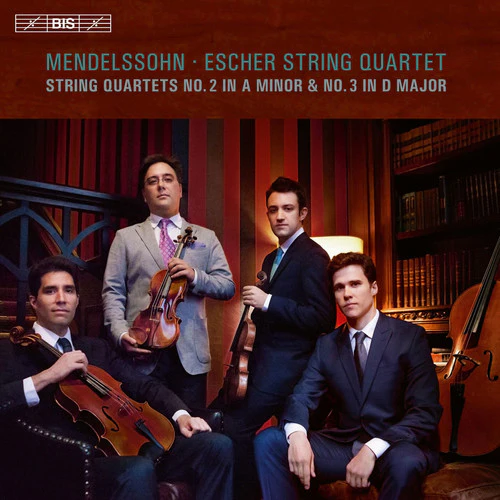
Mendelssohn: String Quartets Nos. 2 & 3 / Escher String Quartet
In 1827, when writing his Quartet in A minor, Op.13, the eighteen-year-old Mendelssohn was especially interested in Beethoven’s late quartets – at a time when these works were generally written off as ‘confused fantasies of a deaf musician’. In Mendelssohn's A minor quartet the debt to Beethoven is evident in the important role of polyphonic techniques, and particularly in the focus on cyclical connections between movements.
Ten years after the Op. 13 quartet, Mendelssohn composed the three quartets that make up his Op. 44. The D major quartet that closes the present disc was the last of these to be completed, but on publication, Mendelssohn placed it as the first in the set.
Mendelssohn also wrote four individual movements for string quartet. These were gathered together and published posthumously with the opus number 81, and on this second volume of their complete Mendelssohn cycle the Escher Quartet perform two of these pieces, both conceived in August 1847, only a couple of months before the composer’s death.
The first volume in the Eschers' series, released in April 2015, has been warmly received by the critics, with the internet site Pizzicato describing it as 'a noteworthy addition to the Mendelssohn discography'.
Reviewds:
The Eschers offer eloquent, full-blooded playing, with spacious tempos, earthy rhythms and rich, dug-in sound. Nothing is rushed or skittered over - and this is notably rewarding in music where an over-precious surface can risk missing the point…the four players offer a beautiful blend of individuality and accord, and BIS's famous SACD sound quality lets them gleam and glow.
– BBC Music Magazine
This young American group respond particularly vividly to the ebullience of the D major Quartet. Digging into the upward arpeggio with which it launches with infectious glee, while the first movement's coda is uproariously dispatched. Also impressive is their combination of finely honed interaction and a sense of playfulness.
– Gramophone
Ten years after the Op. 13 quartet, Mendelssohn composed the three quartets that make up his Op. 44. The D major quartet that closes the present disc was the last of these to be completed, but on publication, Mendelssohn placed it as the first in the set.
Mendelssohn also wrote four individual movements for string quartet. These were gathered together and published posthumously with the opus number 81, and on this second volume of their complete Mendelssohn cycle the Escher Quartet perform two of these pieces, both conceived in August 1847, only a couple of months before the composer’s death.
The first volume in the Eschers' series, released in April 2015, has been warmly received by the critics, with the internet site Pizzicato describing it as 'a noteworthy addition to the Mendelssohn discography'.
Reviewds:
The Eschers offer eloquent, full-blooded playing, with spacious tempos, earthy rhythms and rich, dug-in sound. Nothing is rushed or skittered over - and this is notably rewarding in music where an over-precious surface can risk missing the point…the four players offer a beautiful blend of individuality and accord, and BIS's famous SACD sound quality lets them gleam and glow.
– BBC Music Magazine
This young American group respond particularly vividly to the ebullience of the D major Quartet. Digging into the upward arpeggio with which it launches with infectious glee, while the first movement's coda is uproariously dispatched. Also impressive is their combination of finely honed interaction and a sense of playfulness.
– Gramophone
In 1827, when writing his Quartet in A minor, Op.13, the eighteen-year-old Mendelssohn was especially interested in Beethoven’s late quartets – at a time when these works were generally written off as ‘confused fantasies of a deaf musician’. In Mendelssohn's A minor quartet the debt to Beethoven is evident in the important role of polyphonic techniques, and particularly in the focus on cyclical connections between movements.
Ten years after the Op. 13 quartet, Mendelssohn composed the three quartets that make up his Op. 44. The D major quartet that closes the present disc was the last of these to be completed, but on publication, Mendelssohn placed it as the first in the set.
Mendelssohn also wrote four individual movements for string quartet. These were gathered together and published posthumously with the opus number 81, and on this second volume of their complete Mendelssohn cycle the Escher Quartet perform two of these pieces, both conceived in August 1847, only a couple of months before the composer’s death.
The first volume in the Eschers' series, released in April 2015, has been warmly received by the critics, with the internet site Pizzicato describing it as 'a noteworthy addition to the Mendelssohn discography'.
Reviewds:
The Eschers offer eloquent, full-blooded playing, with spacious tempos, earthy rhythms and rich, dug-in sound. Nothing is rushed or skittered over - and this is notably rewarding in music where an over-precious surface can risk missing the point…the four players offer a beautiful blend of individuality and accord, and BIS's famous SACD sound quality lets them gleam and glow.
– BBC Music Magazine
This young American group respond particularly vividly to the ebullience of the D major Quartet. Digging into the upward arpeggio with which it launches with infectious glee, while the first movement's coda is uproariously dispatched. Also impressive is their combination of finely honed interaction and a sense of playfulness.
– Gramophone
Ten years after the Op. 13 quartet, Mendelssohn composed the three quartets that make up his Op. 44. The D major quartet that closes the present disc was the last of these to be completed, but on publication, Mendelssohn placed it as the first in the set.
Mendelssohn also wrote four individual movements for string quartet. These were gathered together and published posthumously with the opus number 81, and on this second volume of their complete Mendelssohn cycle the Escher Quartet perform two of these pieces, both conceived in August 1847, only a couple of months before the composer’s death.
The first volume in the Eschers' series, released in April 2015, has been warmly received by the critics, with the internet site Pizzicato describing it as 'a noteworthy addition to the Mendelssohn discography'.
Reviewds:
The Eschers offer eloquent, full-blooded playing, with spacious tempos, earthy rhythms and rich, dug-in sound. Nothing is rushed or skittered over - and this is notably rewarding in music where an over-precious surface can risk missing the point…the four players offer a beautiful blend of individuality and accord, and BIS's famous SACD sound quality lets them gleam and glow.
– BBC Music Magazine
This young American group respond particularly vividly to the ebullience of the D major Quartet. Digging into the upward arpeggio with which it launches with infectious glee, while the first movement's coda is uproariously dispatched. Also impressive is their combination of finely honed interaction and a sense of playfulness.
– Gramophone
$3.85
Original: $10.99
-65%Mendelssohn: String Quartets Nos. 2 & 3 / Escher String Quartet—
$10.99
$3.85Description
In 1827, when writing his Quartet in A minor, Op.13, the eighteen-year-old Mendelssohn was especially interested in Beethoven’s late quartets – at a time when these works were generally written off as ‘confused fantasies of a deaf musician’. In Mendelssohn's A minor quartet the debt to Beethoven is evident in the important role of polyphonic techniques, and particularly in the focus on cyclical connections between movements.
Ten years after the Op. 13 quartet, Mendelssohn composed the three quartets that make up his Op. 44. The D major quartet that closes the present disc was the last of these to be completed, but on publication, Mendelssohn placed it as the first in the set.
Mendelssohn also wrote four individual movements for string quartet. These were gathered together and published posthumously with the opus number 81, and on this second volume of their complete Mendelssohn cycle the Escher Quartet perform two of these pieces, both conceived in August 1847, only a couple of months before the composer’s death.
The first volume in the Eschers' series, released in April 2015, has been warmly received by the critics, with the internet site Pizzicato describing it as 'a noteworthy addition to the Mendelssohn discography'.
Reviewds:
The Eschers offer eloquent, full-blooded playing, with spacious tempos, earthy rhythms and rich, dug-in sound. Nothing is rushed or skittered over - and this is notably rewarding in music where an over-precious surface can risk missing the point…the four players offer a beautiful blend of individuality and accord, and BIS's famous SACD sound quality lets them gleam and glow.
– BBC Music Magazine
This young American group respond particularly vividly to the ebullience of the D major Quartet. Digging into the upward arpeggio with which it launches with infectious glee, while the first movement's coda is uproariously dispatched. Also impressive is their combination of finely honed interaction and a sense of playfulness.
– Gramophone
Ten years after the Op. 13 quartet, Mendelssohn composed the three quartets that make up his Op. 44. The D major quartet that closes the present disc was the last of these to be completed, but on publication, Mendelssohn placed it as the first in the set.
Mendelssohn also wrote four individual movements for string quartet. These were gathered together and published posthumously with the opus number 81, and on this second volume of their complete Mendelssohn cycle the Escher Quartet perform two of these pieces, both conceived in August 1847, only a couple of months before the composer’s death.
The first volume in the Eschers' series, released in April 2015, has been warmly received by the critics, with the internet site Pizzicato describing it as 'a noteworthy addition to the Mendelssohn discography'.
Reviewds:
The Eschers offer eloquent, full-blooded playing, with spacious tempos, earthy rhythms and rich, dug-in sound. Nothing is rushed or skittered over - and this is notably rewarding in music where an over-precious surface can risk missing the point…the four players offer a beautiful blend of individuality and accord, and BIS's famous SACD sound quality lets them gleam and glow.
– BBC Music Magazine
This young American group respond particularly vividly to the ebullience of the D major Quartet. Digging into the upward arpeggio with which it launches with infectious glee, while the first movement's coda is uproariously dispatched. Also impressive is their combination of finely honed interaction and a sense of playfulness.
– Gramophone