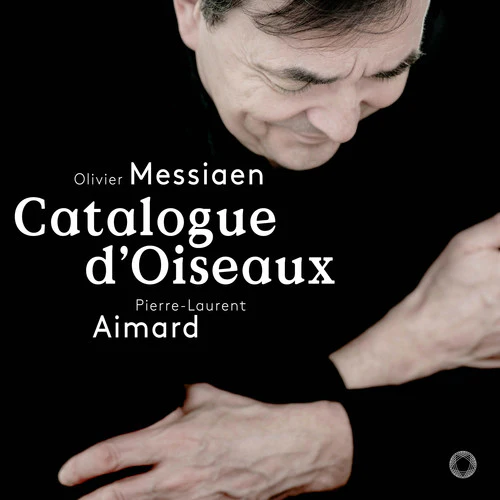
Messiaen: Catalogue d'Oiseaux / Pierre-Laurent Aimard
Renowned French pianist Pierre-Laurent Aimard kicks off his exclusive engagement to PENTATONE with a recording of Olivier Messiaen’s Catalogue d’Oiseaux (1956-1958). The pianist had intimate ties to the composer himself and his wife, Yvonne Loriod, for whom Messiaen wrote the Catalogue.
Praised by The Guardian as “one of the best Messiaen interpreters around,“ this is Aimard’s first recording of Messiaen’s most extensive, demanding and colorful piano composition. The luxurious release set contains an accompanying bonus film, on which Aimard shares his vast knowledge of and love for Messiaen’s work from behind the piano.
Due to its radical naturalism, the Catalogue d’Oiseaux is exceptional within the repertoire for solo piano. It is the grand hymn to nature from a man who never ceased to marvel at the stupefying beauty of landscapes or the magic of bird song. With his Catalogue, Messiaen tried – in his own words – “to render exactly the typical birdsong of a region, surrounded by its neighbors from the same habitat, as well as the form of song at different hours of the day and night,” suggesting an almost scientific approach to his subjects. The idea of ‘reproduction’ may have been central to Messiaen’s conception of the Catalogue d’Oiseaux, but in the finished work we hear a great composer at work, a master of innovative structures who finds an astonishing range of piano sonorities. In a world that is increasingly being destructed by man, Aimard views this cycle as “a musical refuge that resonates with an audience ever more concerned, expanded and affected.”
REVIEWS:
Unsurprisingly, Pierre-Laurent Aimard’s interpretations are anything but tame. His dynamic range is formidable, his voicing of chords scrupulously faithful, his clarity unimpeachable. It’s hard to imagine the textures having greater impact or precision, or the continuity and discontinuity being projected with greater concentration. Nigel Simeone’s essay for Pentatone is exceptionally informative on factual background. One can only salute this outstanding achievement.
– Gramophone (Editor's Choice, April 2018)
Pierre-Laurent Aimard’s long association with Olivier Messiaen’s music dates back to the early 1970s, when the teenaged pianist was a protégée of both the composer and his wife Yvonne Loriod. His 2000 recording of Vingt regards sur l’enfant Jésus has long held sway as a version of reference. In August 2017 Aimard set down the complete Catalogue d’Oiseaux, now released by Pentatone on three SACDS, accompanied by informative booklet notes by Nigel Simone and a valuable DVD where Aimard presents succinct overviews of each piece from the piano and offers interesting insights into Messiaen’s methodology and personality.
As the set reveals time and again, Aimard has long digested and internalized Messiaen’s colorful keyboard syntax. The pianist voices and balances extended sequences of chords with the utmost clarity and specificity. Minute variations in rhythmic asymmetry are scrupulously articulated, while Aimard never shortchanges the music’s frequent moments of silence. He also brings impressive timbral and characterful variety to low-register passagework that can sound muddy or indistinct in the wrong hands. Cases in point include Messiaen’s playful evocation of mating mallards in Le Merle de roche’s opening pages, and Le Loriot’s slow-motion chords that contrast with lively high-register dialogues depicting Garden Warblers.
Le Rousserolle Effarvatte, the cycle’s epicenter and longest movement, emerges as a dramatic and virtuoso tour-de-force, showcasing Aimard’s remarkable concentration throughout sustained contemplative passages, along with his sophisticated gradations in dynamics and touch that seemingly project the gnarly, tumultuous sequences in three-dimensional perspective. To be sure, the pianist’s fortissimos convey an edgy, even metallic patina (so do Yvonne Loriod’s, in fairness), and his occasional vocal grimaces distract. Moreover, there sometimes is more humor to the music than Aimard is willing to concede.
Aimard’s technical, stylistic, and musical authority build upon Loriod’s interpretive legacy, and set modern-day standards that will both inspire and intimidate future generations of Messiaen pianists.
– ClassicsToday (Jed Distler)
Renowned French pianist Pierre-Laurent Aimard kicks off his exclusive engagement to PENTATONE with a recording of Olivier Messiaen’s Catalogue d’Oiseaux (1956-1958). The pianist had intimate ties to the composer himself and his wife, Yvonne Loriod, for whom Messiaen wrote the Catalogue.
Praised by The Guardian as “one of the best Messiaen interpreters around,“ this is Aimard’s first recording of Messiaen’s most extensive, demanding and colorful piano composition. The luxurious release set contains an accompanying bonus film, on which Aimard shares his vast knowledge of and love for Messiaen’s work from behind the piano.
Due to its radical naturalism, the Catalogue d’Oiseaux is exceptional within the repertoire for solo piano. It is the grand hymn to nature from a man who never ceased to marvel at the stupefying beauty of landscapes or the magic of bird song. With his Catalogue, Messiaen tried – in his own words – “to render exactly the typical birdsong of a region, surrounded by its neighbors from the same habitat, as well as the form of song at different hours of the day and night,” suggesting an almost scientific approach to his subjects. The idea of ‘reproduction’ may have been central to Messiaen’s conception of the Catalogue d’Oiseaux, but in the finished work we hear a great composer at work, a master of innovative structures who finds an astonishing range of piano sonorities. In a world that is increasingly being destructed by man, Aimard views this cycle as “a musical refuge that resonates with an audience ever more concerned, expanded and affected.”
REVIEWS:
Unsurprisingly, Pierre-Laurent Aimard’s interpretations are anything but tame. His dynamic range is formidable, his voicing of chords scrupulously faithful, his clarity unimpeachable. It’s hard to imagine the textures having greater impact or precision, or the continuity and discontinuity being projected with greater concentration. Nigel Simeone’s essay for Pentatone is exceptionally informative on factual background. One can only salute this outstanding achievement.
– Gramophone (Editor's Choice, April 2018)
Pierre-Laurent Aimard’s long association with Olivier Messiaen’s music dates back to the early 1970s, when the teenaged pianist was a protégée of both the composer and his wife Yvonne Loriod. His 2000 recording of Vingt regards sur l’enfant Jésus has long held sway as a version of reference. In August 2017 Aimard set down the complete Catalogue d’Oiseaux, now released by Pentatone on three SACDS, accompanied by informative booklet notes by Nigel Simone and a valuable DVD where Aimard presents succinct overviews of each piece from the piano and offers interesting insights into Messiaen’s methodology and personality.
As the set reveals time and again, Aimard has long digested and internalized Messiaen’s colorful keyboard syntax. The pianist voices and balances extended sequences of chords with the utmost clarity and specificity. Minute variations in rhythmic asymmetry are scrupulously articulated, while Aimard never shortchanges the music’s frequent moments of silence. He also brings impressive timbral and characterful variety to low-register passagework that can sound muddy or indistinct in the wrong hands. Cases in point include Messiaen’s playful evocation of mating mallards in Le Merle de roche’s opening pages, and Le Loriot’s slow-motion chords that contrast with lively high-register dialogues depicting Garden Warblers.
Le Rousserolle Effarvatte, the cycle’s epicenter and longest movement, emerges as a dramatic and virtuoso tour-de-force, showcasing Aimard’s remarkable concentration throughout sustained contemplative passages, along with his sophisticated gradations in dynamics and touch that seemingly project the gnarly, tumultuous sequences in three-dimensional perspective. To be sure, the pianist’s fortissimos convey an edgy, even metallic patina (so do Yvonne Loriod’s, in fairness), and his occasional vocal grimaces distract. Moreover, there sometimes is more humor to the music than Aimard is willing to concede.
Aimard’s technical, stylistic, and musical authority build upon Loriod’s interpretive legacy, and set modern-day standards that will both inspire and intimidate future generations of Messiaen pianists.
– ClassicsToday (Jed Distler)
Original: $53.99
-65%$53.99
$18.90Description
Renowned French pianist Pierre-Laurent Aimard kicks off his exclusive engagement to PENTATONE with a recording of Olivier Messiaen’s Catalogue d’Oiseaux (1956-1958). The pianist had intimate ties to the composer himself and his wife, Yvonne Loriod, for whom Messiaen wrote the Catalogue.
Praised by The Guardian as “one of the best Messiaen interpreters around,“ this is Aimard’s first recording of Messiaen’s most extensive, demanding and colorful piano composition. The luxurious release set contains an accompanying bonus film, on which Aimard shares his vast knowledge of and love for Messiaen’s work from behind the piano.
Due to its radical naturalism, the Catalogue d’Oiseaux is exceptional within the repertoire for solo piano. It is the grand hymn to nature from a man who never ceased to marvel at the stupefying beauty of landscapes or the magic of bird song. With his Catalogue, Messiaen tried – in his own words – “to render exactly the typical birdsong of a region, surrounded by its neighbors from the same habitat, as well as the form of song at different hours of the day and night,” suggesting an almost scientific approach to his subjects. The idea of ‘reproduction’ may have been central to Messiaen’s conception of the Catalogue d’Oiseaux, but in the finished work we hear a great composer at work, a master of innovative structures who finds an astonishing range of piano sonorities. In a world that is increasingly being destructed by man, Aimard views this cycle as “a musical refuge that resonates with an audience ever more concerned, expanded and affected.”
REVIEWS:
Unsurprisingly, Pierre-Laurent Aimard’s interpretations are anything but tame. His dynamic range is formidable, his voicing of chords scrupulously faithful, his clarity unimpeachable. It’s hard to imagine the textures having greater impact or precision, or the continuity and discontinuity being projected with greater concentration. Nigel Simeone’s essay for Pentatone is exceptionally informative on factual background. One can only salute this outstanding achievement.
– Gramophone (Editor's Choice, April 2018)
Pierre-Laurent Aimard’s long association with Olivier Messiaen’s music dates back to the early 1970s, when the teenaged pianist was a protégée of both the composer and his wife Yvonne Loriod. His 2000 recording of Vingt regards sur l’enfant Jésus has long held sway as a version of reference. In August 2017 Aimard set down the complete Catalogue d’Oiseaux, now released by Pentatone on three SACDS, accompanied by informative booklet notes by Nigel Simone and a valuable DVD where Aimard presents succinct overviews of each piece from the piano and offers interesting insights into Messiaen’s methodology and personality.
As the set reveals time and again, Aimard has long digested and internalized Messiaen’s colorful keyboard syntax. The pianist voices and balances extended sequences of chords with the utmost clarity and specificity. Minute variations in rhythmic asymmetry are scrupulously articulated, while Aimard never shortchanges the music’s frequent moments of silence. He also brings impressive timbral and characterful variety to low-register passagework that can sound muddy or indistinct in the wrong hands. Cases in point include Messiaen’s playful evocation of mating mallards in Le Merle de roche’s opening pages, and Le Loriot’s slow-motion chords that contrast with lively high-register dialogues depicting Garden Warblers.
Le Rousserolle Effarvatte, the cycle’s epicenter and longest movement, emerges as a dramatic and virtuoso tour-de-force, showcasing Aimard’s remarkable concentration throughout sustained contemplative passages, along with his sophisticated gradations in dynamics and touch that seemingly project the gnarly, tumultuous sequences in three-dimensional perspective. To be sure, the pianist’s fortissimos convey an edgy, even metallic patina (so do Yvonne Loriod’s, in fairness), and his occasional vocal grimaces distract. Moreover, there sometimes is more humor to the music than Aimard is willing to concede.
Aimard’s technical, stylistic, and musical authority build upon Loriod’s interpretive legacy, and set modern-day standards that will both inspire and intimidate future generations of Messiaen pianists.
– ClassicsToday (Jed Distler)